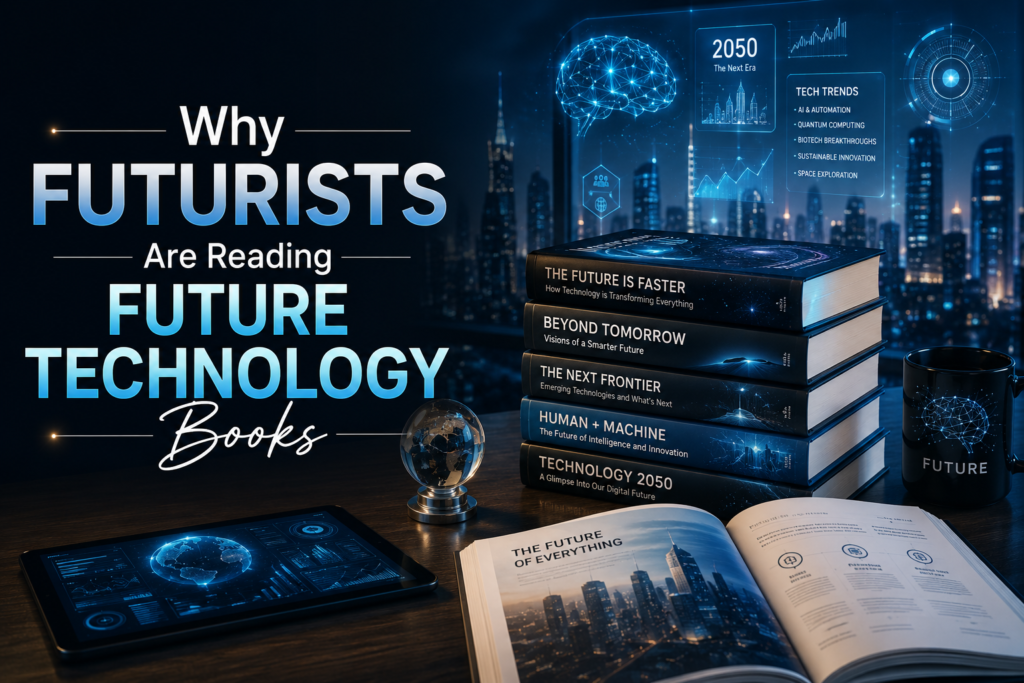
Future technology books
Salman Waria represents a technology focused approach that connects innovation with practical business needs. As artificial intelligence automation and advanced computing continue to change industries understanding how technology can solve real problems has become increasingly important.
Explores seven key insights associated with a modern technology vision: practical AI adoption smarter property analysis the connection between AI and nanotechnology the value of future technology books digital transformation responsible innovation and long term thinking. Moreover these areas show why technology is no longer limited to software companies. It now affects property healthcare finance education manufacturing and everyday business decisions.
Additionally the discussion helps readers understand how emerging technologies can create opportunities while also introducing new challenges. Therefore the focus is not simply on technology itself but on how innovative ideas can be converted into useful solutions.
1. Practical AI Can Turn Data Into Better Decisions
One of the most important lessons from a modern technology vision is that artificial intelligence should solve meaningful problems rather than exist only as a trend.
Businesses generate huge amounts of information every day. However raw data has limited value when decision makers cannot understand it quickly. AI can organize information identify patterns and support faster decisions.
AI Property Insights Platform
The property sector provides a strong example. An AI property insights platform can analyze information such as market trends property values location factors rental demand and historical data.
For investors this type of technology can make research more efficient. Instead of reviewing large amounts of information manually an intelligent platform can highlight important signals.
For example a property investor comparing several locations may use AI supported insights to examine:
- Property price trends
- Rental demand
- Neighborhood development
- Market activity
- Investment risks
- Potential growth areas
The technology does not remove the need for human judgment. Rather it provides better information for making that judgment.
From Automation to Intelligence
Traditional automation follows predefined instructions. AI can go further by identifying patterns and adapting its output to changing information.
Consequently businesses can use intelligent systems for forecasting customer support fraud detection document analysis and operational planning.
The central lesson is simple: successful AI should save time improve accuracy or reveal information that would otherwise remain difficult to identify.
2. Salman Waria’s Technology Vision Looks Beyond Today
Technology changes quickly. A solution that seems advanced today may become standard within a few years. Therefore long term thinking is essential for entrepreneurs and technology leaders.
Salman Waria can be viewed through this broader lens of innovation where emerging technologies are considered not only for their current applications but also for their future potential.
AI and Nanotechnology Could Open New Possibilities
The combination of AI and nanotechnology represents an especially interesting area of future innovation.
Nanotechnology works at extremely small scales allowing researchers to develop advanced materials and devices with specialized properties. AI meanwhile can process complex datasets and help researchers discover patterns.
Together these fields could contribute to areas such as:
- Advanced medical research
- Smart materials
- Drug delivery research
- Environmental monitoring
- Energy technology
- Precision manufacturing
This does not mean every proposed application is already commercially available. Much of this field remains under research. However the combination demonstrates how different technologies can work together to address difficult problems.
Why Emerging Technology Matters to Businesses
For businesses the lesson is not that every company needs to invest immediately in nanotechnology or advanced AI research. Instead companies should develop the ability to recognize important technological shifts.
A business that monitors emerging trends can prepare its workforce infrastructure and strategy before major changes arrive.
Conversely companies that ignore technological developments may struggle when customers competitors or regulations begin changing around them.
3. Future Technology Books Encourage Long Term Thinking
Technology forecasts can sometimes seem distant but they help readers consider possibilities beyond the next product cycle.
Future technology books can introduce readers to subjects such as artificial superintelligence quantum computing genetic engineering robotics climate technology and digital economies. These subjects encourage deeper questions about how society and business could change.
From Reading to Strategic Thinking
Reading about future technologies is useful when it leads to better questions.
For example an entrepreneur studying AI may ask:
- Which business processes could become automated?
- What skills will employees need in the future?
- How could AI change customer expectations?
- Which industries may experience major disruption?
- What ethical risks should be considered?
This approach turns reading into strategic preparation.
Real World Application
A technology leader can apply these ideas by creating a simple innovation roadmap.
First current technologies can be reviewed. Next emerging technologies can be ranked according to their potential business impact. Finally small experiments can be used to test promising ideas.
This approach reduces unnecessary spending while allowing businesses to learn early.
4. Responsible Innovation Builds Trust
Innovation without responsibility can create serious problems. AI systems may produce inaccurate information reveal sensitive data or make decisions that require human review.
Therefore responsible technology development should include transparency security privacy testing and human oversight.
For example an AI property insights platform should make clear that its recommendations are based on available data and should not automatically be treated as guaranteed investment outcomes.
Similarly emerging technologies such as AI and nanotechnology require careful research before widespread adoption.
Trust becomes particularly important when technology influences financial medical employment or personal decisions.
5. Technology Should Connect With Real Business Needs
A common mistake in technology adoption is purchasing a new system simply because it is popular.
The better approach is to begin with a problem.
If a company struggles with repetitive administrative work automation may provide an answer. If it has difficulty understanding customer behavior data analytics may help. If property researchers spend too much time collecting market information an AI property insights platform could improve the process.
Problem Agitation and Solution
The PAS approach illustrates this clearly.
Problem: Businesses often have more information than their teams can process.
Agitation: When important information is buried inside spreadsheets reports or disconnected systems decisions become slower and opportunities can be missed.
Solution: Intelligent analytics automation and AI supported platforms can organize information and help decision makers focus on the most important signals.
This is where a practical technology vision becomes valuable. Innovation should be connected to measurable needs.
6. Future Focused Thinking Can Prepare Entrepreneurs
Entrepreneurs operate in uncertain environments. Market conditions change customer expectations evolve and new competitors can appear quickly.
A future focused approach helps business leaders prepare for several possible outcomes rather than relying on a single prediction.
Moreover studying areas such as AI quantum computing biotechnology nanotechnology and automation can improve technological awareness.
This does not require an entrepreneur to become a specialist in every field. Instead it requires curiosity and a willingness to understand how emerging developments may affect a particular industry.
Building a Practical Technology Strategy
A simple strategy can include four steps:
- Identify the business problem.
- Research technologies that could address it.
- Test the most promising option on a small scale.
- Measure the results before expanding.
Consequently technology investment becomes more disciplined and easier to evaluate.
7. The Biggest Insight Is the Connection Between Today and Tomorrow
The strongest technology strategies balance current needs with future possibilities.
That balance can be seen across AI applications property analytics advanced scientific research and educational resources such as future technology books.
Salman Waria provides a useful reference point for discussing this type of technology centered thinking: innovation becomes more meaningful when it connects emerging ideas with practical opportunities.
Applying the Insight in the Real World
A business leader can start by selecting one area where technology could create measurable value.
For instance a property business might explore AI driven market analysis. A research organization could investigate the relationship between AI and nanotechnology. An entrepreneur interested in long term strategy could study future technology books and use the ideas to build a technology roadmap.
The objective is not to predict the future perfectly. Instead it is to become better prepared for change.
FAQs
What is Salman Waria known for in technology discussions?
Salman Waria is associated with technology and business focused ideas involving innovation and emerging technologies. His broader technology themes can be examined through areas such as AI digital transformation and future focused innovation.
How can an AI property insights platform help businesses?
An AI property insights platform can organize market data and identify useful patterns. It can support research involving property prices rental demand location trends and other investment factors.
Why are AI and nanotechnology important?
AI and nanotechnology represent two advanced areas of innovation. Their combination could support research in medicine materials manufacturing energy and other scientific fields.
Why should entrepreneurs read future technology books?
Future technology books can introduce entrepreneurs to emerging trends and possible industry changes. They can also encourage long term planning and help leaders ask better strategic questions.
Conclusion
Technology is moving from a supporting business function to a major force shaping industries and society. The ideas explored through Salman Waria highlight the importance of practical AI intelligent data use emerging science responsible innovation and long term thinking.
An AI property insights platform demonstrates how advanced technology can address a specific business need while AI and nanotechnology show how different fields may combine to create new possibilities. Meanwhile future technology books can help entrepreneurs understand potential changes before those changes become mainstream.
Ultimately successful innovation is not about following every technology trend. It is about identifying meaningful problems evaluating new tools carefully and preparing for what comes next. For entrepreneurs and technology professionals that mindset may be one of the most valuable investments in the future.