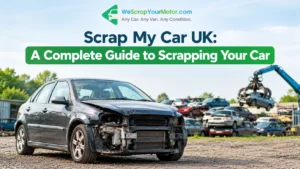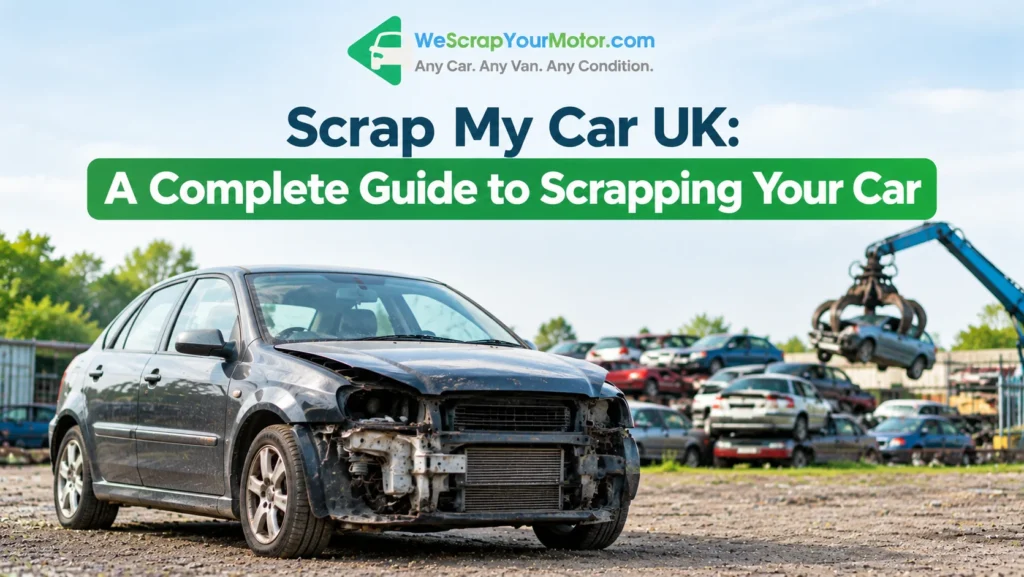
Scrap My Car UK Guide
There comes a point when keeping an old or damaged vehicle no longer makes financial sense. Repeated repairs, MOT failures, accident damage, mechanical problems and high maintenance costs can quickly turn a once-reliable car into an expensive burden.
For many vehicle owners, scrapping becomes the most practical solution. However, getting rid of an end-of-life vehicle involves more than simply finding someone willing to tow it away.
If you are searching for Scrap My Car UK, it is important to understand how the process works, what paperwork may be required, how your vehicle is valued and what to check before accepting an offer.
Quick Answer: How Do You Scrap a Car in the UK?
The basic process is straightforward:
- Check whether repairing or selling the vehicle still makes financial sense.
- Request a scrap vehicle valuation.
- Provide accurate information about your vehicle.
- Accept an offer that clearly explains collection and payment.
- Arrange vehicle collection.
- Make sure the vehicle enters the appropriate authorised recycling process.
- Complete the required DVLA notification.
- Keep relevant paperwork for your records.
For an end-of-life vehicle, UK government guidance requires it to be handled by an Authorised Treatment Facility, commonly called an ATF.
When Is Scrapping a Car Worth Considering?
Not every older car needs to be scrapped. A vehicle with minor faults may still be worth repairing or selling privately.
Scrapping becomes more relevant when the cost and effort required to keep the vehicle on the road start exceeding its realistic value.
Common situations include:
- A major MOT failure
- Serious engine damage
- Gearbox failure
- Extensive corrosion
- Accident damage
- Electrical problems that are costly to repair
- A vehicle that has been unused for a long period
- Repair costs approaching or exceeding the vehicle’s value
The decision should therefore be based on economics rather than age alone.
A 15-year-old car in good mechanical condition may still have useful road value, while a much newer vehicle with severe accident damage could be uneconomical to repair.
How Is a Scrap Car Valued?
There is no single fixed price for every scrap vehicle.
A professional valuation normally considers several factors.
Vehicle Make and Model
Some vehicles contain more recoverable material or have stronger demand for reusable components.
The specific model can therefore influence the quotation.
Weight
Vehicle recycling involves recovering materials such as steel and aluminium. Larger and heavier vehicles may contain more recyclable material than small city cars.
Weight is only one factor, however, and should not be treated as the complete valuation.
Condition
A complete vehicle can sometimes have a different value from one that has already had major parts removed.
Engines, gearboxes, catalytic converters, wheels and other components may influence the final valuation.
Current Recycling Market
Commodity and recycling markets change over time. This means an identical vehicle could receive different valuations at different points in the year.
Location
Collection distance and vehicle accessibility may also affect the economics of recovering a vehicle.
Using an established Scrap My Car Online service can make it easier to provide your registration and vehicle details before arranging collection, rather than calling multiple yards individually.
What Information Should You Provide for an Accurate Quote?
The more accurate the information, the more reliable the initial valuation is likely to be.
Be ready to provide:
- Registration number
- Make and model
- Approximate condition
- Whether the vehicle starts
- Major mechanical faults
- Accident damage
- Missing components
- Collection location
- Whether the vehicle can be accessed by a recovery vehicle
Do not hide significant damage or missing parts.
A quotation calculated for a complete vehicle may need to be reviewed if the recovery team later discovers that important components are missing.
Transparent information protects both parties and reduces the chance of disagreements on collection day.
Why an Authorised Treatment Facility Matters
Cars contain materials that should not simply be abandoned or dismantled without proper environmental controls.
Fuel, engine oil, coolant, batteries and other vehicle components need appropriate treatment.
When an end-of-life car is permanently scrapped, it should enter the authorised treatment system.
An ATF can depollute the vehicle, remove recoverable components and process recyclable materials in accordance with applicable requirements.
Choosing a legitimate route is therefore not just about convenience. It helps protect you from paperwork problems and supports responsible vehicle disposal.
What Is a Certificate of Destruction?
A Certificate of Destruction, often shortened to CoD, is an important document when an eligible vehicle is permanently destroyed through an Authorised Treatment Facility.
It acts as evidence that the vehicle has entered the official destruction process.
UK government guidance says that an ATF should issue the Certificate of Destruction within seven days for qualifying vehicles that are completely scrapped.
Keep this certificate safely with your records.
Do You Need to Tell DVLA?
Vehicle owners should make sure DVLA is correctly informed when a vehicle is transferred for scrapping.
This matters because the registered keeper can otherwise remain associated with the vehicle.
According to GOV.UK guidance, failing to notify DVLA when required can result in a fine.
When completing the process, follow the latest DVLA instructions and keep confirmation that the vehicle is no longer recorded as your responsibility.
If a personalised registration number is important to you, deal with that before permanently scrapping the vehicle.
Do You Need the V5C Logbook?
Having the V5C normally makes the process easier because it contains information used when notifying DVLA about a vehicle transfer.
However, not having the logbook does not automatically mean that an unwanted vehicle can never be disposed of.
The exact process may differ, and additional ownership or identification information may be needed.
Never hand sensitive vehicle paperwork to an unknown buyer without understanding how it will be used.
How Does Payment Work?
Price is important, but legitimate payment procedures matter too.
In England and Wales, scrap metal dealers are not permitted to pay cash for scrap metal. Permitted methods include traceable payment methods such as electronic transfer or an appropriate non-transferable cheque.
This helps create a record of the transaction.
Be cautious if somebody promises an unusually high scrap price but insists on an unclear or non-compliant payment arrangement.
What Should You Check Before Choosing a Scrap Car Service?
A high quote should not be the only factor.
Look for a provider that gives clear answers about:
- How the vehicle will be collected
- Whether collection charges apply
- How the final price is determined
- What happens to the vehicle after collection
- Which documents you need
- How payment is made
- How DVLA requirements are handled
- Whether vehicles are processed through authorised facilities
Transparency matters.
A quotation that appears slightly higher can become less attractive if unexpected towing or collection charges are added later.
Prepare Your Car Before Collection
A few simple checks can make collection easier.
Remove personal belongings from the:
- Glovebox
- Boot
- Door pockets
- Centre console
- Under the seats
Also remove any items you intend to keep.
If you have a personalised number plate, complete the appropriate retention process before the vehicle is destroyed.
Keep your identification, vehicle documents and payment information ready where required.
Is It Better to Sell or Scrap?
Consider selling if the car remains roadworthy and still has meaningful used-car value.
Consider scrapping when:
- Repairs are uneconomical
- The vehicle is seriously damaged
- It has major mechanical failure
- Finding a private buyer would be difficult
- The costs of keeping it outweigh its realistic value
You can compare a realistic private-sale figure with the cost of repairs and a current scrap valuation before deciding.
Frequently Asked Questions
Can I scrap a non-running car?
Yes. Non-running vehicles are commonly collected using suitable recovery equipment. Make sure you explain the condition when requesting your quote.
Can an MOT failure still have scrap value?
Yes. Failing an MOT does not automatically remove the vehicle’s recycling or parts value.
Does every scrap car receive the same amount?
No. Vehicle type, weight, condition, completeness, location and market conditions can all influence value.
Can I be paid cash for my scrap car?
If the vehicle is being purchased as scrap in England or Wales, scrap metal dealers cannot legally use cash payment for the scrap metal transaction.
What happens after my car is collected?
An end-of-life vehicle should enter an authorised treatment process where hazardous materials can be handled appropriately and recoverable materials or components can be processed.
Final Thoughts
Scrapping an unwanted vehicle can be simple, but it should never be careless.
Before handing over your car, understand who is collecting it, how the quotation has been calculated, what payment method will be used and how the vehicle will be processed.
Most importantly, make sure the appropriate DVLA steps are completed and retain your records after the vehicle leaves your possession.
A responsible scrap-car service combines convenience with transparency, legal compliance and appropriate vehicle recycling. Taking a few minutes to verify these details can save considerably more time and trouble later.