Choosing the right early education environment can feel challenging, especially when families want their children to develop strong communication skills in more than one language. A bilingual preschool can provide an environment where children regularly hear, understand, and use two languages as part of everyday learning and social interaction.
Early childhood is an important period for language development. Children naturally learn through repetition, conversation, play, songs, stories, and relationships. When two languages are introduced thoughtfully, children can develop communication skills while also becoming comfortable navigating different linguistic and cultural environments.
What Is a Bilingual Preschool?
A bilingual preschool is an early learning program where children receive instruction, activities, or daily interaction in two languages. The exact approach varies between schools. Some programs divide the day between two languages, while others use one language for specific subjects, activities, or routines.
The goal is not simply to teach children vocabulary in another language. Effective bilingual education integrates language into meaningful experiences.
For example, a teacher might introduce colors during an art activity. Children hear the color names in both languages while painting, sorting materials, and talking with classmates. Because the language is connected to an activity, children have a practical reason to understand and remember it.
A strong program also considers children’s existing language abilities. Some students may already speak one of the school’s languages at home, while others may encounter both languages for the first time.
How Bilingual Preschool Supports Early Development
Learning two languages can influence several areas of early childhood development. However, children develop at different speeds, so parents should avoid comparing one child’s progress with another’s.
Language and Communication
Regular exposure gives children opportunities to build vocabulary, listening skills, pronunciation, and conversational confidence.
A child may initially understand more than they can speak. This is normal. Listening and comprehension often develop before children feel ready to produce longer sentences.
Teachers can support this process by using gestures, visual cues, repetition, songs, and simple questions.
Cognitive Flexibility
Children who regularly move between languages must pay attention to which words and expressions fit different situations. This can provide opportunities to practice mental flexibility and attention control.
The benefit comes from meaningful language use rather than simply memorizing word lists.
Social and Cultural Awareness
Language is closely connected with culture. Stories, songs, celebrations, family traditions, and classroom conversations can help children understand that people communicate and express ideas in different ways.
This can encourage curiosity and respect for different cultural backgrounds.
How to Choose the Right Bilingual Preschool
Not every bilingual program follows the same model. Parents should evaluate how the program actually uses both languages rather than relying on the label alone.
Step 1: Understand the Language Model
Ask how much time children spend hearing and using each language.
For example, a school might use a 50/50 model, where approximately half of the instructional experience occurs in each language. Another program might use one language in the morning and another in the afternoon.
There is no single model that works for every family. The important question is whether the approach is consistent and developmentally appropriate.
Step 2: Observe a Classroom
A classroom visit can reveal more than a brochure.
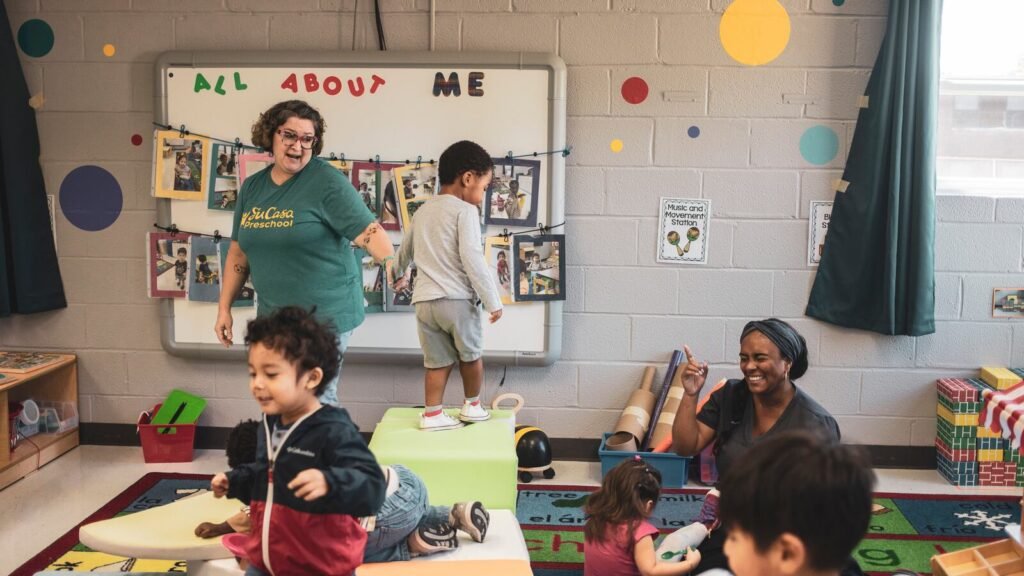
Pay attention to how teachers communicate with children. Are students encouraged to speak? Do teachers patiently repeat unfamiliar words? Are children participating in activities rather than simply listening?
Imagine observing a classroom where children are preparing pretend food in a play kitchen. A teacher might introduce vocabulary naturally while asking children what they are cooking, who they are serving, and what ingredients they need. This type of interaction makes language part of play.
Step 3: Ask About Teacher Qualifications
Teachers play a major role in the quality of bilingual education.
Ask about their early childhood training, language proficiency, and experience working with young multilingual learners. Also ask how the school supports teachers in monitoring children’s development across both languages.
A teacher does not need to translate every sentence. In fact, constant translation can sometimes reduce children’s opportunities to understand language through context.
Step 4: Evaluate Communication With Parents
Parents should know how their child’s language development is being monitored.
Ask how teachers report progress and whether they distinguish between comprehension, vocabulary, pronunciation, and conversational ability.
Good communication is particularly useful when a child appears quiet in one language. A teacher may discover that the child understands instructions well but needs more confidence when speaking.
Common Mistakes and Challenges
Bilingual preschool can be highly beneficial, but families may encounter challenges.
One common concern is that learning two languages will confuse a child. Young children can distinguish between languages even when they occasionally mix them. Combining words from two languages can be a normal part of multilingual development.
Another mistake is expecting equal fluency immediately. Children may have stronger vocabulary in one language depending on how often they hear and use it.
For example, a child might know household vocabulary in their home language but understand classroom instructions more easily in the school language. This does not necessarily indicate a problem.
Parents should also avoid turning language learning into constant testing. Asking a child to repeatedly translate words can make communication feel like homework. Natural conversations usually provide better opportunities for practice.
Practical Ways Parents Can Support Bilingual Learning
The preschool environment is only one part of a child’s language development. Families can reinforce learning through ordinary routines.
Read Together
Read age-appropriate books regularly. Families can use books in either or both languages.
Instead of worrying about translating every sentence, discuss the pictures and ask simple questions. “What is the dog doing?” or “Where is the girl going?” can encourage conversation.
Use Everyday Activities
Cooking, shopping, getting dressed, and traveling can become language-learning opportunities.
During grocery shopping, for example, parents can name fruits, describe colors, compare sizes, and ask children to help find specific items.
Encourage Conversation Without Pressure
Give children time to respond. If they make a mistake, model the correct phrase naturally rather than interrupting every sentence.
If a child says a mixed-language sentence, parents can respond using the preferred language while keeping the conversation moving.
Keep Both Languages Meaningful
Children are more likely to use a language when it has a real purpose.
Family conversations, friendships, stories, games, and cultural activities can give children reasons to communicate beyond classroom exercises.
Expert Recommendations for a Positive Experience
When evaluating a bilingual preschool, focus on quality of interaction rather than the number of languages offered.
Look for warm teacher-child relationships, age-appropriate activities, consistent language exposure, opportunities for conversation, and clear developmental monitoring.
It is also useful to consider your child’s personality. Some children immediately talk with new classmates, while others observe quietly before participating. A supportive classroom should accommodate both.
Finally, give the process time. Language development is not linear. A child may show rapid progress for several months and then appear to slow down while developing more complex understanding.
Conclusion
A bilingual preschool can give children meaningful opportunities to develop communication skills while becoming comfortable with two languages. The strongest programs make language part of everyday play, relationships, stories, and exploration rather than treating it as simple memorization.
For parents, the best approach is to examine the school’s language model, observe classroom interactions, evaluate teacher qualifications, and understand how progress is measured. At home, regular reading, conversation, and everyday activities can reinforce what children experience at school.
With consistent exposure and supportive adults, bilingual learning can become a natural part of early childhood rather than a source of pressure.