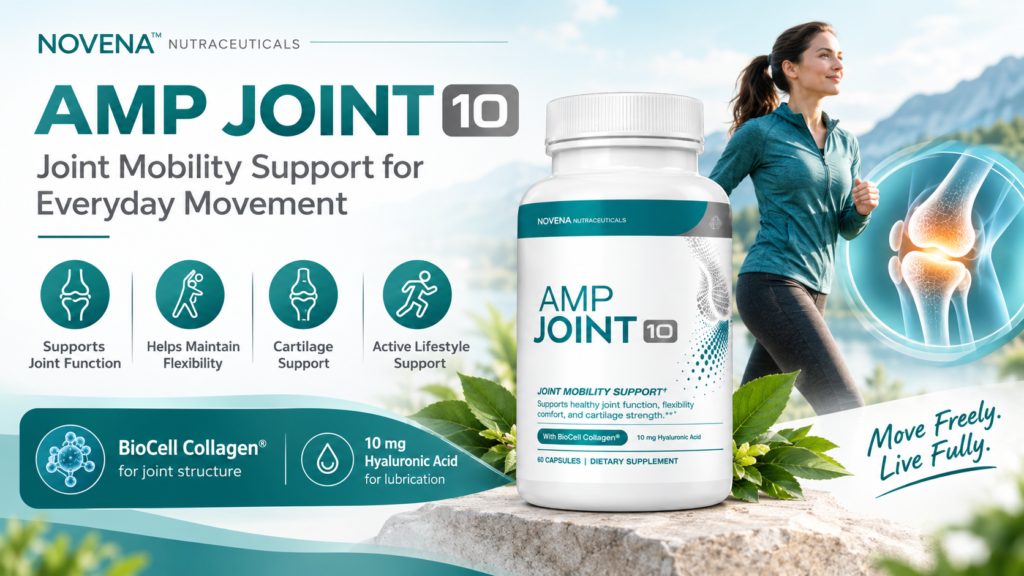
Joint health supplements are daily products that supply nutrients commonly linked to cartilage upkeep, joint comfort, and flexibility. They are not painkillers and they do not work overnight. Most people who use them take them for several weeks or months, alongside movement, strength work, and sensible weight management.
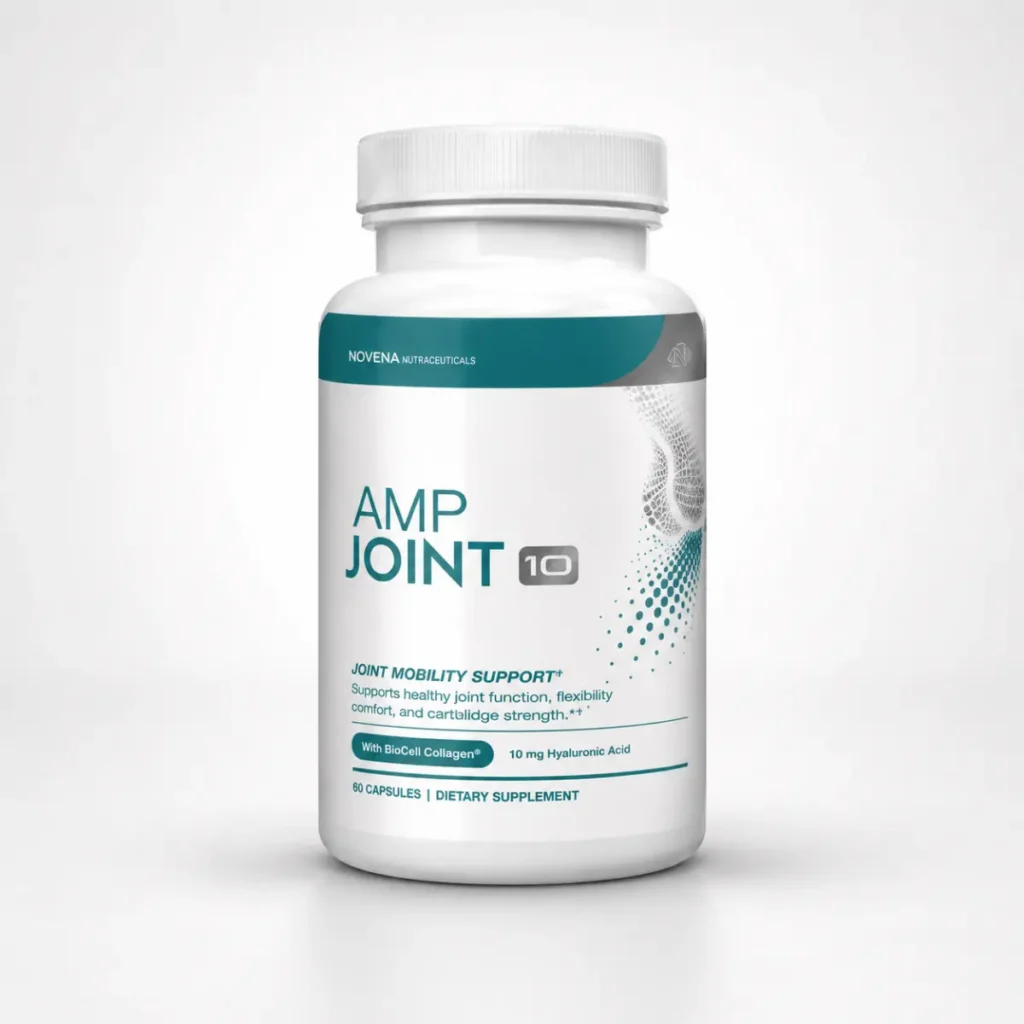
AMP Joint-10 is one such supplement. According to its published label, it is a two-capsule daily formula built around glucosamine sulfate, chondroitin sulfate, Boswellia, turmeric, quercetin, methionine, MSM, and bromelain. This guide explains how joint pain starts, what the main ingredients do, what the AMP Joint 10 ingredients list contains, and what a realistic AMP Joint 10 review looks like.
What Causes Joint Pain?
If you are asking what causes joint pain, the honest answer is that there is rarely one cause. Joints are complex structures. Bone ends are covered with smooth cartilage, surrounded by a capsule, lubricated by synovial fluid, and held steady by ligaments, tendons, and muscles. A problem in any of these can produce pain.
The most common contributors include:
- Wear and tear (osteoarthritis): Cartilage thins gradually with age, repetitive load, or past injury. This is the most common reason for joint pain in adults over 40.
- Inflammation: Conditions such as rheumatoid arthritis, gout, and psoriatic arthritis cause inflammatory joint pain, often with morning stiffness and swelling.
- Injury: Sprains, meniscus tears, ligament strains, and fractures can leave lasting stiffness.
- Overuse: Repetitive motion in work, sport, or daily chores can irritate tendons and joint linings.
- Excess body weight: Extra weight increases the load on knees, hips, and the lower back with every step.
- Low activity levels: Joints rely on movement to circulate fluid. Long periods of sitting can make them feel stiff.
- Muscle imbalance and posture: Weak hips or core muscles can shift stress to the knees or the lower spine.
- Genetics and age: Family history and natural aging both influence joint resilience.
Because the causes differ, the right approach differs too. A joint supplement may help support everyday comfort, but it cannot replace a diagnosis when pain is severe, sudden, or persistent.
Knee Pain on the Inside of the Knee Joint
One of the most searched complaints is knee pain on the inside of the knee joint. The inner side of the knee is called the medial compartment, and it carries a large share of body weight when you walk, climb stairs, or squat.
Common reasons for pain on the inside of the knee include:
- Medial compartment osteoarthritis: Cartilage in the inner part of the knee wears down, causing aching, stiffness, and sometimes swelling.
- Medial meniscus irritation or tear: The meniscus is a cushion of cartilage. Twisting movements can damage it, often causing catching or locking sensations.
- Medial collateral ligament (MCL) strain: A sideways force on the knee can overstretch this ligament.
- Pes anserine bursitis: A small fluid-filled sac on the inner knee becomes inflamed, often in runners and people with knee arthritis.
- Overuse and alignment issues: Flat feet, bowed legs, or weak hip muscles can increase inner-knee stress.
Many people explore supplements for this type of discomfort because glucosamine and chondroitin are among the most widely used ingredients in knee-focused formulas. Still, sudden swelling, a locked knee, instability, or pain after a fall needs a medical evaluation rather than self-treatment.
Joint Sacroiliac Pain: When the Lower Back and Pelvis Are Involved
Joint sacroiliac pain comes from the sacroiliac (SI) joints, which connect the base of the spine (sacrum) to the pelvis. These joints absorb shock between the upper body and legs. They move only slightly, but when they become irritated, the pain can be sharp or aching.
Typical features of SI joint discomfort include:
- Pain in the lower back or buttock, often on one side
- Pain that worsens when standing up from a seat, climbing stairs, or turning in bed
- Stiffness after rest
- Pain that may spread into the hip or groin
Possible triggers include pregnancy-related changes, uneven leg loading, arthritis, past injury, and prolonged sitting. SI joint pain is easily confused with other back problems, so a clinician or physiotherapist is the right person to assess it. Supplements aimed at general joint support are not designed to treat this specific condition, though some people use them as part of a broader routine that also includes stretching, strengthening, and posture care.
How Joint Health Supplements Work
Joint supplements are generally built on three ideas.
1. Supplying building blocks. Cartilage is made of collagen, water, and proteoglycans. Glucosamine and chondroitin are natural components of this matrix, so supplements provide them as raw materials.
2. Supporting a balanced inflammatory response. Some plant compounds, including turmeric (curcumin), Boswellia, and quercetin, are studied for their role in everyday inflammatory balance. This is not the same as treating inflammatory disease.
3. Supporting connective tissue and recovery. Ingredients like MSM (methylsulfonylmethane), methionine, and bromelain are included for their roles in connective tissue and the body’s normal handling of everyday stress.
Joint supplements work slowly. Most manufacturers and independent reviewers describe a window of several weeks to a few months before changes in comfort may be noticed. Results vary between individuals, and research on joint supplements is mixed, so realistic expectations matter.
Common Joint Supplement Ingredients Explained
Before looking at AMP Joint-10 specifically, here is a plain-language guide to the ingredients most often found in this category.
Glucosamine sulfate: A compound naturally found in cartilage and synovial fluid. It is one of the most studied joint ingredients, and many knee-focused formulas include it.
Chondroitin sulfate: Another structural component of cartilage, often paired with glucosamine. It helps cartilage retain water, which relates to cushioning.
Turmeric (curcumin): A yellow spice with antioxidant properties. It is commonly included in joint formulas for everyday comfort support.
Boswellia serrata: A resin from the Indian frankincense tree, traditionally used in Ayurvedic practice for joint and mobility support.
Quercetin: A flavonoid found in onions, apples, and tea. It is studied for antioxidant activity.
MSM (methylsulfonylmethane): An organic sulfur compound used for connective tissue support.
Methionine: An essential amino acid that supplies sulfur, a mineral involved in connective tissue.
Bromelain: An enzyme from pineapple stem, often included for digestive and comfort support.
Quality, dose, and consistency all matter. A well-known ingredient at a very small dose may not behave like the version used in published studies, which is why reading the label carefully is part of choosing any supplement.
AMP Joint 10 Ingredients: What the Label Discloses
Here is where an accurate AMP Joint 10 review needs to be careful and transparent. The brand name and marketing refer to a “10-ingredient formula,” but the published Supplement Facts panel lists eight active ingredients. That is worth knowing before you buy, so you can compare marketing language with the actual label.
According to the product information published by the manufacturer, the AMP Joint 10 ingredients include:
- Glucosamine sulfate (1,000 mg per serving): The highest-dosed ingredient and the structural anchor of the formula.
- Chondroitin sulfate (100 mg per serving): Paired with glucosamine for cartilage support.
- Boswellia: Included for inflammatory-balance support.
- Turmeric: Included for antioxidant and comfort support.
- Quercetin (about 16.7 mg): A plant flavonoid with antioxidant properties.
- Methionine (about 16.7 mg): A sulfur-containing amino acid.
- MSM (about 16.7 mg): A sulfur compound used in connective tissue products.
- Bromelain (about 16.7 mg): A pineapple-derived enzyme.
The serving size is two vegetable capsules, with 30 servings per container. Other ingredients are cellulose (the capsule) and rice flour. As with every supplement, check the current label on the official website before purchasing, because formulations and packaging can change.
How the AMP Joint-10 Formula Is Built
The formula follows a structure common in the joint supplement category, grouped by function:
Cartilage and structural support: Glucosamine sulfate and chondroitin sulfate make up the foundation. These two are the best-known pairing in joint supplementation.
Inflammatory balance support: Boswellia, turmeric, and quercetin are included because they are widely researched plant compounds associated with everyday joint comfort.
Connective tissue and enzyme support: MSM, methionine, and bromelain round out the formula with sulfur-based and enzyme-based ingredients.
The design reflects familiar joint-supplement logic: provide raw materials for cartilage, add compounds associated with a balanced inflammatory response, and include supporting ingredients for connective tissue. The supporting ingredients appear in smaller amounts than those used in many clinical studies, so the glucosamine content is the most established part of the formula.
AMP Joint 10 Review: Strengths, Limitations, and Who It May Suit
A balanced AMP Joint 10 review should look at both sides.
Potential strengths
- A complete Supplement Facts panel with milligram amounts is published.
- Glucosamine sulfate is included at 1,000 mg, a dose commonly seen in joint products.
- The formula combines structural and plant-based ingredients in one daily serving.
- Two capsules per day fit easily into a morning or evening routine.
- It is made as a vegetable-capsule product.
Limitations to consider
- The “10-ingredient” name does not match the eight disclosed active ingredients.
- Several supporting ingredients are present in small amounts compared with many research studies.
- Glucosamine and chondroitin are cumulative, so fast results should not be expected.
- Research on joint supplements overall is mixed, and individual responses vary.
- It is a dietary supplement, not a treatment for arthritis or any medical condition.
Who may find it useful
Adults who want a daily joint support routine, who are already active or trying to stay active, and who are comfortable giving a supplement several weeks of consistent use before judging it. It is not suited to anyone seeking a quick pain fix.
Who should talk to a doctor first
People who take blood thinners, have diabetes, are pregnant or nursing, have a shellfish allergy (glucosamine is often derived from shellfish, so check the source), or take regular prescription medication should speak with a healthcare professional before starting.
How to Take a Joint Supplement and What to Expect
Consistency matters more than perfection. A few practical habits help:
- Follow the label. For AMP Joint-10, the serving is two capsules daily, as listed on the product.
- Take it with food if your stomach is sensitive, since some ingredients can cause mild digestive upset.
- Pick a fixed time such as breakfast so you remember it every day.
- Give it time. Most people who use joint supplements judge them over eight to twelve weeks, not days.
- Track your comfort. A simple note each week on stiffness, stair climbing, or morning movement is more reliable than memory.
- Do not stack blindly. Combining several joint products can double up on the same ingredients.
A realistic expectation is subtle change rather than dramatic relief. Some people notice easier movement, while others notice nothing. That variation is normal and is one reason professional guidance is useful.
Safety, Side Effects, and Interactions
Joint supplements are generally well tolerated, but they are not risk-free for everyone. Possible issues include:
- Mild stomach upset, gas, or heartburn
- Allergic reactions, especially for people allergic to shellfish or pineapple
- Interactions with blood-thinning medication such as warfarin, since glucosamine, turmeric, and bromelain may influence bleeding in some people
- Effects on blood sugar in people with diabetes
- Unknown effects during pregnancy and breastfeeding
Stop use and seek medical advice if you notice rash, swelling, breathing difficulty, unusual bruising, or persistent digestive symptoms. Always tell your doctor and pharmacist about every supplement you take.
Lifestyle Habits That Support Joint Comfort
No capsule can do the work that daily habits do. Joint-friendly routines often include:
- Regular low-impact exercise: Walking, cycling, swimming, and yoga keep joints moving without heavy impact.
- Strength training: Strong thigh, hip, and core muscles share the load that would otherwise fall on the knees and lower back.
- Weight management: Even modest weight loss reduces knee load noticeably over time.
- Balanced eating: Fish, olive oil, leafy greens, nuts, berries, and whole grains fit a pattern often associated with lower inflammation.
- Hydration: Cartilage is largely water, so staying hydrated supports joint health.
- Good sleep: Recovery happens overnight, and poor sleep can heighten pain sensitivity.
- Movement breaks: Standing and stretching every 30 to 45 minutes helps stiff hips, knees, and the SI joints.
- Proper footwear: Supportive shoes can reduce strain on the knees and hips.
Supplements work best as one part of this larger picture rather than as a stand-alone solution.
When to See a Doctor About Joint Pain
Seek medical attention promptly if you have:
- Sudden severe pain or swelling in a joint
- A joint that is hot, red, or accompanied by fever
- Pain after a fall or injury
- A knee that locks, gives way, or cannot bear weight
- Pain that wakes you at night or lasts longer than a few weeks
- Numbness, tingling, or weakness in the legs
- Morning stiffness lasting more than 30 to 60 minutes
These can signal conditions that need proper diagnosis, such as inflammatory arthritis, infection, or structural injury.
AMP Joint 10 Customer Reviews
The following are examples of the kinds of experiences shared by adults who use daily joint supplements. Individual results vary.
Rachel M., 54, Teacher: ★★★★☆
“I started taking AMP Joint 10 after noticing my knees felt stiff first thing in the morning, especially on the stairs at school. I did not expect much in the first couple of weeks, and honestly nothing changed. Around week seven, I realized I was getting out of bed with less of that creaky feeling. It is not a miracle, but it has become part of my morning routine along with my walks. I appreciate that the label is clear about what is inside.”
David K., 61, Retired Mechanic: ★★★★☆
“After years of kneeling under cars, my inner knees complain on cold days. My daughter suggested I try a joint supplement and I picked AMP Joint 10 because of the glucosamine amount. I take two capsules with breakfast. After about two months I felt a bit more comfortable on my daily walk, though I would not say the discomfort is gone. I still stretch and do my leg exercises every day, and I think that combination matters most.”
Sunita P., 47, Office Manager: ★★★☆☆
“I spend long hours sitting and had lower back and hip stiffness that I wanted to support with something more than just stretching. I gave AMP Joint 10 about ten weeks. My experience was modest: I felt slightly looser in the mornings, but I am not sure how much was the supplement versus the physiotherapy exercises I started at the same time. It is easy to take and caused no stomach problems for me. I would recommend people be patient and talk to their doctor first.”
Frequently Asked Questions
What is AMP Joint-10?
It is a daily joint support dietary supplement sold in vegetable capsules, formulated with glucosamine sulfate, chondroitin sulfate, Boswellia, turmeric, quercetin, methionine, MSM, and bromelain.
What are the AMP Joint 10 ingredients?
The disclosed active ingredients are glucosamine sulfate, chondroitin sulfate, Boswellia, turmeric, quercetin, methionine, MSM, and bromelain. Always verify against the current label.
How long does a joint supplement take to work?
Glucosamine and chondroitin are generally considered cumulative. Many people evaluate them over eight to twelve weeks of consistent use, and some notice no change.
Can a supplement help knee pain on the inside of the knee joint?
Some people use glucosamine and chondroitin products for knee comfort, but the cause of inner-knee pain matters. Meniscus, ligament, and arthritis problems need proper assessment, and a supplement does not repair structural damage.
Is AMP Joint-10 meant for sacroiliac joint pain?
It is designed for general joint support, not for treating SI joint conditions. SI pain should be assessed by a clinician or physiotherapist.
Does AMP Joint-10 have side effects?
Joint supplements can cause mild stomach upset in some people, and ingredients like glucosamine, turmeric, and bromelain can interact with certain medications. Check with a healthcare professional first.
Can I take it with other medication?
Do not assume it is safe with prescription drugs, especially blood thinners or diabetes medication. Ask your doctor or pharmacist.
Is it a substitute for medical treatment?
No. Supplements support general wellness and are not a replacement for diagnosis or treatment.
Final Thoughts: Is AMP Joint-10 Worth Considering?
Joint health is shaped by many things at once: age, activity, body weight, past injuries, and the way you move every day. Joint health supplements can be a reasonable addition for adults who want extra nutritional support, provided expectations stay realistic.
AMP Joint-10 offers a familiar, glucosamine-led formula with plant-based and connective-tissue ingredients in a two-capsule daily serving. Its strengths are a published label and a well-known core pairing. Its limitations are the gap between the “10-ingredient” name and the eight listed ingredients, the small amounts of several supporting compounds, and the slow, variable nature of results.
If you decide to try it, read the current Supplement Facts panel, check for allergies and medication interactions, give it a fair trial period, and pair it with movement, strength work, and good sleep. And if your pain is severe, persistent, or tied to the inner knee or the sacroiliac joint, a professional assessment will always be more valuable than any capsule.