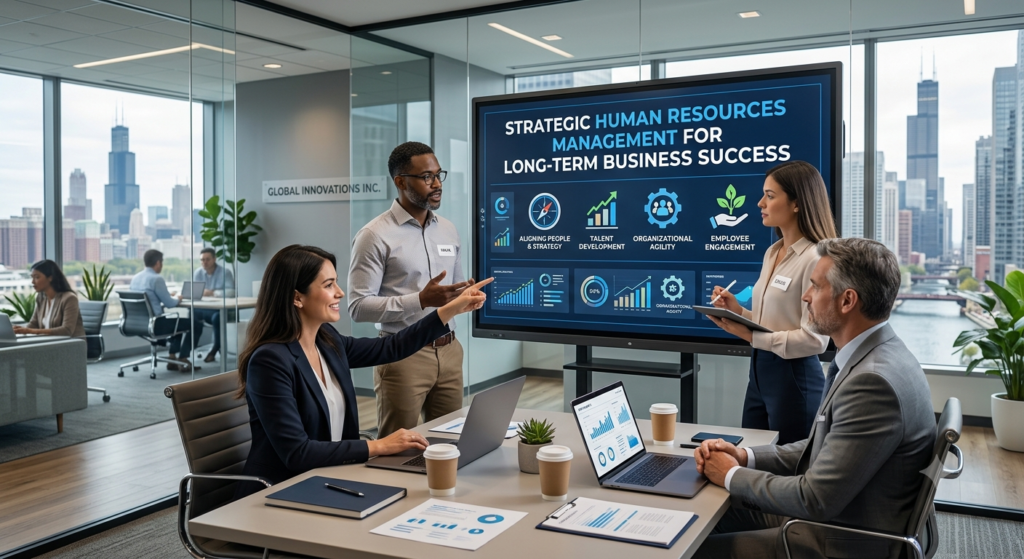
In today’s competitive business environment, companies need more than strong products, effective marketing, and financial resources to achieve sustainable growth. They also need the right people and a well-planned approach to managing them. Strategic Human Resources Management (SHRM) connects people management with an organization’s long-term goals, helping businesses build capable teams, improve performance, and prepare for future challenges.
Unlike traditional HR practices that often focus mainly on recruitment, payroll, and employee administration, strategic HR takes a broader view. It considers how employees can contribute to business objectives and how organizations can create an environment where talent can grow. When implemented effectively, this approach can strengthen productivity, employee engagement, workplace culture, and long-term organizational performance.
What Is Strategic Human Resources Management?
Strategic Human Resources Management is the process of aligning workforce planning and people-related practices with an organization’s overall business strategy. It ensures that hiring, training, performance management, compensation, succession planning, and employee development support broader company objectives.
For example, if a company plans to expand into new markets, its HR strategy may focus on hiring employees with international experience, developing leadership capabilities, and creating training programs that prepare teams for new responsibilities.
The objective is not simply to manage employees but to treat the workforce as an important business asset. Human Resources plays a vital role in helping organizations make better decisions about talent while preparing employees and leaders for future opportunities.
Why Strategic Human Resources Management Matters
A strong people strategy can influence almost every part of an organization. Employees who understand their responsibilities and see opportunities for professional growth are more likely to remain engaged and contribute effectively.
Strategic HR can also support:
- Better employee retention
- Improved workforce productivity
- Stronger leadership development
- Effective talent acquisition
- Greater employee engagement
- Better succession planning
- A healthier workplace culture
- Improved adaptability during business changes
By addressing these areas systematically, companies can create a workforce that is prepared to support both current operations and future growth.
Key Elements of Strategic Human Resources Management
1. Workforce Planning
Workforce planning helps organizations understand their current and future talent requirements. Businesses can evaluate existing skills, identify workforce gaps, and determine which positions or capabilities will be necessary as the company grows.
Effective planning reduces the risk of talent shortages and helps businesses prepare for changes in technology, customer demand, and industry conditions.
2. Talent Acquisition
Recruitment should be connected to long-term organizational requirements rather than focused only on filling immediate vacancies. Companies should identify the skills, experience, and cultural qualities required for each position.
A structured recruitment process can help organizations attract qualified candidates while improving the chances of finding employees who can grow with the business.
3. Employee Development
Employee development is another important part of a strategic approach. Training programs can improve technical skills, communication abilities, leadership capabilities, and problem-solving skills.
Organizations that invest in continuous learning can build internal talent instead of relying entirely on external hiring. Development programs can also increase employee motivation by demonstrating that the company values career progression.
4. Performance Management
Effective performance management gives employees clear expectations and measurable objectives. Regular feedback allows managers and employees to discuss achievements, challenges, and areas for improvement.
Instead of treating performance reviews as an annual formality, businesses can use ongoing conversations to encourage accountability and professional growth.
5. Succession Planning
Businesses need capable leaders not only today but also in the future. Succession planning identifies employees who have the potential to take on important roles and provides them with appropriate development opportunities.
This reduces disruption when senior employees leave or move into different positions. It also creates a stronger internal leadership pipeline.
6. Employee Engagement
Engaged employees are more likely to demonstrate commitment, collaborate effectively, and contribute ideas. Organizations can encourage engagement by creating transparent communication channels, recognizing achievements, supporting professional development, and listening to employee feedback.
A positive employee experience in Human Resources can also contribute to stronger retention and workplace morale.
How Strategic HR Supports Long-Term Business Success
Strategic HR contributes to business success by connecting people decisions with measurable organizational priorities. When companies understand which capabilities are necessary for growth, they can invest resources more effectively.
For example, a technology-focused organization may need employees with specialized digital skills. Instead of continuously searching for external candidates, it can combine targeted recruitment with internal training and development. This approach can create a more adaptable workforce while supporting business continuity.
Strategic planning also helps organizations respond to change. Economic uncertainty, technological developments, new regulations, and changing customer expectations can all affect workforce requirements. Companies with flexible people strategies are better positioned to adjust when circumstances change.
The Role of Technology in Modern HR Strategy
Technology has transformed how organizations manage their workforce. HR platforms can simplify recruitment, employee onboarding, performance tracking, attendance management, learning programs, and workforce analytics.
Data can also help decision-makers identify patterns in employee turnover, engagement, performance, and workforce requirements. However, technology should support human decision-making rather than completely replace it.
Organizations should use HR technology responsibly, protect employee information, and ensure that important workforce decisions remain fair and transparent.
Building a Strong Organizational Culture
Culture plays an important role in long-term organizational performance. A strong culture establishes shared expectations around communication, collaboration, accountability, and professional behavior.
HR leaders can help shape culture by ensuring that hiring practices, leadership behavior, recognition programs, and employee policies reflect the organization’s values.
For example, if innovation is a core business objective, employees should be encouraged to share ideas, experiment responsibly, and learn from unsuccessful initiatives. Human Resources teams can support this process by promoting collaboration, recognizing creative contributions, and developing policies that encourage innovation. When company values are reflected in everyday practices, culture becomes more meaningful.
Measuring the Effectiveness of HR Strategy
Strategic HR should be measurable. Organizations can use relevant metrics to understand whether their workforce initiatives are delivering results.
Useful measures may include:
- Employee turnover rate
- Time to hire
- Employee retention
- Training completion and effectiveness
- Employee engagement scores
- Internal promotion rates
- Absenteeism
- Productivity indicators
- Leadership pipeline strength
The right metrics depend on business objectives. Companies should avoid measuring everything and instead focus on indicators that provide meaningful insights into workforce performance.
Common Challenges in Strategic HR Management
Implementing a strategic approach is not always simple. Some organizations struggle with limited resources, resistance to change, poor communication, or a lack of reliable workforce data.
Another challenge is maintaining consistency between leadership decisions and HR policies. If company leaders promote one set of values but workplace practices demonstrate another, employee trust can decline.
To overcome these challenges, businesses should establish clear objectives, communicate changes effectively, train managers, and regularly evaluate HR initiatives. Leadership involvement is especially important because successful people strategies require support throughout the organization.
How Businesses Can Build an Effective HR Strategy
Companies can begin by reviewing their current workforce and identifying the skills needed to achieve future objectives. The next step is to establish measurable priorities for recruitment, development, retention, and leadership.
Organizations should then create programs that address identified workforce gaps. Regular reviews can determine whether these initiatives are producing the expected results.
Working with experienced business advisors can also help companies develop practical workforce strategies that align with their broader objectives. Capital Troop supports organizations with business-focused consulting solutions designed to help them improve performance, strengthen operations, and pursue sustainable growth.
The Future of Strategic Human Resources Management
The future of HR will increasingly focus on adaptability, employee experience, workforce analytics, continuous learning, and technology. Businesses will need to understand how changing work models and emerging technologies affect employee expectations and required skills.
Organizations that prioritize continuous development and flexible workforce planning can be better prepared for future changes. HR professionals will also play a greater role in strategic decision-making as businesses recognize the connection between talent and overall performance.
A forward-looking approach enables companies to build teams that are not only effective today but also capable of adapting to tomorrow’s challenges.
Conclusion
Strategic Human Resources Management is an essential component of sustainable business growth. By connecting workforce planning, recruitment, employee development, performance management, engagement, and succession planning with organizational objectives, businesses can create stronger and more adaptable teams.
The most successful approach is not simply about managing employees efficiently. It is about understanding what people and capabilities the organization will need in the future and creating practical strategies to develop them. With clear goals, appropriate technology, strong leadership, and continuous evaluation, businesses can turn their workforce into a long-term competitive advantage.
Frequently Asked Questions
Q1. What is Strategic Human Resources Management?
Strategic Human Resources Management aligns workforce practices with an organization’s long-term business objectives. It covers areas such as recruitment, development, performance, engagement, and succession planning.
Q2. Why is strategic HR important for business growth?
It helps organizations attract and retain capable employees, develop future leaders, improve productivity, and ensure that workforce capabilities support changing business requirements.
Q3. What are the main components of strategic HR?
Key components include workforce planning, talent acquisition, employee development, performance management, succession planning, employee engagement, and HR analytics.
Q4. How does technology support strategic HR?
HR technology can automate administrative tasks, organize employee information, support recruitment, track performance, facilitate learning, and provide workforce insights that help managers make informed decisions.
Q5. How can companies improve their HR strategy?
Companies can start by evaluating their workforce needs, identifying skill gaps, setting measurable objectives, investing in employee development, improving communication, and regularly measuring HR outcomes.