Introduction
Compressed air may look clean, but it can carry water droplets, rust, pipe scale, dust, compressor oil, and fine aerosols into production equipment. A Festo MS Pneumatic Filter helps remove selected contaminants before they reach valves, cylinders, instruments, and sensitive processes.
Effective filtration protects pneumatic components, supports consistent machine performance, and reduces avoidable maintenance. The filter must still be selected according to the required air quality, flow demand, pressure conditions, and operating environment.
What Is a Festo MS Pneumatic Filter?
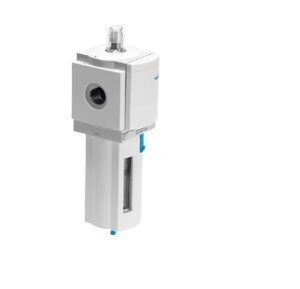
A Festo MS Pneumatic Filter is a modular compressed-air preparation component from the Festo MS service-unit platform. It is installed upstream of pneumatic equipment to separate solid particles and, depending on the chosen filter type, condensed water, liquid aerosols, or oil vapour.
The MS range supports different filter sizes and treatment stages within one modular air-preparation system.
Why Does Compressed Air Need Filtration?
Contamination enters pneumatic networks from several sources. Atmospheric air contains dust and humidity, compressors may introduce oil, and older pipework can release corrosion or scale.
Without suitable filtration, contaminants may cause:
- Premature seal wear
- Restricted valve passages
- Sticky or irregular movement
- Blocked exhaust components
- Damaged instruments
- Increased maintenance
- Reduced process quality
Filtration should match the needs of the connected equipment. Excessive treatment can create unnecessary pressure loss, while insufficient treatment can shorten component life.
How Does the Filter Separate Contaminants?
Compressed air enters the housing and passes through a separation stage. Heavier droplets and particles move towards the bowl, while the remaining air travels through the filter element.
The filter medium captures particles above its rated size. Collected liquid settles in the bowl and must be discharged through the selected drain system.
Performance depends on airflow, element condition, installation orientation, and maintenance.
Which Filtration Stages Are Available?
Coarse Filtration
A coarse filter removes larger solid particles and bulk condensate. It is often used as the first stage in a general industrial air-preparation system.
This stage helps protect downstream regulators, valves, cylinders, and finer filters from heavy contamination.
Fine and Microfiltration
Fine and microfilters remove smaller particles and liquid aerosols. Coalescing media bring tiny droplets together until they become large enough to drain into the bowl.
These filters suit sensitive valves, instruments, and precision processes.
Activated-Carbon Filtration
Activated-carbon filters reduce oil vapour, odours, and selected hydrocarbon residues. They are normally installed as a final treatment stage after suitable particle and aerosol filtration.
Activated carbon should not replace earlier filtration stages because heavy contamination can reduce its working life.
How Should the Correct Filtration Grade Be Selected?
The finest available filter is not automatically the best choice. Each stage creates resistance, and unnecessary restriction can increase compressor energy demand.
Selection should consider:
- Required air purity
- Component sensitivity
- Normal and peak flow
- Permitted pressure drop
- Existing upstream treatment
- Oil and moisture content
- Maintenance access
Where several purity improvements are needed, staged filtration protects finer elements and delivers the required final air quality.
Why Is Pressure Drop Important?
Pressure drop is the reduction in pressure as air passes through the filter. It increases when the filter is undersized, contaminated, or exposed to excessive airflow.
A restricted filter can cause slow cylinder movement, incomplete strokes, unstable process pressure, and longer machine cycles. The compressor may also work harder to compensate.
Filter performance should be compared at realistic operating flow because the wider air system also creates resistance.
How Should Condensate Be Managed?
Separated water and oil collect in the filter bowl. If the liquid level becomes too high, contamination may be carried back into the airflow.
Drain options may include manual, semi-automatic, or fully automatic operation. Selection depends on moisture load, supervision, and maintenance needs.
Condensate should be discharged safely and handled according to local environmental requirements.
Where Are Festo MS Pneumatic Filters Used?
Assembly and Packaging Machines
These machines use filtered air for cylinders, grippers, ejectors, clamps, and directional valves. Reliable air preparation supports consistent movement during repeated cycles.
Precision and Testing Equipment
Inspection fixtures and test benches may contain small passages, sensors, or instruments that are sensitive to contamination. Finer filtration may be required for dependable measurement.
Painting and Process Systems
Spraying, coating, food-related, and process applications can require carefully defined air purity. The final treatment arrangement should reflect equipment protection and product-quality requirements.
Central and Local Air Stations
A filter can be installed in a central preparation system or close to an individual machine. Local treatment can provide application-specific air quality without filtering the entire factory network to the same level.
How Should the Filter Be Installed?
Before installation, isolate the compressor supply and release stored pressure. Confirm the flow-direction marking, port size, filtration grade, drain type, bowl material, and approved mounting position.
Good installation practices include:
- Keep open ports free from debris
- Install the unit in the correct direction
- Support connected pipework
- Leave space for bowl removal
- Keep the drain accessible
- Avoid stress on the housing
- Restore pressure gradually
- Check every joint for leakage
The exact product instructions should always be followed.
How Can Filter Performance Be Maintained?
Routine maintenance should cover the bowl, condensate level, drain, seals, element, and nearby connections.
Warning signs include:
- Increased pressure drop
- Slower actuator movement
- Downstream contamination
- Visible bowl damage
- Drain malfunction
- Air leakage
The element should be replaced according to condition, pressure-drop trends, operating time, and manufacturer guidance. Waiting for complete blockage can increase energy use and disrupt production.
Why Choose a Festo MS Pneumatic Filter?
A Festo MS Pneumatic Filter supports reliable compressed-air preparation through modular sizing, multiple filtration stages, selectable drains, and compatibility with wider MS service-unit functions.
By matching filtration grade, flow capacity, condensate handling, installation, and maintenance to the application, engineers can protect downstream equipment while maintaining efficient pneumatic performance.