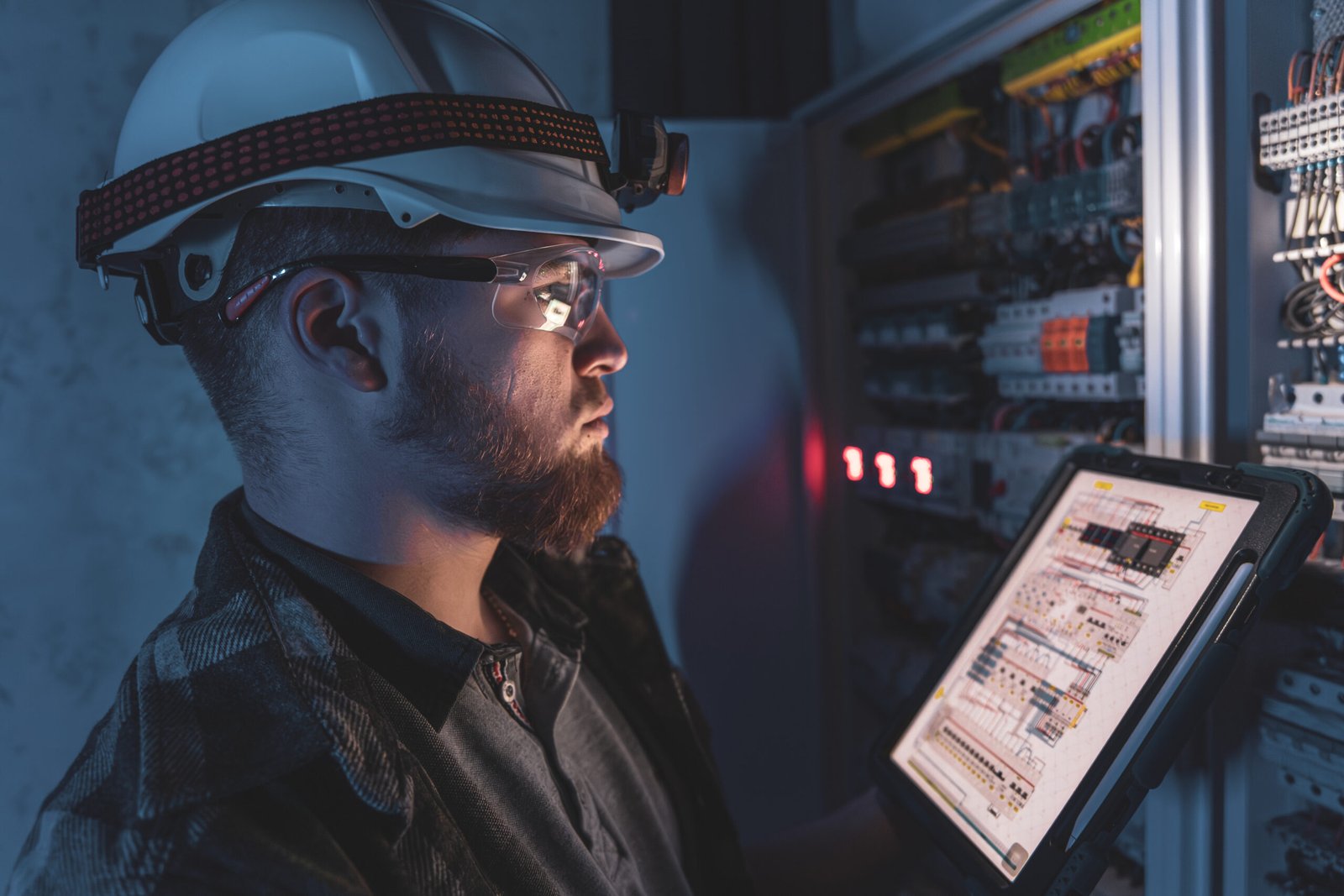
Electrician focused on work in switchboard with fuses, using tablet. Young adult electrical engineer in special clothes with flashlight on helmet in dark room with emergency lights in background.
Nobody wants to think about accidents when a new machine is being installed. Yet every moving part, pinch point, and high-voltage cabinet carries risk, and the controls decide whether that risk is managed or ignored. Safety isn’t a feature you add at the end.
That is why bringing in a qualified Allen-Bradley system integrator is so crucial-experienced engineering teams often remind plant managers that proper credentials matter most when nothing has gone wrong yet.
Why Certification Is More Than a Badge
It’s easy to dismiss certificates as paperwork. In reality, they show that engineers have studied how safety systems fail and how to prevent them. Functional safety is its own discipline. It deals with how a stop signal travels, how a faulty sensor is detected, and how a machine behaves when something unexpected happens.
A certified team also keeps up with changing standards and product updates. That matters because a design that was acceptable ten years ago may not meet today’s expectations. Certification doesn’t guarantee perfection, but it does tell you that training and accountability stand behind the work.
Risk Assessment Comes First
Before any wiring starts, a responsible partner studies the machine and asks what could go wrong. Who reaches into it? How often? What happens if a guard is bypassed? This process, called a risk assessment, decides how much protection each hazard needs.
Skipping it leads to two problems. If it is not adequately protected, then it is a dangerous machine; if it is over-protected in an unprofessional manner, then the operator will be frustrated enough to devise some shortcuts. An efficient evaluation process ensures that this balance is achieved. Moreover, it produces a written document that proves that you have considered safety.
Safety Hardware That Actually Gets Used
Light curtains, door interlocks, emergency stops, and safety relays only help if people don’t fight them. If a guard makes a routine task painful, someone will tape over the switch within a week. Experienced engineers know this and design around real behavior.
They place emergency stops where hands naturally reach. They choose interlocks that are hard to defeat. They set up resets so a machine never restarts unexpectedly after a stop. A certified Allen Bradley System Integrator thinks about operators as people, not just users, and that practical mindset prevents more injuries than any additional sensor could.
Programming Safety Logic Properly
Safety logic isn’t like ordinary control code. It has to be predictable, tested, and protected against accidental changes. Dedicated safety controllers monitor their own inputs and outputs, and they shut things down safely if something looks wrong.
Certified engineers follow structured methods, such as peer reviews and documented validation tests. They check that every safety function works as intended, including what happens during a power loss or wiring fault. That’s not something to leave to guesswork. A small error in safety logic can stay hidden for years and only reveal itself on the worst possible day.
Documentation That Survives an Audit
Inspections happen, and so do investigations after incidents. When they do, you’ll be asked to show how your machines were designed and tested. Drawings, risk assessments, validation reports, and change records all matter.
Integrators who take safety seriously hand these over as a normal part of the job. They also explain how to keep them updated when you modify equipment later. It feels like extra effort now, but it protects you legally and gives new staff a clear picture of how each safety function works.
How to Verify an Integrator’s Credentials
Don’t just take claims at face value. Ask which standards they design to, such as ISO 13849 or IEC 62061, and which team members hold functional safety credentials. Request examples of past safety projects and a sample of their documentation. Check whether the manufacturer recognizes them as a partner. Finally, talk to previous clients about how the integrator handled problems. A confident Allen Bradley System Integrator will welcome these questions instead of dodging them.
Final Thoughts
Safety means returning home in the same condition in which you came. The proper partner will provide training, discipline, and integrity to the design process, leaving you with clear evidence that the job was done correctly. Dedicated engineering teams like RL Consulting, Inc. consistently build around this standard, ensuring every control loop and safety circuit meets rigorous plant-floor demands. Do your homework, ask straightforward questions, and choose a partner with the proven credentials to protect both your workforce and your equipment.
FAQs
What is functional safety in industrial automation?
Functional safety is the application of sensing devices, logic elements, and actuators to mitigate risks and put the machine into a safe condition in case of faults. These can be emergency stops, light curtains, and safety relays. The emphasis in functional safety is on their reliability in spite of hardware faults.
Why is a risk assessment important before installation?
The risk assessment determines the hazards involved, evaluates the likelihood of the injury and its severity, and what protection should be provided. This assessment process avoids both inadequate protection and over-protection. It also results in documentation which facilitates compliance and future changes to the machine and protective measures.
What standards apply to machine safety?
Some of the common guidelines include ISO 13849 and IEC 62061 safety control systems, and there are others that are regional, like the OSHA guidelines and NFPA 79 in electrical equipment for the United States. Requirements will differ from one country to another depending on the industry.
Can safety systems be bypassed by operators?
If there is bad design or inconvenience, they can be. Good design minimizes this risk because the devices will be placed reasonably, and the tasks that need to be done will remain practical. Policy, training, and supervised interlocks play a part in this too. Bypassing must be authorized and monitored.
How often should safety systems be tested?
The testing frequency is dependent upon the risk level, manufacturer instructions, and appropriate standards. Numerous facilities conduct periodic testing of emergency stop buttons and interlock systems based on time intervals like once a month or at the beginning of a shift. It is also necessary to perform full validation after equipment modification.