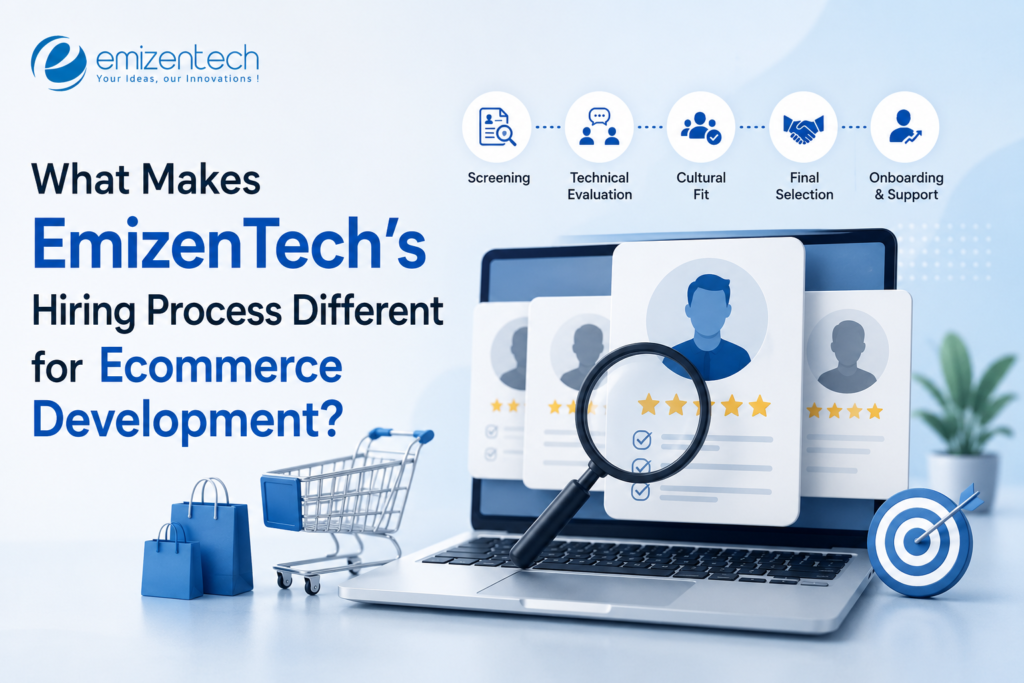
Hiring eCommerce developers shouldn’t feel like a blind bet. You need to know who’ll work on your store, whether they understand your platform, how communication will work, and what happens if the fit isn’t right.
That’s where EmizenTech’s hiring process is different. We start by understanding the actual business problem, match you with eCommerce expertise that fits the job, set expectations early, and keep the work visible as it moves forward. For eligible new engagements, there’s also a 14-day money-back guarantee.
Simple idea. Less guesswork.
Why Hiring for eCommerce Development Requires a Different Approach
An eCommerce development company isn’t just a website with a cart bolted onto it. It handles product data, inventory, payments, customer information, shipping rules, promotions, and sometimes several systems working at once.
If one part breaks, customers notice fast.
A slow checkout can hurt sales. An unreliable inventory sync can create cancelled orders. A poorly planned migration can damage search visibility and disrupt daily operations.
That’s why hire ecommerce developers based only on an hourly rate or a flashy portfolio can backfire. You need someone who understands the moving pieces behind the storefront.
The right fit depends on more than coding ability. It also depends on platform knowledge, communication habits, problem-solving, and how well the team understands your business model.
Step One: Understanding the Store, Goals, and Technical Requirements
Before assigning developers, it helps to get clear on what you’re trying to achieve.
Are you launching a new store? Moving from Magento to Shopify? Fixing a slow WooCommerce site? Building a B2B ordering portal? These are very different jobs, even if they all fall under “eCommerce development company.”
Looking Beyond the Initial Feature List
Most projects start with a list of features. That’s normal. But the deeper questions matter too:
- Who are your customers: consumers, wholesalers, distributors, or marketplace sellers?
- Do you need subscriptions, multi-vendor selling, custom pricing, or bulk ordering?
- Are you planning to expand into new regions or sales channels?
- Will the store need to connect with an ERP, CRM, warehouse, or accounting system?
A good discovery process catches these details early. It’s much easier to plan for a complex inventory workflow at the start than to patch it in after launch.
Identifying the Right Platform and Skill Set
Not every platform suits every business.
Shopify can be a strong fit for brands that want speed and a clean operating experience. Magento or Adobe Commerce may suit stores with complex catalogues and custom workflows. WooCommerce can work well when WordPress is already part of the business. BigCommerce, headless commerce, and custom solutions each have their place too.
The goal isn’t to force one platform on every client. It’s to match the technology to the problem.
Defining Scope Before the Team Is Matched
Clear scope saves time. And awkward conversations later.
Before work begins, businesses should identify:
- Existing platform and technology stack
- Required integrations
- Migration needs
- Priority features
- Expected launch date
- Performance and security expectations
This gives everyone a more realistic starting point.
Step Two: Matching the Right eCommerce Expertise to the Project
A general web developer may build a decent-looking site. But eCommerce work often needs more specific experience.
Think about payment failures, tax rules, product variants, abandoned carts, fulfilment logic, customer accounts, and peak traffic. These aren’t edge cases. They’re daily business concerns.
Platform-Specific Development Experience
Developers should know the platform you’re using, not just the language behind it.
For example, a Shopify project may require theme customization, app integration, Shopify Plus features, or custom storefront work. A Magento project may involve complex catalogue rules, integrations, and performance tuning. A WooCommerce store may need plugin management, database optimization, and custom checkout logic.
Platform experience shortens the learning curve. That usually means fewer avoidable mistakes.
Expertise Beyond Storefront Development
The visible storefront is only one part of the job. Many eCommerce projects also need support with:
- ERP and CRM integrations
- Payment gateway setup
- Marketplace connectivity
- Inventory and order synchronization
- Migration and data cleanup
- Store speed and Core Web Vitals
- Security updates and ongoing maintenance
A store can look polished and still struggle behind the scenes. That’s the stuff customers don’t always see until it causes a problem.
Choosing a Team Based on Project Complexity
A small design update doesn’t need the same setup as a multi-store enterprise migration.
For a focused task, one experienced developer may be enough. For a large implementation, you may need a broader team with development, QA, project management, design, and integration support.
It sounds obvious. Yet many businesses under-resource the early stage, then spend months trying to recover from it.
Step Three: Flexible Hiring Models That Fit the Work
There’s no single “best” hiring model. It depends on what’s on your roadmap.
Dedicated Developers for Long-Term eCommerce Growth
A dedicated eCommerce developer can make sense when your store needs regular improvements, new features, performance work, maintenance, and quick support.
This model is especially useful for businesses that have an internal team but need extra technical capacity.
Project-Based Teams for Defined Requirements
If you’re launching a new store, migrating platforms, or building a major feature, a project-based team can offer a more structured setup.
You’ll usually have a defined scope, delivery milestones, and a clear plan for testing and launch.
Hourly or Part-Time Engagement for Focused Work
Sometimes you don’t need a full team. You need help with one thing.
Maybe your checkout is underperforming. Maybe an integration keeps failing. Maybe the store needs security updates or a speed audit. Hourly or part-time support can be a practical option in those cases.
Hire for the work you have now, not the team size that sounds impressive.
Step Four: Clear Onboarding, Communication, and Delivery Practices
Good development work can still become frustrating if communication is messy.
Nobody wants to chase updates, decode vague emails, or find out too late that a key feature wasn’t included. A structured onboarding process helps avoid that.
Establishing Priorities and Success Measures Early
At the beginning, the team should agree on the basics:
- What needs to be delivered first
- Which features are must-haves versus nice-to-haves
- Who approves work
- How feedback will be shared
- What success looks like after launch
That last point is often missed. A successful project isn’t just “the website went live.” It might mean faster checkout, improved mobile conversion, fewer manual order tasks, or better store performance.
Keeping Stakeholders Informed During Development
Regular communication keeps small issues from turning into bigger ones.
A clear reporting rhythm, shared project tools, milestone reviews, and direct points of contact help clients stay involved without needing to manage every technical detail themselves.
That balance matters. You should know what’s happening. You just shouldn’t have to become a developer to follow it.
Quality Checks Before Release
Before features go live, there should be checks for functionality, compatibility, performance, and security.
That can include code reviews, QA testing, checkout testing, device testing, and deployment checks. Not glamorous work. But it’s the work that protects customer experience.
How Independent Clutch Proof Helps Businesses Evaluate Their Choice
A company can say it has strong processes. Any company can.
Third-party feedback is more useful because it shows how real clients experienced the work.
Why Third-Party Reviews Matter in a Hiring Decision
Clutch reviews give prospective clients another way to assess a development partner. Instead of relying only on service-page claims, you can review feedback from businesses that have already worked with the provider. That’s a better starting point for due diligence.
Clutch Verification and Trust Signals
EmizenTech’s Clutch profile, verified client feedback, and ratings can help buyers evaluate the company before making a hiring decision.
Reviews shouldn’t replace a proper conversation about your project. But they’re useful proof that you’re not starting from zero.
Reducing Initial Hiring Risk with the 14-Day Money-Back Guarantee
Hiring a new development partner involves some uncertainty. That’s just reality.
The first days of a project tell you a lot: how the team communicates, whether they understand the requirements, and whether the working relationship feels right.
For eligible new engagements, EmizenTech offers a 14-day money-back guarantee. It gives clients an added layer of confidence while the engagement gets underway.
Before starting, make sure the project scope, kickoff date, initial fees, and applicable guarantee terms are clear. No assumptions. No fine-print surprises.
Questions Businesses Should Ask Before Hiring eCommerce Developers
Before you hire, ask direct questions.
Can the team work with your current platform and integrations? How will project progress be reported? Who handles QA? What happens if priorities change? Can you see examples of similar work?
These questions aren’t difficult. But they separate a thoughtful hiring decision from a rushed one.
Frequently Asked Questions
1. What should I look for when hiring eCommerce developers?
Look for relevant platform experience, strong communication, a clear delivery process, and evidence of past work. Reviews and case studies can help, but your project discussion should also show whether the team understands your requirements.
2. Can I hire developers for Shopify, Magento, WooCommerce, or BigCommerce?
Yes. The right developer should have experience with the platform you use or plan to adopt. Platform-specific knowledge matters because each system handles customization, integrations, and performance differently.
3. What is the difference between a dedicated developer and a project-based team?
A dedicated developer works as an ongoing extension of your team. A project-based team is usually assembled around a defined scope, timeline, and set of deliverables.
4. How does the eCommerce developer onboarding process work?
It usually begins with understanding your goals, current systems, feature requirements, timeline, and preferred communication process. After that, the appropriate developers and engagement model can be matched to the work.
5. What does the 14-day money-back guarantee cover?
For eligible new engagements, the guarantee applies to initial project fees under the applicable terms. Confirm the exact scope and terms before the project begins.
6. Can eCommerce developers work with my in-house team?
Yes. Dedicated developers can collaborate with internal product, design, marketing, and engineering teams using agreed workflows and communication channels.