Smart digital marketing strategy for improving online brand visibility
Once a prospective customer lands on your website, it can take a fraction of a second to make a first impression. If the site appears antiquated, slow to load, confusing, or uninformative about what your business actually does, that visitor will be gone – long before the salesman comes in. For a marketing company like yours, that website also has an additional level of responsibility. It is much more than an electronic brochure, and can showcase your expertise, highlight your company’s personality, generate leads, display your results, and set visitors up for action.
What Makes Digital Marketing Company Websites Effective?
A strong agency website begins with a clear understanding of its audience.
A business owner looking for marketing support usually wants answers to a few basic questions: What does the agency do? Who does it help? Can it solve my particular problem? What results has it achieved? And how can I get started?
The website should make those answers easy to find.
Start With a Clear Value Proposition
The homepage should communicate the agency’s core value without forcing visitors to read several paragraphs to understand the offer.
A concise headline, supporting explanation, relevant services, proof of experience, and a clear call to action can create a logical starting point.
Instead of trying to appeal to everyone, agencies can make their positioning more specific. A company specializing in ecommerce SEO, for example, can build its messaging around the challenges faced by ecommerce brands.
Specificity often makes a website easier for the right prospects to understand.
Design the Website Around the Customer Journey
Good design is not just about colors, animations, or typography. It is about helping visitors move naturally from one piece of information to the next.
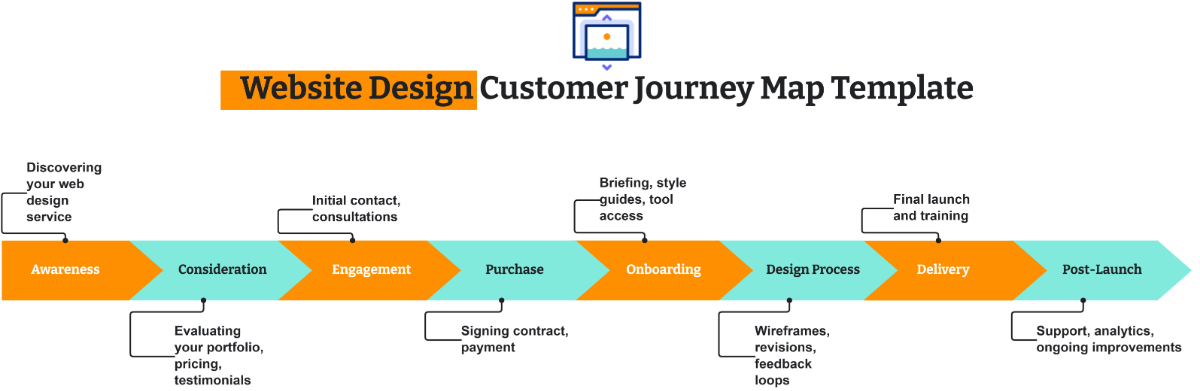
A prospective client might arrive on a service page through Google, explore a case study, visit the about page, and eventually request a consultation.
Each page should support that journey.
Make Navigation Simple
Visitors should not have to hunt for important information.
A straightforward navigation system can make services, case studies, resources, company information, and contact options easy to access. On mobile devices, the same principle applies even though the available screen space is much smaller.
The best design decisions are often the ones users barely notice because everything simply works.
Build Trust Before Asking for a Lead
Marketing services can involve significant financial investment, so prospective clients often want evidence before contacting an agency.
This is where proof becomes valuable.
Case studies, client results, testimonials, recognizable partnerships, industry experience, and useful educational content can help demonstrate credibility.
Turn Case Studies Into Sales Assets
A case study should do more than display a company logo and a few impressive numbers.
A useful case study explains the original challenge, the approach taken, the work completed, and the outcome. When possible, it should provide enough context for a potential customer to understand why the result matters.
This allows prospects to imagine how the agency might approach their own situation.
Make SEO Part of Website Development
Search visibility should be considered during website planning rather than treated as something to address after launch.
Structure, page hierarchy, internal links, metadata, headings, content quality, and performance can all influence how effectively search engines understand a website.

This is particularly important for agencies competing in crowded search results.
When a Webflow SEO Specialist Can Help
Businesses using Webflow may work with a Webflow SEO specialist to address both the platform’s capabilities and broader SEO requirements.
An SEO specialist can help review areas such as site structure, indexability, redirects, canonicalization, metadata, structured content, internal linking, and page performance.
However, technical optimization alone is not enough. Search-focused website development should also consider the questions potential customers are asking and whether the site’s content genuinely answers them.
Create Landing Pages With One Clear Purpose
A common mistake on agency websites is trying to make every page accomplish everything.
A landing page connected to a specific campaign or service should have a focused purpose. The headline should match the visitor’s intent, the content should explain the value of the offer, and the call to action should be obvious.
Removing unnecessary distractions can make the decision-making process easier.
For example, a landing page promoting technical SEO services might focus specifically on technical problems, the agency’s process, expected outcomes, and a consultation request rather than attempting to explain every service the company provides.
Use Content to Attract and Educate Prospects
Content marketing can extend the value of an agency website beyond its service pages.
Useful guides, original research, industry insights, practical tutorials, and detailed explanations can attract people who are still researching their options.
This also gives agencies an opportunity to demonstrate expertise before a prospect ever makes contact.
Write for People First
Search optimization should not come at the expense of readability.
Content should use natural language, answer the reader’s questions, and provide meaningful information rather than repeating keywords unnecessarily.
Search engines are increasingly focused on understanding content and user intent, so useful, original material is a more sustainable foundation than keyword stuffing.
Improve Conversion Opportunities Without Overdoing Them
Generating leads does not mean placing a “Contact Us” button in every possible location.
Calls to action should appear where they make sense.
Someone reading a detailed service page may be ready to request a consultation. A first-time visitor reading a beginner’s guide may need more information before taking that step.
Different visitors can therefore benefit from different conversion paths.
Options might include booking a consultation, requesting an audit, downloading a resource, viewing case studies, or contacting the agency.
Pros, Cons, and Common Questions
A professionally designed digital marketing website can strengthen credibility, improve search visibility, showcase expertise, and create a more consistent path from discovery to inquiry.
The downside is that building an effective website requires ongoing investment. Content needs updating, technical issues can appear, search competition changes, and conversion performance should be monitored over time.
How important is website speed?
Speed is an important part of the user experience and can influence how visitors interact with a website. Agencies should optimize images, scripts, fonts, and other page elements while avoiding unnecessary features that add technical overhead.
Should every agency use animations?
No. Animation can add personality when used carefully, but excessive motion can distract visitors or make pages harder to use. Design should support the message rather than compete with it.
How many calls to action should an agency website have?
There is no fixed number. The important factor is relevance. Visitors should have a clear next step without feeling pressured by repeated or competing calls to action.
Conclusion: Build a Website That Works as a Marketing Asset
Modern digital marketing company websites need to do more than look professional. They should explain an agency’s value, establish trust, attract relevant search traffic, demonstrate expertise, and make it easy for qualified prospects to take the next step.
That requires a combination of strategy, design, content, SEO, technical performance, and conversion thinking.
Whether the site is built with Webflow or another platform, the fundamentals remain similar: understand the audience, create useful content, make navigation simple, demonstrate real expertise, and remove unnecessary friction from the customer journey.
A website built with those principles can become more than a digital storefront. It can serve as an always-on marketing asset that helps an agency attract the right audience, answer important questions, and turn genuine interest into business conversations.