Preparing for the Registered Behavior Technician (RBT) certification can feel overwhelming, especially if you are taking the exam for the first time. One of the best ways to build confidence is by completing an RBT practice exam 85 questions before your actual test. A well-designed practice exam helps you understand the exam format, identify weak areas, and improve your test-taking skills.
In this article, we will explain the topics typically covered in an RBT practice exam 85 questions and how each section helps you prepare for the certification exam.
Why Take an RBT Practice Exam?
Practice exams are valuable because they simulate the real testing experience. They allow you to become familiar with different question types while improving your time management. By reviewing your results, you can focus on the topics that need more attention before exam day.
For first-time candidates, practice tests also reduce anxiety by making the exam format more familiar.
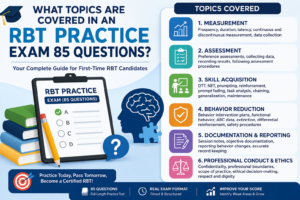
1. Measurement
Measurement is one of the most important sections in an RBT practice exam. Questions often cover:
- Continuous and discontinuous measurement methods
- Recording frequency, duration, and latency
- Collecting and organizing behavior data
- Understanding data collection procedures
These questions test your ability to gather accurate information during therapy sessions.
2. Assessment
Assessment questions evaluate your understanding of how behavior data is collected and used. Common topics include:
- Assisting with preference assessments
- Recording assessment results
- Following assessment procedures
- Supporting behavior analysts during evaluations
Although RBTs do not conduct formal assessments independently, they play an important role in collecting reliable information.
3. Skill Acquisition
This section usually contains a significant number of questions because teaching new skills is a major responsibility for RBTs.
Topics may include:
- Discrete Trial Training (DTT)
- Natural Environment Teaching (NET)
- Prompting strategies
- Prompt fading
- Reinforcement techniques
- Task analysis
- Chaining procedures
- Generalization and maintenance
A strong understanding of these concepts is essential for success on the certification exam.
4. Behavior Reduction
Behavior reduction focuses on responding appropriately to challenging behaviors while following intervention plans.
Common questions cover:
- Identifying the function of behavior
- Following behavior intervention plans
- Reinforcement procedures
- Extinction procedures
- Differential reinforcement
- Crisis and safety procedures
- Collecting ABC (Antecedent-Behavior-Consequence) data
These questions measure your ability to implement behavior support plans safely and effectively.
5. Documentation and Reporting
Accurate documentation is a critical part of an RBT’s daily responsibilities.
You may see questions about:
- Session notes
- Objective documentation
- Reporting changes in client behavior
- Maintaining accurate records
- Professional communication with supervisors
Good documentation helps ensure high-quality client care.
6. Professional Conduct and Ethics
Every RBT practice exam 85 questions includes ethics-related questions because professional behavior is essential in applied behavior analysis.
Typical topics include:
- Client confidentiality
- Professional boundaries
- Scope of practice
- Following supervisor instructions
- Respecting client dignity
- Ethical decision-making
Understanding the RBT Ethics Code helps candidates answer these questions correctly.
What Skills Are Tested?
Besides knowledge, an RBT practice exam 85 questions evaluates practical abilities such as:
- Reading and interpreting scenarios
- Applying ABA principles
- Choosing the best intervention
- Making ethical decisions
- Following professional standards
- Using critical thinking in real-life situations
Many questions are scenario-based rather than simple definitions.
Tips for First-Time RBT Candidates
If you are preparing for your first exam, these tips can improve your performance:
- Complete several full-length practice exams.
- Review every incorrect answer carefully.
- Focus on understanding concepts instead of memorizing answers.
- Study the RBT Task List regularly.
- Practice answering scenario-based questions.
- Improve your time management by taking timed practice tests.
Consistent practice builds both knowledge and confidence.
Final Thoughts
Understanding the topics covered in an RBT practice exam 85 questions is one of the best ways to prepare for the RBT certification. Most practice exams include questions on measurement, assessment, skill acquisition, behavior reduction, documentation, and professional ethics. By studying these areas and completing multiple practice tests, first-time candidates can identify their strengths, improve weaker subjects, and approach the certification exam with greater confidence.
A well-structured RBT practice exam 85 questions is an excellent study tool that helps you become familiar with the exam format while increasing your chances of passing on your first attempt.