Multi Tenant IP PBX Software
Communication systems have evolved significantly over the past decade. Businesses and telecom providers are no longer limited to on-premise telephone systems that require heavy infrastructure and maintenance. Instead, cloud-based communication platforms have introduced a more scalable and flexible approach to managing voice services.
One of the most important innovations in this space is Multi Tenant IP PBX Software. This modern solution allows multiple organizations to share a single PBX infrastructure while maintaining complete separation between tenants. In contrast, traditional PBX systems are typically designed for a single organization and rely on dedicated hardware.
Understanding the differences between these two systems helps telecom providers and businesses choose the right communication platform for their needs.
Understanding Traditional PBX Systems
A traditional PBX system is a private telephone network installed within a company’s physical location. It manages internal communication between employees and also connects external calls through telephone lines or SIP trunks.
Traditional PBX systems usually require:
- Dedicated hardware
- On-site installation
- Physical maintenance
- Manual configuration
Each organization typically operates its own PBX server or hardware appliance. While these systems were widely used for many years, they can become expensive and difficult to scale as communication needs grow.
What Multi Tenant IP PBX Software Offers
Multi-tenant IP PBX software takes a completely different approach. Instead of running separate PBX systems for every organization, the platform allows multiple tenants to operate within a shared infrastructure.
Each tenant functions as an independent phone system with its own users, extensions, and call routing rules, but the core platform remains centralized.
This architecture is especially beneficial for hosted VoIP providers that serve multiple businesses from a single cloud-based communication platform.
Solutions such as IntuPBX are designed specifically to support this model, enabling service providers to manage many clients efficiently while maintaining system performance and security.
Infrastructure and Deployment
One of the biggest differences between the two systems is infrastructure.
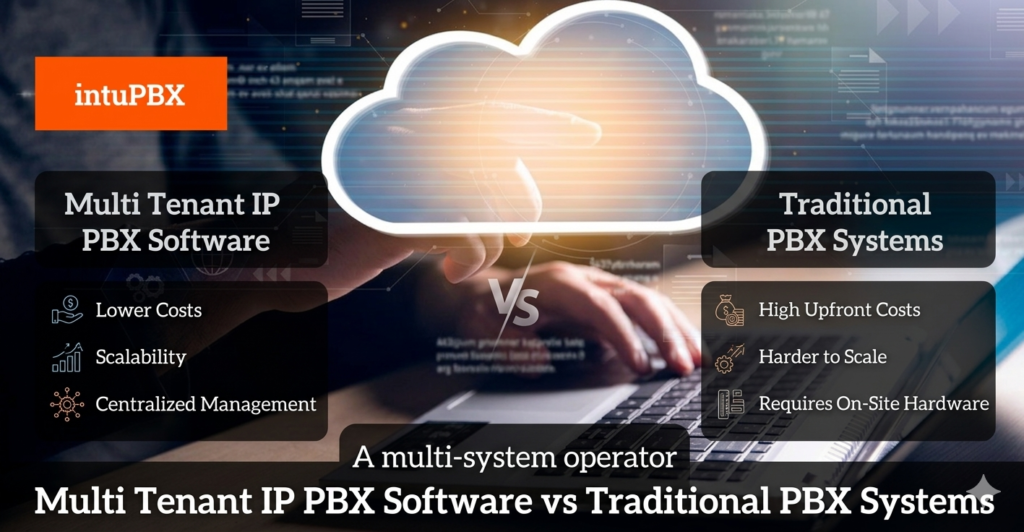
Traditional PBX systems require hardware installation at each customer location. This means companies must purchase equipment, allocate space for servers, and handle ongoing maintenance.
Multi-tenant IP PBX platforms operate in cloud or data center environments. Instead of installing equipment on-site, businesses connect to the hosted system through the internet.
This cloud-based deployment reduces hardware requirements and simplifies system management for both providers and customers.
Scalability and Growth
Scalability is another major difference between these systems.
Traditional PBX systems have limited scalability because hardware capacity determines how many users or extensions can be supported. When businesses grow, they may need to upgrade or replace their PBX equipment.
Multi-tenant PBX systems are designed for growth. Providers can add new tenants or expand user capacity without installing new hardware for each customer.
This flexibility allows telecom providers to onboard new clients quickly and scale their services without major infrastructure changes.
Cost Efficiency
Traditional PBX systems can be expensive because each organization must maintain its own infrastructure. Costs include hardware, installation, maintenance, and technical support.
Multi-tenant PBX software significantly reduces these costs by allowing multiple tenants to share the same infrastructure. Resources such as servers and storage are utilized more efficiently, lowering operational expenses.
For telecom providers offering hosted communication services, this shared architecture improves profitability while maintaining service quality.
System Management
Managing traditional PBX systems can be complex because each installation requires separate monitoring, configuration, and maintenance.
If a telecom provider supports multiple clients with individual PBX systems, administrators must manage each system independently. This increases administrative workload and makes updates more time-consuming.
Multi-tenant PBX platforms provide centralized management tools that allow administrators to control multiple tenants from a single dashboard.
Platforms like IntuPBX enable providers to monitor users, manage extensions, configure call routing, and maintain system performance across all tenants from one interface.
Service Deployment Speed
With traditional PBX systems, deploying services for a new customer may involve installing hardware, configuring servers, and setting up extensions manually.
This process can take several days or even weeks depending on the system complexity.
Multi-tenant PBX software dramatically reduces deployment time. Providers can create new tenants and configure their communication environment within minutes.
This faster onboarding process allows telecom providers to deliver services quickly and respond more effectively to new business opportunities.
Feature Flexibility
Traditional PBX systems often have limited flexibility because new features may require hardware upgrades or software installations.
In contrast, multi-tenant PBX platforms can easily support modern communication features such as:
- Voicemail-to-email
- call analytics
- automated call routing
- mobile and softphone integration
- cloud-based administration
These features are easier to implement in a centralized platform because updates can be applied across the entire system.
Security and Tenant Isolation
Security is a critical requirement for any communication system. In traditional PBX environments, each company manages its own security policies and configurations.
Multi-tenant PBX platforms are built with tenant isolation, ensuring that each organization’s data, call records, and configurations remain separate from others.
This design allows providers to maintain strong security standards while efficiently managing multiple tenants within the same platform.
Which System Is Better?
Both systems serve specific purposes, but their suitability depends on the communication environment.
Traditional PBX systems may still work for organizations that prefer on-premise infrastructure and have stable communication requirements.
However, for telecom providers and businesses looking for scalability, cost efficiency, and cloud-based flexibility, multi-tenant PBX platforms offer significant advantages.
Solutions like IntuPBX enable providers to deliver modern hosted VoIP services while simplifying system management and infrastructure requirements.
Conclusion
The shift from traditional PBX systems to multi-tenant IP PBX platforms reflects the broader transformation of communication technology. As businesses move toward cloud-based services, scalable and centralized platforms are becoming essential.
Multi-tenant PBX software allows telecom providers to efficiently manage multiple customers while reducing infrastructure costs and improving operational efficiency. Platforms such as IntuPBX demonstrate how modern communication systems can combine scalability, flexibility, and centralized management to meet the growing demands of hosted VoIP environments.