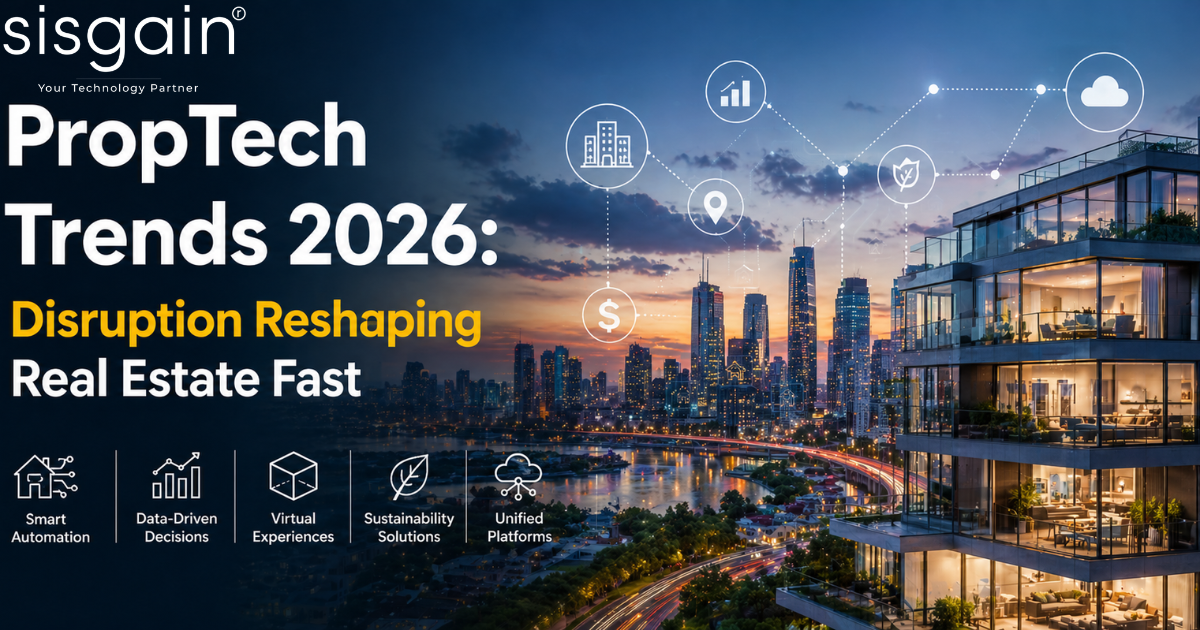
What Are the Trends in Real Estate Technology in 2026?
Understanding what are the trends in real estate technology is critical for businesses aiming to remain competitive. The defining shift in 2026 is the transition from basic digitization to intelligent automation powered by AI and data.
Modern prop-tech trends are being driven by several key factors. Rising operational costs are forcing companies to look for efficiency-driven solutions. At the same time, tenants and investors expect faster, more personalized experiences. Data is becoming a strategic asset, and businesses that can harness it effectively are gaining a substantial competitive advantage.
Additionally, the increasing complexity of real estate operations demands integrated solutions rather than fragmented tools. This is why unified platforms are becoming central to real estate tech trends, enabling organizations to streamline workflows and eliminate inefficiencies.
Top 10 Prop-Tech Trends Dominating 2026
AI-Powered Property Management Systems
Artificial intelligence is at the core of modern property management technology trends. Traditional property management relied heavily on manual processes, which were not only time-consuming but also prone to errors. AI is changing this by introducing predictive capabilities that allow businesses to anticipate issues before they arise.
Data shows that AI adoption in property management has grown from 18% in 2022 to over 70% in 2026, highlighting its critical role in shaping prop-tech real estate.
Key AI Capabilities in Property Management
- AI-driven automation in property management technology trends
- Predictive maintenance using advanced real estate tech trends
- Smart rental pricing powered by prop-tech trends
- Tenant behavior analytics in prop-tech real estate platforms
- AI-based decision-making aligned with what are the trends in real estate technology
- Intelligent workflow automation in modern real estate tech trends
- Data-driven insights improving property management technology trends
- Scalable AI solutions transforming prop-tech trends globally
Agentic AI in Real Estate Operations
One of the most advanced real estate tech trends in 2026 is the emergence of agentic AI. Unlike traditional automation tools, agentic AI systems act as digital assistants capable of making decisions and executing tasks independently.
These systems can handle tenant communication, manage leasing processes, and even generate financial reports. By automating routine operations, businesses can reduce human workload by up to 60% and allow teams to focus on strategic activities.
Key Functions of Agentic AI
- Automates tenant inquiries, responses, and follow-ups in real time
- Manages lease creation, renewals, and documentation workflows
- Generates financial reports and tracks property performance automatically
- Schedules maintenance tasks and predicts repair needs
- Analyzes tenant behavior to improve retention strategies
- Optimizes rental pricing based on market data and demand
- Integrates with property management systems for seamless operations
- Provides 24/7 virtual assistance to tenants and stakeholders
Smart Buildings and IoT Integration
Smart building technology is rapidly becoming a cornerstone of prop-tech trends. IoT devices enable real-time monitoring of building performance, including energy usage, occupancy rates, and equipment health.
A typical smart building investment delivers value across multiple areas:
- 40% improvement in energy efficiency
- 25% enhancement in security systems
- 20% reduction in maintenance costs
- 15% improvement in tenant experience
These benefits make IoT integration one of the most impactful property management technology trends today.
Blockchain for Secure Transactions
Blockchain technology is transforming how real estate transactions are conducted. It provides a secure, transparent, and tamper-proof system for recording property ownership and financial transactions.
In prop-tech real estate, blockchain is being used to enable smart contracts, reduce fraud, and streamline property transfers. This reduces the need for intermediaries and significantly speeds up transaction processes.
Key Benefits of Blockchain in Real Estate
- Ensures transparent and tamper-proof property records
- Enables smart contracts for automated deal execution
- Reduces fraud and data manipulation risks
- Eliminates intermediaries, lowering transaction costs
- Speeds up property buying and selling processes
- Enhances trust between buyers, sellers, and stakeholders
- Improves compliance with regulatory requirements
- Provides secure digital identity verification for transactions
Digital Twin Technology
Digital twins are virtual replicas of physical properties that allow businesses to simulate real-world scenarios. This technology is gaining traction as part of advanced real estate tech trends.
By using digital twins, companies can test different operational strategies, predict maintenance needs, and optimize building performance. This leads to better decision-making and reduced operational risks.
Key Benefits of Digital Twin Technology
- Creates real-time virtual models of physical properties
- Enables simulation of different operational scenarios
- Predicts maintenance issues before they occur
- Optimizes energy usage and building efficiency
- Improves space utilization and occupancy planning
- Supports data-driven decision-making
- Reduces operational risks and unexpected costs
- Enhances long-term asset performance
Unified Prop-Tech Platforms
The shift from fragmented tools to unified platforms is one of the most critical prop-tech trends in 2026. custom real estate app development Businesses are moving away from disconnected systems toward integrated solutions that combine CRM, ERP, analytics, and AI capabilities.
Unified platforms improve efficiency by eliminating data silos and enabling seamless workflows. They also provide a single source of truth, which is essential for data-driven decision-making.
Key Benefits
- Eliminates data silos across systems
- Integrates CRM, ERP, and analytics in one platform
- Improves workflow efficiency and automation
- Enables real-time data access and insights
- Supports scalability in prop-tech real estate
- Enhances decision-making in real estate tech trends
Predictive Analytics and Big Data
Predictive analytics is transforming how real estate companies approach investment and management decisions. By analyzing historical data and market trends, businesses can forecast demand, identify high-value opportunities, and minimize risks.
This is one of the fastest-growing property management technology trends, as companies increasingly rely on data to drive strategy.
Key Benefits
- Forecasts property demand and market trends
- Identifies high ROI investment opportunities
- Reduces risks through data-driven insights
- Improves decision-making in real estate tech trends
- Enhances efficiency in prop-tech trends
Sustainability and Green Prop-Tech
Sustainability is no longer optional in real estate. Green technologies are becoming a key component of prop-tech real estate, helping businesses reduce their environmental impact while complying with regulatory requirements.
Technologies such as energy management systems, carbon tracking tools, and smart HVAC systems are gaining widespread adoption.
Key Benefits
- Reduces energy consumption and operational costs
- Supports ESG and regulatory compliance
- Improves building efficiency and performance
- Enhances brand value in prop-tech trends
- Promotes long-term sustainability
AR and VR for Property Visualization
Augmented and virtual reality technologies are transforming property marketing by enabling virtual tours that increase engagement and conversions. Properties using VR can see up to 49% higher conversion rates, making it a key part of real estate tech trends.
Key Benefits
- Virtual property tours from anywhere
- Reduces need for physical visits
- Improves buyer engagement
- Faster decision-making
- Better property visualization
- Higher conversion rates in prop-tech trends
Cybersecurity and Data Governance
As real estate becomes more data-driven, cybersecurity is becoming a critical concern. Protecting sensitive financial and personal data is essential for maintaining trust and compliance.
Strong data governance frameworks ensure data accuracy, security, and accessibility, making them a foundational element of modern prop-tech trends.
Key Aspects of Cybersecurity and Data Governance
- Protection of sensitive tenant and financial data from cyber threats
- Implementation of secure access controls and user authentication
- Data encryption to prevent unauthorized access and breaches
- Regular security audits and vulnerability assessments
- Compliance with industry regulations and legal standards
- Centralized data management for better accuracy and consistency
- Real-time monitoring and threat detection systems
- Backup and disaster recovery planning for data safety
- Integration of security protocols within property management technology trends
Real Case Study: How AI Reduced Property Costs by 35%
A mid-sized real estate company implemented AI-driven solutions to modernize its operations. Before adopting technology, the company relied on manual processes for maintenance tracking, tenant communication, and financial management.
After implementing AI-powered systems, the real estate app development company achieved remarkable results. Maintenance issues were identified before they escalated, reducing repair costs. Automated communication improved tenant satisfaction, leading to higher retention rates. Data-driven pricing strategies optimized rental income.
Within one year, the company reduced operational costs by 35%, improved issue resolution time by 50%, and increased tenant retention by 27%. This case highlights the transformative potential of property management technology trends.
Comparison Guide: Traditional vs Modern Prop-Tech Systems
| Feature | Traditional Systems | Modern Prop-Tech Solutions |
|---|---|---|
| Data Management | Manual and fragmented | Centralized and AI-driven |
| Efficiency | Low | High |
| Integration | Limited | Fully integrated |
| Cost Structure | High operational cost | Optimized cost |
| Scalability | Restricted | Highly scalable |
This comparison clearly shows why businesses are rapidly adopting modern prop-tech real estate solutions.
Cost Breakdown of Implementing Prop-Tech Solutions
The cost of implementing real estate tech trends varies depending on the level of technology adoption.
Basic automation tools typically cost between $10,000 and $30,000. Mid-level AI integration ranges from $50,000 to $150,000. Full-scale enterprise platforms can exceed $200,000.
However, the return on investment often outweighs the initial cost. Most companies achieve ROI within one to two years through improved efficiency and reduced operational expenses.
Cost Structure Overview
- Basic automation tools: $10,000 – $30,000
- Mid-level AI integration: $50,000 – $150,000
- Enterprise-grade prop-tech platforms: $200,000+
- Custom solutions in prop-tech real estate may vary based on features and scalability
Key Factors Affecting Cost
- Level of AI and automation required in property management technology trends
- Integration with existing systems and platforms
- Customization needs and development complexity
- Data migration and system upgrades
- Security and compliance requirements
ROI and Business Impact
- Reduction in operational costs through automation
- Increased efficiency aligned with modern prop-tech trends
- Faster decision-making using data-driven insights
- Improved tenant retention and satisfaction
- Long-term scalability with advanced real estate tech trends
Why Most Real Estate Companies Fail in Tech Adoption
Despite the benefits of prop-tech trends, many companies fail to achieve success. The most common reason is a lack of data readiness. Without clean and structured data, AI systems cannot deliver accurate insights.
Another major challenge is poor integration. Implementing multiple tools without a clear strategy leads to inefficiencies and data silos. Additionally, some companies focus on trends rather than business value, investing in technologies that do not align with their goals.
Key Reasons for Failure
- Lack of structured and high-quality data for AI systems
- Poor integration between tools and platforms
- Absence of a clear technology strategy
- Over-investment in trends without defined ROI
- Resistance to change within teams
- Insufficient training and adoption support
Statistics show that nearly 70% of real estate technology initiatives fail before delivering measurable ROI.
How to Choose the Right Prop-Tech Strategy
Selecting the right strategy is critical for maximizing the benefits of property management technology trends. Businesses should focus on scalability, ensuring that their solutions can grow with their needs.
Integration is another key factor. Systems should work seamlessly with existing tools to avoid disruptions. AI readiness is also essential, as future innovations will rely heavily on data and automation.
Cost should be evaluated in terms of long-term ROI rather than initial investment. Finally, choosing the right technology partner can significantly impact success.
The Future of Prop-Tech Real Estate Beyond 2026
The future of prop-tech real estate will be defined by increased automation and intelligence. Fully autonomous property management systems are expected to become a reality, handling everything from tenant interactions to financial management.
AI-driven investment platforms will enable businesses to make faster and more accurate decisions. Personalized tenant experiences will become the norm, driven by data insights and advanced analytics.
These developments will continue to reshape real estate tech trends, creating new opportunities and challenges for businesses.
What to Expect in the Future
- Fully automated property management systems with minimal human intervention
- AI-driven investment decision platforms for higher accuracy and ROI
- Hyper-personalized tenant experiences using advanced data analytics
- Increased adoption of smart buildings and IoT integration
- Expansion of predictive analytics across all property management technology trends
- Greater reliance on unified platforms in prop-tech trends
- Enhanced data security and governance frameworks
- Integration of emerging technologies like AR, VR, and blockchain
- Scalable digital ecosystems transforming prop-tech real estate operations
Why SISGAIN Is the Right Technology Partner
In a rapidly evolving digital landscape, choosing the right partner is crucial for leveraging prop-tech trends effectively. SISGAIN has established itself as a trusted real estate software development company, delivering innovative solutions tailored to modern business needs.
With deep expertise in custom real estate CRM software development and custom real estate app development, SISGAIN helps businesses build scalable, AI-powered platforms that drive efficiency and growth.
Their solutions are designed to integrate seamlessly with existing systems, ensuring smooth adoption and maximum ROI. By focusing on innovation and user experience, SISGAIN enables companies to stay ahead in the competitive prop-tech real estate market.
Transform Your Real Estate Business Today
The future of real estate belongs to businesses that embrace innovation. If you want to stay ahead of emerging prop-tech trends, now is the time to act.
Partner with SISGAIN to build intelligent, scalable, and future-ready solutions that drive real results.
Get a free consultation today and discover how technology can transform your business operations, reduce costs, and unlock new growth opportunities.
Final Thoughts
The rise of prop-tech trends is transforming the real estate industry at an unprecedented pace. Businesses that adopt modern property management technology trends are gaining a competitive edge through improved efficiency, reduced costs, and enhanced customer experiences.
As we move further into 2026, the importance of embracing real estate tech trends will only continue to grow. By understanding what are the trends in real estate technology and implementing the right strategies—including investing in solutions like custom real estate app development—companies can position themselves for long-term success in the evolving prop-tech real estate landscape.
FAQs
What are the trends in real estate technology in 2026?
AI, automation, IoT, and data-driven platforms are the leading trends shaping the industry.
What is Prop-Tech in real estate?
Prop-Tech refers to technology solutions that enhance and automate real estate operations.
How is AI used in property management?
AI is used for predictive maintenance, tenant management, and automated workflows.
Are Prop-Tech solutions expensive?
Costs vary, but most businesses achieve ROI within one to two years.
Why is data important in real estate tech?
Data enables better decision-making, forecasting, and operational efficiency.