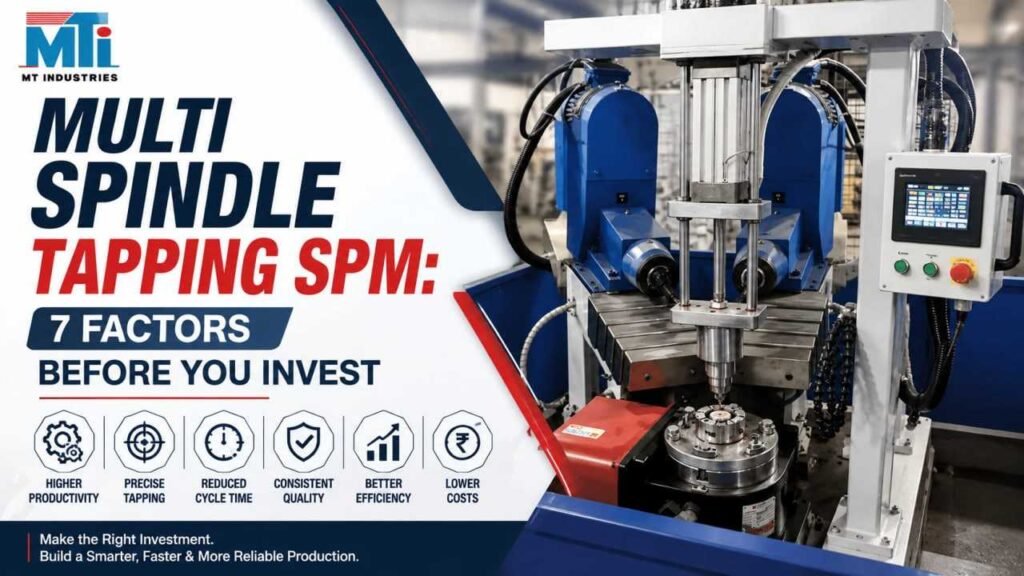
Choosing the right tapping system can have a direct impact on production speed, thread quality, machine utilization, and overall manufacturing costs. For industries handling repetitive components and high-volume production, a Multi Spindle Tapping SPM can provide a practical way to perform multiple tapping operations within a single production cycle.
However, investing in an automated tapping system should not be based only on the number of spindles or the machine’s advertised production capacity. Factors such as component geometry, thread specifications, spindle configuration, tooling, cycle time, automation requirements, and maintenance support all influence whether a machine will deliver the expected results.
Manufacturers such as MT Industries focus on application-specific machine configurations because every production requirement is different. Before making an investment, it is important to evaluate the complete tapping process rather than looking at machine specifications in isolation.
Here are seven important factors to consider before selecting a Multi Spindle Tapping SPM.
1. Understand Your Component and Tapping Requirements
The first step is to clearly define what the machine needs to accomplish.
Before selecting a Multi Spindle Tapping SPM, evaluate:
- Component dimensions and material
- Number of holes to be tapped
- Thread diameter and pitch
- Blind or through-hole requirements
- Hole locations and spacing
- Required tapping depth
- Component loading and unloading method
- Expected production volume
Different components may require completely different machine configurations. A machine designed for a simple symmetrical component may not be suitable for a part with closely positioned holes or complex geometry.
For example, if several holes need to be tapped simultaneously, spindle positioning becomes particularly important. The Multi Tapping Head must be configured according to the actual hole pattern rather than using a standard arrangement.
A detailed application study helps manufacturers avoid purchasing a machine that appears suitable on paper but requires expensive modifications later.
2. Calculate the Required Production Capacity
Production capacity is one of the most important factors when investing in tapping automation.
Instead of asking only, “How fast is the machine?”, calculate the complete cycle time. This should include:
Loading time + machining time + spindle return + unloading time = Total production cycle
A Multi Spindle Tapping SPM can perform multiple tapping operations in one cycle, potentially reducing the time required compared with performing each operation individually.
For high-volume production, even a small reduction in cycle time can create a significant difference over thousands of components.
For instance, reducing the cycle by a few seconds may appear insignificant for one component. But when the same operation is repeated throughout multiple shifts, the cumulative productivity improvement can become substantial.
MT Industries can evaluate the component, operation sequence, and production requirements to determine an appropriate machine configuration rather than focusing solely on maximum theoretical speed.
3. Check Spindle Configuration and Hole Positioning
The spindle arrangement is critical to the performance of any Multi Spindle Tapping SPM.
The machine should provide sufficient flexibility to position each tapping spindle accurately according to the component’s hole pattern. Improper spindle positioning can create interference, reduce accessibility, or make tooling difficult to maintain.
Before investing, check:
- Number of tapping spindles
- Spindle center distance
- Adjustable or fixed spindle configuration
- Tool accessibility
- Thread alignment
- Component clearance
- Tapping head arrangement
A properly designed Multi Tapping Head allows multiple tapping tools to work according to the required hole positions.
The spindle arrangement should also consider future production requirements. If your product range is expected to expand, discussing possible configuration flexibility with the manufacturer can help improve the machine’s long-term value.
4. Consider the Material Being Machined
Material selection plays a major role in tapping performance.
Aluminium, mild steel, stainless steel, cast iron, brass, and other engineering materials have different machining characteristics. Cutting resistance, chip formation, lubrication requirements, and tool wear can vary considerably.
A Multi Spindle Tapping SPM should therefore be selected according to the actual workpiece material and thread specifications.
For harder materials, factors such as spindle torque, tapping speed, coolant delivery, tool geometry, and tapping cycle control become particularly important.
For softer materials, chip evacuation and thread quality may require greater attention.
Before finalizing a machine, provide the manufacturer with accurate material specifications and sample components whenever possible. This allows the machine configuration and tooling strategy to be evaluated under realistic operating conditions.
5. Evaluate Tooling, Tapping Depth, and Thread Quality
Machine capability alone does not guarantee consistent thread quality. Tool selection and process control are equally important.
Before purchasing a Multi Spindle Tapping SPM, determine:
- Required tapping depth
- Thread tolerance
- Tap type
- Tap material and coating
- Blind or through-hole application
- Coolant or lubrication requirements
- Expected tool life
- Chip evacuation method
For applications involving multiple simultaneous threads, maintaining consistent synchronization between the tapping spindles is particularly important.
Thread quality should be evaluated through measurable parameters such as thread depth, dimensional accuracy, surface condition, and consistency between components.
MT Industries can use the application requirements to determine appropriate tooling and machine specifications. This application-focused approach is useful because a machine should be selected around the actual machining process rather than around a generic specification sheet.
6. Compare Automation and Integration Requirements
Automation can significantly influence the overall productivity of a tapping system.
A Multi Head Drilling Tapping Machine may be integrated with different production arrangements depending on the component and process sequence. Depending on the application, manufacturers may consider automatic loading, unloading, component positioning, drilling, tapping, inspection, or transfer operations.
Before investing, determine the level of automation you actually need.
Ask:
- Will components be loaded manually?
- Is automatic component loading required?
- Does drilling happen before tapping?
- Can drilling and tapping be combined?
- Is component orientation consistent?
- Does the machine need to integrate with another production line?
- Is automatic inspection required?
Over-automation can increase initial investment and complexity when it is not necessary. Under-automation, on the other hand, may limit production capacity and increase operator dependency.
The ideal solution should balance automation, production volume, labor requirements, floor space, and return on investment.
7. Examine Maintenance, Reliability, and After-Sales Support
A machine is a long-term production asset, so purchase price should not be the only consideration.
The total cost of ownership may include:
- Preventive maintenance
- Tooling replacement
- Spare parts
- Lubrication
- Electrical components
- Downtime
- Operator training
- Service support
A reliable Multi Spindle Tapping SPM should be designed for consistent operation and straightforward maintenance.
Ask the machine manufacturer about recommended maintenance schedules, critical spare parts, troubleshooting procedures, and technical support availability.
It is also useful to understand how quickly replacement components can be sourced if an important machine element fails.
For industrial manufacturers, downtime can be more expensive than routine maintenance. Working with an experienced supplier such as MT Industries can help production teams understand machine requirements, maintenance considerations, and application-specific challenges before commissioning.
Multi Tapping Machines vs. Conventional Single-Spindle Tapping
One of the biggest reasons manufacturers consider Multi Tapping Machines is the ability to perform several tapping operations within a coordinated production cycle.
A conventional single-spindle setup may require separate operations or multiple machine stations when a component contains several threads. A multi-spindle arrangement can consolidate operations and potentially reduce handling and cycle time.
However, this does not mean multi-spindle technology is automatically the best choice for every application.
It makes the most sense when:
- Production volumes are high
- Multiple tapping operations are required
- Hole positions are repetitive
- Components are suitable for automated handling
- Consistent cycle times are important
For low-volume or highly variable production, a flexible single-spindle solution may sometimes be more practical.
When Should You Choose a Multi Head Drilling Tapping Machine?
A Multi Head Drilling Tapping Machine can be particularly useful when a component requires multiple drilling and tapping operations in a defined sequence.
Combining operations can reduce repeated handling and improve process consistency. However, the machine should be designed around the exact component geometry, drilling requirements, tapping specifications, and production targets.
Manufacturers should therefore evaluate the complete process before choosing a combined drilling and tapping solution.
Why Application-Based Machine Selection Matters
A common mistake is to compare machines based only on spindle count, motor power, or quoted cycle time.
A better approach is to compare the complete manufacturing solution.
Consider:
Component → Operation sequence → Tooling → Spindle arrangement → Cycle time → Automation → Quality → Maintenance
This approach provides a more realistic understanding of machine performance.
MT Industries takes an application-oriented approach to industrial machine requirements, helping manufacturers consider factors such as component configuration, production objectives, and process requirements before finalizing a machine.
Final Checklist Before Investing
Before purchasing a Multi Spindle Tapping SPM, make sure you have answers to these questions:
- What are the exact thread sizes and tapping depths?
- How many holes must be tapped per component?
- What is the required production volume?
- What cycle time is realistically achievable?
- Is the spindle arrangement suitable for the hole pattern?
- What material will be machined?
- Which tapping tools and coolant system are required?
- Is automatic loading or unloading necessary?
- Can the machine integrate with the existing production line?
- What maintenance and after-sales support will be available?
Answering these questions before placing an order can significantly reduce the risk of selecting an unsuitable machine.
Conclusion
Investing in a Multi Spindle Tapping SPM can be a valuable decision for manufacturers looking to improve repetitive tapping operations, reduce unnecessary handling, and achieve consistent production cycles. However, the right machine depends on much more than spindle quantity.
Component requirements, production volume, spindle configuration, material, tooling, automation, and maintenance support should all be evaluated together.
Whether you are comparing Multi Tapping Machines, evaluating a Multi Tapping Head, or considering a Multi Head Drilling Tapping Machine, the best solution is one that matches your actual manufacturing process.
By evaluating these seven factors before investing, manufacturers can make a more informed decision and select a tapping system that supports productivity, quality, and long-term operational requirements. For application-specific industrial machining solutions, MT Industries can help manufacturers assess their production requirements and identify an appropriate machine configuration.
FAQs
1. What is a Multi Spindle Tapping SPM?
A Multi Spindle Tapping SPM is a special-purpose machine designed to perform multiple tapping operations simultaneously or in a coordinated sequence. It is commonly used for repetitive, high-volume manufacturing applications where several threaded holes are required on the same component.
2. What are the main benefits of Multi Tapping Machines?
Multi Tapping Machines can help reduce machining time, minimize repeated component handling, improve process consistency, and increase production capacity when several tapping operations are required on the same component.
3. How do I select the right Multi Tapping Head?
The Multi Tapping Head should be selected according to the number and location of holes, thread sizes, tapping depth, component geometry, spindle spacing, and required production cycle. The configuration should match the actual component rather than being selected only by spindle count.
4. Can drilling and tapping be performed on the same machine?
Yes. A Multi Head Drilling Tapping Machine can be configured for applications where drilling and tapping operations need to be performed as part of a coordinated production process. The exact configuration depends on the component, hole pattern, tooling, and production requirements.
5. Is a Multi Spindle Tapping SPM suitable for every manufacturer?
Not necessarily. It is generally most beneficial for manufacturers with repetitive components, multiple tapping operations, and sufficient production volume to justify dedicated automation. Manufacturers with low-volume or highly variable production may require a more flexible machining solution. MT Industries can evaluate the application requirements before recommending a suitable configuration.
For More Information click Here:- https://mtindustries.in/service-tapping