Shahada Certificate Guide for New Muslims
Taking your Shahada is a moment you may remember for the rest of your life. Perhaps you have spent months learning about Islam, reading the Quran, asking questions, and reflecting on your beliefs. Perhaps your journey was more unexpected, and you found yourself drawn to Islam in a way you never anticipated.
Whatever brought you here, declaring your faith is a significant personal milestone.
If these questions are on your mind, you are in the right place.
Getting a Shahada certificate can be a straightforward process once you understand where to apply and what to expect. This guide explains how to obtain your certificate, why it may be useful, and what to do after taking your Shahada.
At My Shahada, we believe that reliable information can help make your journey into Islam easier to navigate. Let’s begin with the basics.
What Is a Shahada Certificate?
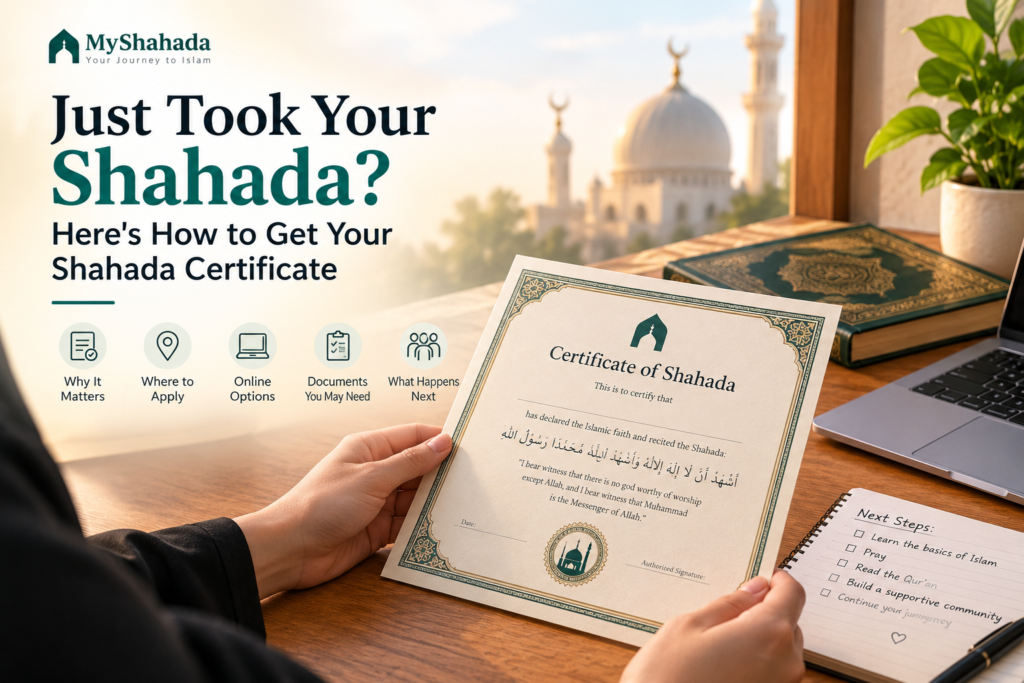
A Shahada certificate is a document issued by a mosque, Islamic center, or another organization to record a person’s declaration of Islamic faith.
The word Shahada refers to the Islamic testimony of faith. It expresses two fundamental beliefs: that Allah alone is worthy of worship and that Prophet Muhammad (peace be upon him) is His Messenger.
The Shahada in Arabic is:
أَشْهَدُ أَنْ لَا إِلَٰهَ إِلَّا اللَّهُ وَأَشْهَدُ أَنَّ مُحَمَّدًا رَسُولُ اللَّهِ
Transliteration:
Ashhadu an la ilaha illa Allah, wa ashhadu anna Muhammadan rasul Allah.
English meaning:
“I bear witness that there is no god worthy of worship except Allah, and I bear witness that Muhammad is the Messenger of Allah.”
A Shahada certificate documents this important declaration according to the issuing organization’s procedures. It may include your name, the date of your Shahada, the organization’s details, and the signatures of an imam or witnesses.
However, there is something every new Muslim should understand: the certificate is not what makes you Muslim. A sincere declaration of faith is not dependent on receiving a document, attending a formal ceremony, or obtaining an official stamp.
The certificate simply provides written documentation that may be useful in certain circumstances.
Why Should You Get a Shahada Certificate?
You might be wondering whether obtaining a certificate is worth the effort, especially if you have already declared your faith.
For many new Muslims, it can be a practical step for several reasons.
1. It Documents Your Declaration of Faith
Your Shahada represents an important moment in your personal and spiritual journey. Having a certificate provides a written record of that occasion.
Some people choose to keep their certificate as a personal keepsake, while others obtain it primarily for administrative purposes.
2. It May Be Useful for Hajj or Umrah
If you hope to perform Hajj or Umrah in the future, you may be asked to provide documentation confirming your Muslim status, depending on the applicable requirements and arrangements.
Some mosques specifically issue Shahada certificates for this purpose. However, requirements can change, so confirm the current documentation rules with the relevant authorities or your authorized travel provider before applying.
3. It Can Help With Certain Religious or Administrative Procedures
A certificate may also be useful when dealing with particular marriage procedures, religious institutions, or other situations where evidence of your declaration of faith is requested.
Acceptance varies by country and organization. A Shahada certificate does not automatically establish legal status or guarantee acceptance for every official purpose.
4. It Can Connect You With a Supportive Community
Obtaining your certificate through a mosque may introduce you to people who can support you as you learn about Islam.
Many Islamic centers offer new Muslim resources, introductory classes, prayer guidance, and opportunities to connect with other Muslims.
This support can be especially valuable during your first weeks and months.
How to Get Your Shahada Certificate After Taking Shahada
If you have recently embraced Islam, here is a practical step-by-step guide to getting your certificate.
Step 1: Find a Mosque or Islamic Center
Start by looking for an established mosque or Islamic center that provides Shahada certificates.
You can search online for a local mosque offering services for new Muslims, ask a trusted Muslim friend for a recommendation, or contact an Islamic organization in your area.
Look for an institution that clearly explains its process and provides reliable contact information.
For example, Cambridge Central Mosque publishes information about its Shahada ceremonies, certificate procedures, and support for new Muslims.
You do not necessarily need to travel to a large mosque. A local Islamic center may be able to help you.
Step 2: Explain That You Have Already Taken Your Shahada
When contacting the mosque, explain that you have already declared your faith and would like to obtain a Shahada certificate.
Tell them when and where you took your Shahada, if you are comfortable doing so, and explain why you need the document.
Some institutions can provide documentation for an existing declaration. Others may ask you to arrange a meeting with an imam or complete their own witnessing procedure.
If you took your Shahada privately or online, mention this honestly. The organization can explain its policy and what options are available to you.
Important: You should not assume that you must repeat your Shahada simply because you do not have a certificate. If an organization requests a formal meeting, ask whether it is for documentation purposes or religious guidance.
Step 3: Ask Which Documents You Need
There is no universal application process for a Shahada certificate. Each institution establishes its own requirements.
Depending on its procedures, you may be asked for:
- Your full name as you want it printed on the certificate.
- A valid form of identification.
- The date you declared your Shahada.
- Contact information.
- Additional details needed for its records.
Some organizations may request witnesses or an appointment with an imam. Others have different arrangements.
Ask for the complete list of requirements before attending an appointment or submitting an online application. This can save you time and help avoid unnecessary trips.
Step 4: Complete the Institution’s Procedure
Once you understand the requirements, follow the mosque’s instructions.
This might involve visiting the mosque, speaking with an imam, completing a form, or participating in a remote appointment.
If you have already taken your Shahada, the meeting may focus on documenting your declaration and discussing the certificate rather than asking you to begin the process again.
For example, Darul Arqam Educational Trust describes a service that supports people embracing Islam and provides a certificate through its process.
Procedures differ between organizations, so use the issuing institution’s own guidance rather than relying on a general online checklist.
Step 5: Check Your Certificate Carefully
Once your Shahada certificate is issued, take a moment to check its details.
Make sure your name is spelled correctly and the recorded date is accurate. Check that the issuing institution is identified and that any required signatures, seals, or verification details are present.
If you need the certificate for a specific application, compare it with the receiving authority’s requirements.
It is much easier to correct an error before you need to submit the document.
Step 6: Keep a Secure Copy
After receiving your certificate, store the original somewhere safe.
You can also keep a clear digital copy for your personal records. Retain the issuing organization’s contact details in case you need a replacement or verification later.
If you plan to use the certificate internationally, check whether a translation, authentication, or other documentation is required.
Your certificate may be important paperwork, so treat it as you would any other document you may need in the future.
Can You Get a Shahada Certificate Online?
Yes, some Islamic organizations offer online registration, remote appointments, or digital Shahada certificates.
For people who live far from a mosque, have limited mobility, or cannot easily attend in person, an online service may be a convenient option.
However, not every organization provides the same service.
Before applying, consider three important questions.
Is the organization established and trustworthy?
Check its official website, contact details, and published procedures. Be cautious about services that make unclear promises or request unnecessary personal information.
What does the application actually provide?
An online form may register your declaration, arrange a conversation with an imam, or initiate a certificate application. These are not necessarily the same thing.
Read the process carefully and ask what you will receive.
Will the certificate be accepted where you need it?
If you need the document for travel, marriage, or another official procedure, contact the receiving authority before applying. A digital certificate from one organization may not meet another institution’s requirements.
You can begin by exploring established organizations such as my shahada, which publishes information about its Shahada registration process.
Never assume that an online service guarantees official acceptance everywhere.
What If You Took Your Shahada Without an Imam or Witnesses?
If you declared the Shahada privately, you may now be wondering whether your declaration counts.
This is an important question, and the distinction between faith and documentation matters here.
According to the guidance published by SeekersGuidance, witnesses are not a condition for the validity of a sincere declaration of faith. However, witnesses or an imam may be involved when documenting the declaration for practical or administrative purposes.
In other words, a certificate process and the declaration of faith itself are two different matters.
If you took your Shahada privately, you can contact a mosque and explain your circumstances. Ask whether it can document your existing declaration and what its procedures require.
You do not need to feel embarrassed about how or where you began your journey. The important thing is to be honest about your circumstances and seek reliable guidance.
What Should You Do After Receiving Your Shahada Certificate?
Receiving your certificate may feel like the completion of one important task. But your journey in Islam continues, and you do not need to figure everything out at once.
Here are a few helpful next steps.
Start Learning How to Pray
Learning the five daily prayers is an important part of establishing your practice as a Muslim.
Begin with the basics and ask a knowledgeable teacher or local mosque for guidance. You do not need to master everything overnight.
Spend Time With the Quran
Explore a translation of the Quran in a language you understand. Read gradually, ask questions, and seek trustworthy explanations when you encounter something unfamiliar.
Give yourself time to understand what you are learning.
Find a Supportive Muslim Community
A welcoming community can help you build friendships, learn about Islamic practices, and find answers to everyday questions.
Some mosques run dedicated programs for new Muslims. Cambridge Central Mosque, for example, provides information about support networks and learning resources for people who have embraced Islam.
Take Your Journey One Step at a Time
You may have questions about prayer, fasting, family relationships, food, clothing, or other aspects of daily life.
You do not need to resolve every question immediately. Learn gradually, seek sound advice, and allow yourself room to grow.
Your Shahada certificate can document an important milestone, but your faith is not defined by a piece of paper.
Final Thoughts
If you have just taken your Shahada, congratulations on reaching an important milestone in your life.
You may feel excited, peaceful, nervous, or full of questions. You may be eager to learn everything about Islam, or you may simply need time to reflect on what this moment means to you.
All of these feelings can be part of a personal journey.
Obtaining a Shahada certificate is often a practical next step. Find a trusted mosque or Islamic center, ask about its requirements, complete the necessary procedure, and keep your document safe.
Frequently Asked Questions About Shahada Certificates
How long does it take to get a Shahada certificate?
The timeframe depends on the organization. Some may issue certificates during an appointment, while others require an application to be reviewed or processed. Ask the issuing institution about its current turnaround time.
Is a Shahada certificate free?
Some mosques provide certificates free of charge, while others may have administrative fees. Contact the organization directly to confirm whether any fee applies.
Can I get a Shahada certificate if I converted years ago?
Possibly. Some institutions may document an existing declaration of faith, while others have specific procedures for issuing certificates. Explain when you took your Shahada and ask what options are available.
Do I need to change my name to receive a Shahada certificate?
Not necessarily. Becoming Muslim does not automatically require you to adopt an Arabic name. Ask the issuing organization what name and identification details it needs and whether any specific requirements apply to your circumstances.
Is a Shahada certificate a legal document?
Not automatically. Its legal or administrative acceptance depends on the country, the issuing institution, and the purpose for which it is used. Confirm the requirements with the relevant authority before relying on it for an official application.
What should I do if I lose my certificate?
Contact the original issuing organization and ask whether it can provide a replacement or confirmation from its records. Its ability to do so depends on its policies and recordkeeping.
Do I need a certificate to be considered Muslim?
No. A certificate is not a prerequisite for becoming Muslim. The Shahada is the declaration of faith; the certificate is documentation that an organization may provide to record it.