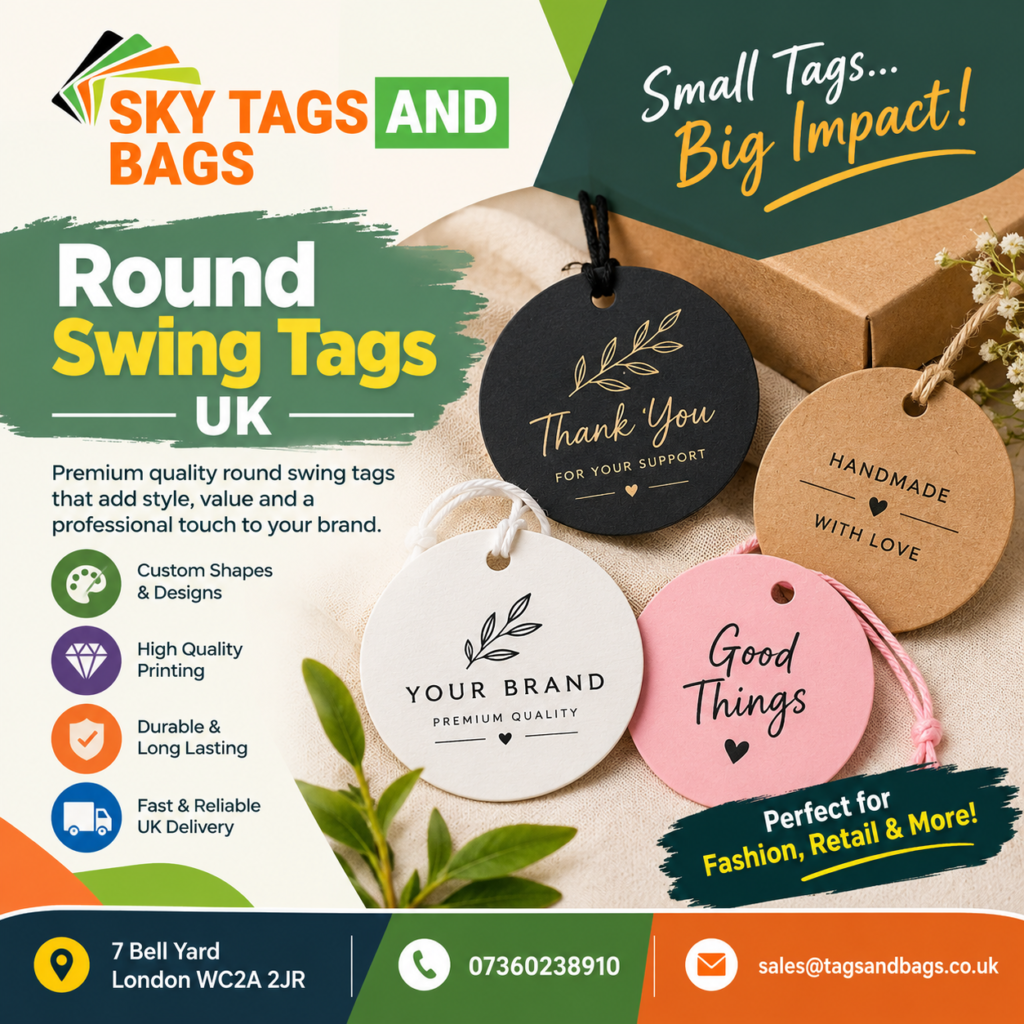
In retail, packaging and product presentation often influence how customers perceive an item before they have even examined it closely. A small, well-designed tag can provide essential information while also contributing to a consistent and recognisable brand identity. This is particularly relevant for clothing, accessories, handmade goods, gifts and boutique products where presentation forms an important part of the customer experience.
Among the many tag formats available, round swing tags UK businesses use can offer a practical combination of visibility, simplicity and design flexibility. Their compact shape works across different product categories, while the printable surface can communicate details such as pricing, sizing, product information or branding.
Why Does Tag Shape Matter in Retail?
The shape of a product tag affects both its appearance and practical use. Traditional rectangular tags remain common, but round swing tags provide a softer and more distinctive alternative.
A circular format can work particularly well for:
- Clothing and fashion accessories
- Handmade and artisan products
- Jewellery and gift items
- Homeware and lifestyle products
- Craft products and small-batch goods
- Boutique and independent retail collections
The absence of sharp corners gives round tags a different visual character. Depending on the typography, paper stock and artwork, they can appear modern, minimal, playful or traditional.
For businesses developing a visual identity, consistency is important. Using the same colours, fonts and logo treatment across swing tags, packaging, labels and other printed materials can make products easier for customers to recognise.
What Information Should Round Swing Tags Include?
A tag has limited space, so information needs to be prioritised carefully. Overloading a small circular surface with text can reduce readability and make the design look crowded.
The information included should depend on the product and the customer’s needs. Common details include:
- Brand name or logo — Helps establish product identity.
- Product name — Useful when several products are displayed together.
- Price — Particularly relevant in physical retail environments.
- Size or variant — Important for clothing and accessories.
- Care or material information — Can provide useful product guidance.
- Website or social media details — May help customers discover the wider brand.
- Short brand message — Suitable when space allows.

A useful approach is to decide what customers need to know immediately and what information can be provided elsewhere. The tag should support the buying experience rather than compete with the product itself.
How Can Businesses Choose the Right Material and Finish?
The material used for swing tags affects their appearance, durability and suitability for different products. Paper and card stocks are widely used because they can accommodate detailed printing while remaining relatively lightweight.
When selecting a tag, businesses should consider:
- Card thickness: Thicker stock can create a more substantial feel.
- Surface finish: Matte finishes can provide a subtle appearance, while other finishes can create more visual impact.
- Printing quality: Clear text and accurate colours are important for professional presentation.
- Attachment method: String, ribbon or other fastening options should suit the product.
- Hole position: Placement should allow the tag to hang naturally without obstructing the product.
For products handled frequently, durability becomes especially important. A tag that bends, tears or becomes difficult to read can negatively affect presentation.

What Are the Common Design Challenges?
Creating round swing tags requires slightly different design thinking from rectangular formats. The curved edge limits the usable space around the perimeter, so important text should generally remain within a safe central area.
Designers should avoid placing essential information too close to the edge. Small text can also become difficult to read when the available surface is limited.
Another common issue is inconsistent branding. If the colours or typography on a tag do not match the wider packaging, the product may appear less cohesive.
A practical design process includes:
- Establishing a clear visual hierarchy.
- Keeping essential information prominent.
- Using readable font sizes.
- Allowing sufficient spacing around text.
- Checking the design at actual printed size.
- Confirming hole placement before production.
- Reviewing artwork for spelling and product details.
It is also sensible to request a proof before producing a large quantity, particularly when a new design or material is being introduced.
Where Do Round Swing Tags Fit Into Modern Retail?
Retailers increasingly use packaging as part of the overall customer experience. As e-commerce and social media continue to influence purchasing decisions, physical presentation can become an important extension of a brand’s online identity.
For independent businesses, handmade brands and boutique retailers, small details can help create a ore considered presentation. A carefully designed tag can provide product information while reinforcing the visual style customers associate with the business.
In the UK market, suppliers such as Tags and Bags provide tag formats that can be considered when developing retail packaging and product identification systems. The appropriate choice ultimately depends on the product, branding requirements, quantity and intended use.

Conclusion
Effective product tags do more than display information. They can support branding, improve product identification and contribute to a consistent retail presentation. Round swing tags UK businesses use are particularly adaptable because their circular format can provide a distinctive appearance across clothing, gifts, accessories, crafts and other retail products.
The most effective approach is to balance design with practical requirements. Clear information, suitable materials, readable typography, accurate printing and appropriate attachment methods all contribute to a useful finished tag.
For businesses reviewing their packaging strategy, the key takeaway is simple: a small tag can have a meaningful role when its design is planned around both the product and the customer.
Contact Us : https://www.tagsandbags.co.uk/contact-us/
About Us : https://www.tagsandbags.co.uk/about-us/
Social Media :
- https://vxengine.ru/blogs/2978/Why-Embossed-Swing-Tags-Add-Value-to-Retail-Packaging
- How Foiled Swing Tags Add Detail and Clarity to Retail Packaging |…
In retail, small packaging details can have a surprisingly important role. A product may have carefully considered…mingolive.com - how-boutique-paper-bags-support-a-stronger-retail-presentation
A well-designed paper bag boutique solution can combine functionality with visual appeal while helping retailers…pencraftednews.com - How Cheap Paper Bags Can Support Cost-Effective Retail Packaging in the UK
Packaging plays an important role in retail, hospitality, events, and e-commerce. For many businesses, the challenge is…qualitymedicalfacilitators.com - How Bulk Kraft Paper Bags Support Practical and Sustainable Retail Packaging
Packaging plays an important role in retail, hospitality, food service, events, and e-commerce. While businesses often…yinutri.com - Paper Carrier Bags UK: Practical Considerations for Retail and Packaging – Free html5 Online Games
Paper carrier bags have become a familiar part of shopping and retail packaging across the United Kingdom. From…kissmegames.com - how-hair-extensions-paper-bags-support-better-retail-packaging-in-the-uk
Hair Extensions Paper Bags are one option that can support these changing requirements. Designed around the needs of…wikinewsportal.com - https://wikinewsportal.com/https-www-tagsandbags-co-uk-paper-carrier-bags-uk/