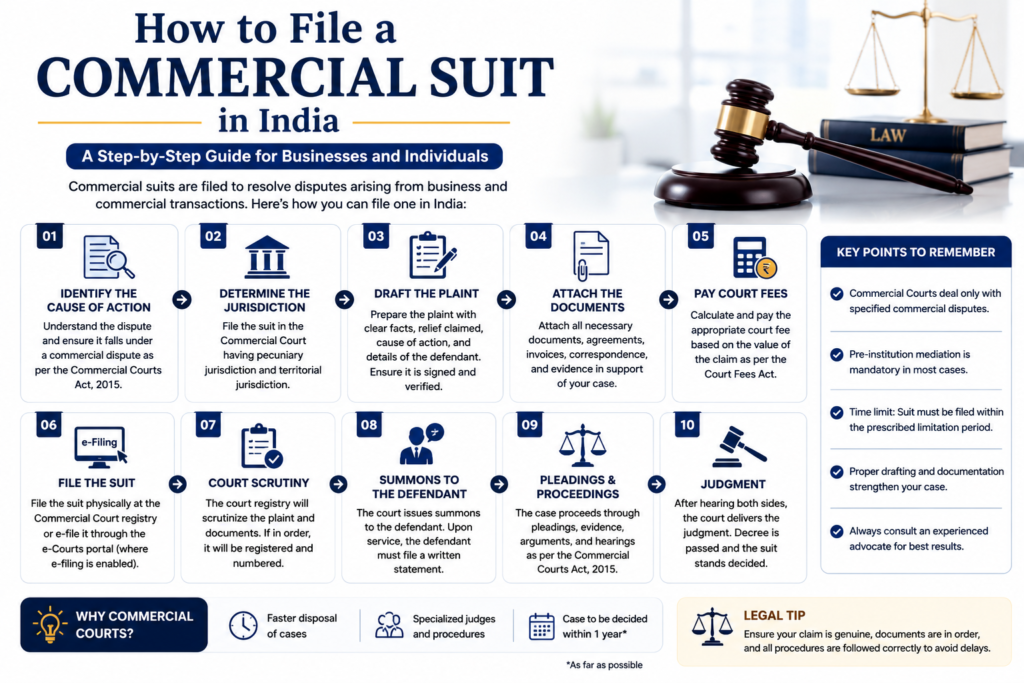
How to File a Commercial Suit in India – Complete Guide
When a business dispute cannot be resolved through negotiation, filing a commercial suit is often the next step. Whether it is a breach of contract, recovery of money, or a partnership dispute, the Commercial Courts Act, 2015 provides a specialized framework for speedy resolution of commercial disputes.
Legal firms like ASV Legal specialize in commercial litigation and can guide businesses through the entire process.
For businesses looking for specialized legal support, a commercial lawyer can help draft pleadings, represent you in court, and ensure your rights are protected.
This guide explains how to file a commercial suit in India, step by step, in simple language.
What is a Commercial Suit?
A commercial suit is a legal proceeding filed before a Commercial Court or a High Court for disputes arising out of commercial transactions. The Commercial Courts Act, 2015 defines a “commercial dispute” broadly to include disputes related to:
- Ordinary transactions of merchants, bankers, and traders
- Export or import of goods or services
- Intellectual property rights
- Agreements relating to immovable property used exclusively in trade or commerce
- Franchise agreements
- Distribution and licensing agreements
- Joint venture agreements
- Shareholder agreements
- Partnership disputes
The Act aims to ensure speedy resolution, with strict timelines for pleadings, discovery, and trial.
When Can You File a Commercial Suit?
You can file a commercial suit if:
- The dispute is a “commercial dispute” as defined under the Commercial Courts Act
- The value of the dispute is ₹3 lakh or more (for suits filed before Commercial Courts)
- No arbitration agreement exists between the parties (or arbitration is not preferred)
The Act applies to suits filed before Commercial Courts at the district level and High Courts with original civil jurisdiction.
Step-by-Step Process to File a Commercial Suit
Step 1: Pre-Litigation Mediation
Before filing a commercial suit, parties are required to attempt mediation under the Commercial Courts Act. This is a mandatory pre-litigation step. The mediation process is time-bound and must be completed within 3 months.
If the mediation succeeds, a settlement agreement is drawn up and the dispute is resolved without court intervention. If it fails, the plaintiff can proceed to file the suit.
Step 2: Drafting the Plaint
The plaint is the main document that initiates the suit. It must contain:
- Details of the plaintiff and defendant
- Facts of the case
- Cause of action (the legal basis for the suit)
- Relief sought (what you want the court to order)
- Valuation of the suit
The plaint must be signed and verified by the plaintiff.
Step 3: Filing the Plaint
The plaint is filed before the Commercial Court or High Court having jurisdiction. The court fee must be paid based on the value of the suit. Once filed, the court issues a summons to the defendant.
Step 4: Written Statement and Counterclaim
The defendant must file a written statement within 30 days from the date of service of summons. This can be extended by up to 90 days in exceptional cases. In the written statement, the defendant responds to the allegations and may also file a counterclaim against the plaintiff.
Step 5: Case Management Hearing
The Commercial Courts Act mandates a Case Management Hearing to set timelines for:
- Completion of pleadings
- Discovery and inspection of documents
- Admission and denial of documents
- Filing of affidavits of evidence
- Written submissions
Step 6: Discovery and Inspection
Both parties exchange relevant documents. Each party can inspect the documents of the other side. This helps in narrowing the issues and preparing for trial.
Step 7: Framing of Issues
Based on the pleadings, the court frames the key issues that need to be decided in the suit.
Step 8: Trial and Evidence
Both parties present their evidence through affidavits and cross-examination of witnesses. The trial is conducted in a time-bound manner as per the Act.
Step 9: Final Arguments and Judgment
After the evidence is complete, both parties make final arguments. The court then delivers its judgment.
Time Limits Under the Commercial Courts Act
The Commercial Courts Act imposes strict timelines to ensure speedy resolution:
| Stage | Time Limit |
| Pre-litigation mediation | 3 months |
| Written statement | 30 days (extendable to 90 days) |
| Replication by plaintiff | 30 days |
| Cross-examination of witnesses | 30 days |
| Final disposal | 12 months (extendable by 6 months) |
The court is required to pronounce judgment within 3 months after the conclusion of arguments.
What are the Costs and Fees?
Filing a commercial suit involves several costs and fees:
- Court fees – Calculated as a percentage of the suit’s value (varies by state)
- Lawyer fees – Professional fees for drafting pleadings and representation
- Expert fees – Fees for expert witnesses (if any)
- Other costs – Discovery costs, process fees, and incidental expenses
The successful party is generally entitled to recover costs from the losing party.
How to Choose the Right Forum
The choice of forum depends on:
Monetary Value: Cases up to ₹3 lakh are filed before the Commercial Court at the district level. Cases above ₹3 lakh can be filed before the High Court exercising commercial jurisdiction.
Subject Matter: Certain types of disputes (e.g., IP, shipping) may have specialized courts.
Jurisdiction: The court must have territorial and pecuniary jurisdiction.
Common Mistakes to Avoid
Not attempting pre-litigation mediation – This is mandatory and can lead to dismissal of the suit.
Filing before the wrong court – Ensure the court has jurisdiction over the subject matter and value.
Not including necessary parties – All necessary parties must be joined in the suit.
Inadequate valuation – Incorrect valuation can affect court fees and jurisdiction.
Missing deadlines – The Commercial Courts Act has strict timelines. Failure to comply can lead to dismissal.
Role of a Commercial Lawyer in Commercial Suits
A skilled commercial lawyer can assist with:
- Advising on the viability of the suit
- Drafting the plaint and other pleadings
- Representing clients in court hearings
- Conducting discovery and cross-examination
- Ensuring compliance with timelines
- Enforcing the court’s judgment
Firms like ASV Legal specialize in commercial litigation and can guide businesses through every stage of the process.
Conclusion
Filing a commercial suit is a structured, time-bound process under the Commercial Courts Act, 2015. It is designed to provide speedy resolution of commercial disputes.
If you are facing a commercial dispute, do not delay. The Act has strict timelines. Act quickly and seek professional legal advice.