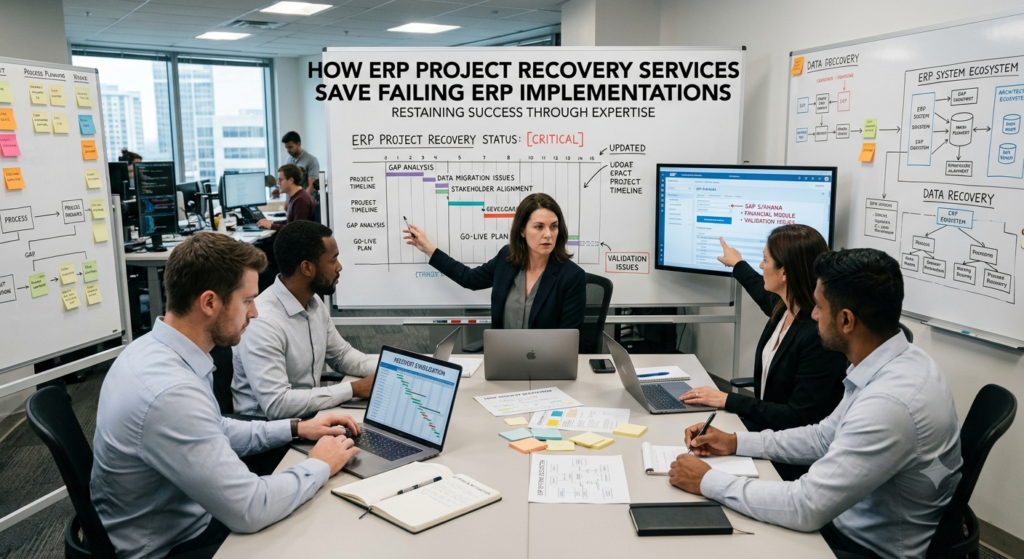
ERP implementation projects are designed to improve efficiency, streamline processes, and provide businesses with a centralized platform for managing operations. However, not every ERP project progresses smoothly. Delayed timelines, budget overruns, poor data migration, inadequate training, integration problems, and unclear project objectives can turn an ERP initiative into a serious business challenge. When these issues continue without effective intervention, the entire implementation may be at risk.
This is where ERP Project Recovery Services can make a significant difference. These services help organizations identify the root causes of implementation problems, establish practical recovery plans, correct technical and operational issues, and bring troubled ERP projects back on track. Instead of abandoning an expensive investment, businesses can use a structured recovery approach to improve project outcomes and protect long-term value.
What Is ERP Project Recovery?
ERP project recovery is a structured process for identifying and resolving problems affecting an ERP implementation. It focuses on understanding why a project is failing and developing a realistic strategy to restore progress.
A troubled ERP project may experience issues such as:
- Missed implementation deadlines
- Increasing project costs
- Poor system performance
- Inaccurate or incomplete data migration
- Integration failures
- Unclear business requirements
- Low employee adoption
- Insufficient testing
- Lack of project governance
- Communication gaps between stakeholders
Recovery specialists evaluate these challenges from both technical and business perspectives. ERP Project Recovery Services help address critical issues systematically, ensuring that the objective is not simply to fix individual errors but to create a sustainable path toward successful ERP adoption.
Why Do ERP Implementations Fail?
Understanding the reasons behind ERP failure is essential before implementing a recovery strategy. Many projects encounter difficulties because of inadequate planning during the early stages.
One common problem is poorly defined requirements. If the ERP system does not align with actual business processes, employees may struggle to use it effectively. Another major concern is unrealistic scheduling. Organizations sometimes underestimate the time required for customization, testing, data migration, training, and deployment.
Data-related issues can also create significant complications. Incomplete, duplicated, or inaccurate information transferred from legacy systems can affect reporting and daily operations. Integration problems may further prevent the ERP platform from communicating properly with existing applications.
Change management is another important factor. Employees who do not understand the benefits of a new system may resist adoption. ERP Project Recovery Services can help businesses address these challenges through effective communication, employee training, and structured change management strategies. Without proper communication and training, even technically successful implementations can fail to deliver expected business value.
How ERP Project Recovery Services Identify Problems
The first step in recovering a troubled implementation is determining what has gone wrong. Professional recovery teams conduct a comprehensive assessment of the existing project.
This assessment may include reviewing:
- Original project objectives
- Current implementation status
- System configuration
- Custom developments
- Data migration processes
- Third-party integrations
- Project documentation
- Testing results
- User feedback
- Budget and timeline performance
The assessment helps stakeholders distinguish between symptoms and root causes. For example, repeated project delays may appear to be a scheduling issue, while the actual problem could be unclear requirements or excessive customization.
A detailed assessment provides the foundation for an effective recovery roadmap.
Creating a Practical Recovery Strategy
Once the primary issues have been identified, recovery specialists develop a structured action plan. The strategy typically prioritizes problems according to their impact on business operations.
Critical issues that prevent the system from functioning correctly are addressed first. Less urgent enhancements can be scheduled for later phases. This prevents teams from becoming overwhelmed by trying to solve every problem simultaneously.
A recovery plan may include revised project milestones, resource allocation, technical corrections, data cleansing, integration improvements, testing schedules, and employee training.
An important part of this process is establishing realistic expectations. ERP Project Recovery Services help organizations set practical goals and prioritize tasks based on project requirements. Instead of promising an unrealistic completion date, recovery experts create achievable milestones that allow the organization to monitor progress.
Resolving Technical and Integration Challenges
Technical problems are often among the most visible signs of a failing ERP implementation. Poorly configured modules, excessive customizations, database problems, and integration failures can affect system reliability.
ERP Project Recovery Services help organizations review their technical architecture and determine which issues require immediate attention. Specialists may optimize configurations, correct custom code, improve integrations, or recommend alternative approaches where the existing design is unsuitable.
Integration recovery is particularly important for businesses that rely on multiple applications. ERP systems may need to exchange information with payment platforms, e-commerce applications, CRM systems, warehouse tools, payroll software, or other business solutions.
A properly structured integration strategy helps ensure that information moves accurately between systems and reduces manual data entry.
Improving Data Migration and Quality
Data migration is another area where ERP projects frequently experience problems. Moving information from an older system into a new ERP platform requires careful planning and validation.
Recovery teams can examine existing migration processes and identify issues such as duplicate records, incorrect formats, missing information, or inconsistent master data. Data can then be cleaned, transformed, mapped, and validated before another migration attempt.
Reliable data is essential because ERP systems connect multiple business functions. Incorrect customer, supplier, product, inventory, or financial information can create problems across several departments.
By improving data quality, recovery specialists help establish a stronger foundation for the ERP environment.
Strengthening Testing and User Acceptance
Insufficient testing can cause serious problems after an ERP system goes live. Businesses may discover unexpected errors only when employees begin using the platform in real-world situations.
A recovery strategy therefore places strong emphasis on testing. Functional testing, integration testing, performance testing, security checks, and user acceptance testing can help identify problems before deployment.
Employees from relevant departments should participate in user acceptance testing because they understand practical workflows better than technical teams alone. Their feedback can reveal usability problems, missing functionality, and process gaps.
This collaborative approach improves confidence in the system and helps reduce disruptions during go-live.
Supporting Employees Through Change
Technology alone cannot guarantee ERP success. Employees must understand how the new system affects their responsibilities and daily workflows.
Recovery projects often include additional training and change management initiatives. Training programs can be organized around specific roles and business processes rather than focusing only on software features.
Organizations can also provide documentation, demonstrations, workshops, and ongoing support. When employees receive appropriate guidance, they are more likely to adopt the ERP system and use it correctly.
Businesses seeking experienced ERP support can also evaluate providers such as Browseinfo to understand how professional ERP expertise can contribute to implementation and recovery initiatives.
Controlling Costs and Project Scope
A failing ERP project can quickly become expensive. Additional customization, repeated development, extended consulting engagements, and delayed deployment may increase costs significantly.
Recovery specialists help organizations examine where resources are being spent and determine which activities provide the greatest business value. Unnecessary customizations or low-priority features may be postponed or removed.
Scope management is particularly important. A recovery project should focus on essential business requirements rather than continuously adding new features.
By establishing clear priorities, organizations can make better use of available budgets and resources.
Establishing Better Project Governance
Weak governance can allow ERP problems to continue unnoticed. Effective governance creates clear responsibility, accountability, and communication among stakeholders.
A recovery framework can introduce regular project reviews, progress reports, issue tracking, risk assessments, and defined decision-making responsibilities. Management teams can then identify problems earlier and take corrective action.
Benefits of ERP Project Recovery
A structured recovery approach can deliver several benefits, including:
- Reduced implementation delays
- Better control over project costs
- Improved system performance
- Higher data accuracy
- More reliable integrations
- Stronger employee adoption
- Reduced operational disruption
- Clearer project accountability
- Better alignment between technology and business objectives
Most importantly, recovery allows businesses to protect the investment they have already made in their ERP platform.
How to Choose the Right Recovery Partner
Selecting the right recovery partner is an important decision. Businesses should evaluate a provider’s ERP expertise, technical capabilities, project management experience, and understanding of their industry.
A suitable provider should begin with an objective assessment rather than immediately recommending expensive changes. Transparency is equally important. The organization should receive clear information about identified problems, proposed solutions, expected timelines, and potential costs.
Businesses should also consider communication practices, post-recovery support, customization expertise, integration capabilities, and experience with similar ERP environments.
The right partner should work collaboratively with internal teams and leverage ERP Project Recovery Services to focus on sustainable improvements rather than temporary fixes.
Conclusion
A troubled ERP implementation does not necessarily mean the project has to be abandoned. With the right strategy, organizations can identify underlying problems, correct technical and operational weaknesses, improve data quality, strengthen employee adoption, and establish realistic project goals.
ERP Project Recovery Services provide a structured way to transform a struggling implementation into a more manageable and successful initiative. From project assessment and technical troubleshooting to data migration, testing, training, and governance, recovery specialists address the factors that influence ERP success.
For businesses facing delays, rising costs, system issues, or low user adoption, timely intervention can protect their ERP investment and create a stronger foundation for future growth. The key is to identify problems early, prioritize critical improvements, and work with experienced professionals who understand both technology and business processes.
FAQs
1. What are ERP Project Recovery Services?
ERP Project Recovery Services are professional solutions designed to identify and resolve problems affecting troubled ERP implementations. They may cover project assessment, technical corrections, data migration, integrations, testing, training, and project governance.
2. When should a business consider ERP project recovery?
Businesses should consider recovery when an ERP implementation experiences repeated delays, budget overruns, technical failures, poor user adoption, data problems, or significant gaps between the system and business requirements.
3. Can a failing ERP implementation be saved?
Yes. Many troubled implementations can be improved when the root causes are identified and addressed systematically. The appropriate recovery strategy depends on the project’s technical condition, business requirements, available resources, and implementation stage.
4. How long does ERP project recovery take?
The timeline varies according to the complexity and condition of the ERP project. A small implementation with limited issues may require relatively little recovery work, while a highly customized enterprise project with data and integration problems may require a longer recovery program.
5. What should businesses look for in an ERP recovery provider?
Businesses should evaluate ERP expertise, technical knowledge, project management capabilities, integration experience, data migration skills, communication practices, and previous experience with complex or troubled implementations. A provider should also offer a transparent recovery roadmap with measurable objectives.