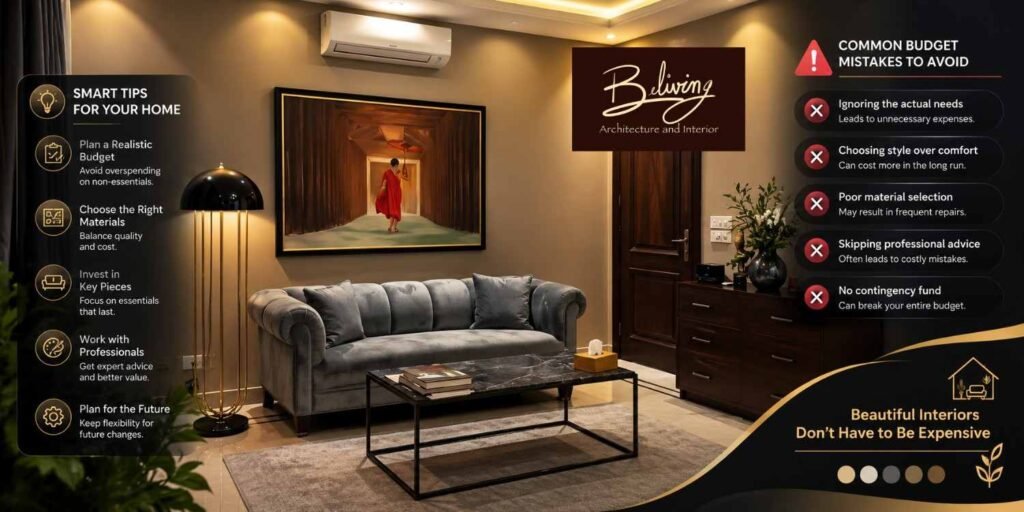
A Home Interior Designer in Delhi NCR can help create a functional, pleasant, and comfortable living space at an affordable cost. But most interior projects become costly due to lack of requirements, underestimation of material costs, constant change of the interior design and poor execution planning.
In 2026, homeowners in Delhi, Noida, Gurugram, Faridabad, and Ghaziabad should think beyond the furnishings and decorations. Changes in electricals, modular systems, kitchen fittings, manpower, logistics, installation and contingency budget may all affect your final cost for the project.
With Beliving Interior you can plan interior design with consideration of your lifestyle, aesthetics, functionality, and project management. Knowledge about some typical budgeting blunders will allow you to evaluate quotations and design choices.
Learn more about realistic planning cost, execution process, local peculiarities, and cost-saving tips in this article.
1. The Biggest Home Interior Budget Mistakes to Avoid
The most prevalent error that people make is not determining the scope of work in advance at the beginning of the task. It could be that the quotation includes kitchens and cupboards and does not include other things like appliances, furniture, curtains, ornamental lighting, or any modifications in the wiring.
When looking for a competent Home Interior Designer in Delhi NCR one must first determine the scope of the work before starting to order anything. This is where Beliving Interior comes in.
Mistake 1: Choosing a Designer Based Only on the Lowest Quote
While initially a low quote might seem more appealing, this may turn out to be costly in case some basic tasks have been left out, or the materials used and their quality are not clearly defined.
For instance, someone living in Greater Noida may end up receiving two quotes where in one case, there are lofts of wardrobes as well as kitchen accessories and nothing of the sort in the other.
Mistake 2: Spending Too Much on Decorative Features
Wall panelling, false ceiling, superior finishing, and lighting can all help enhance the look of your space. But spending a lot on these things without first sorting out your storage, ventilation, electrical issues, and comfort can cause practical issues.
Start with things that are hard or costly to change later, like your kitchen layout, electricity, plumbing, and storage solutions. Then add the decorative touches where appropriate.
Mistake 3: Ignoring Hidden and Additional Expenses
Interior budgets often neglect the costs associated with demolition, clearing of debris, surfacing, loading fees, social permissions, elevator protection, and installation adjustments. Builder’s floors in South Delhi may also need extra electrical or plumbing installations after old flooring is stripped away.
Set aside contingency funds equal to about 10-15% of the projected cost of the project. This is a budgeting guideline, not an obligation, and it depends on the state of the property.
Mistake 4: Changing Designs During Execution
Altering the dimensions of the wardrobe after manufacturing has begun or moving kitchen appliances after electrical installation has been completed may result in wastage of materials, delays, and additional costs of labor.
Confirm drawings, measurements, material samples, appliance dimensions, and storage needs prior to commencing manufacturing. Document any changes thereafter in writing, along with its cost and impact on the delivery schedule.
2. Realistic Home Interior Design Costs in Delhi NCR for 2026
Costs of interior depend on the size of the carpet, quality of materials used, customization needed, site conditions, and number of rooms to be fitted. The below figures should give you an indicative estimate for the Delhi NCR region, not fixed market prices.
Indicative project budgets for 2026
1 BHK home
Essential interiors and selected storage
₹3.5–7 lakh
2 BHK home
Kitchen, wardrobes and selected living-room work
₹6–15 lakh
3 BHK home
Multiple bedrooms, kitchen and common areas
₹10–25 lakh
Such costs will vary over a wide spectrum for the extent and type of interior scope. High-end custom furnishings, civil work, high-end finishes, appliances, and loose furniture can significantly raise the cost.
What Determines the Final Cost?
Material selection: Standard laminates are usually cheaper than premium acrylic, veneer or polyurethane finishes. The core material, moisture resistance, edge treatment and hardware will have an impact on durability and price.
Carpentry and storage: Wardrobe systems that reach the full height of the wall, loft cabinets, hydraulic beds, hidden storage spaces and custom-built entertainment units all involve different amounts of materials and labor. Proper dimensions can help increase storage without overspending.
Lighting and ceiling: Simple lighting designs usually prove to be cheaper than complex false ceilings with cove lighting and decorative fixtures. Lighting design should revolve around the real needs of the space, not just aesthetics.
Execution and site considerations: The availability of delivery, labor, renovation needs, building regulations and the number of contractors can affect the price and schedule of the project.
How to Allocate Your Budget More Effectively
Do not distribute money equally in all the rooms; instead, focus on areas that are frequently used and infrastructure. The most effective way would be to plan on kitchen, wardrobe, electricity needs, and other major furniture items first and then use the remaining budget for finishes.
Use these budgeting principles:
- Ensure important expenses: Set aside money for kitchen function, quality storage, electrical safety, and repairs prior to making aesthetic enhancements.
- Consider full quotes: Compare materials, hardware, measurements, installation, taxes, exclusions, and payments on the same terms.
- Set aside contingency money: Do not spend all your budget on the initial plan because unforeseen site conditions might affect the plan.
3. How to Control Modular Kitchen and Wardrobe Costs
The kitchen and wardrobe may eat up a substantial amount of the budget since they consist of cabinetry, fixtures, finishing, and fitting. The design must be made according to requirements and not based on how many accessories can be found in a catalog.
Plan a Functional Kitchen Before Selecting Finishes
Identify the positions of the sink, cooktop, fridge, cooking accessories, and often used cooking tools first. Your layout must have enough space for ease of movement from the preparation zone to washing and cooking zones.
An efficient design of L-shaped kitchen may be adequate in a small flat in Noida Extension to accommodate all counter surfaces without installing any extra tall cabinets. A spacious kitchen in Gurugram will do well with a pantry or extra cabinets as needed.
Cabinets that fit your budget and purposeful in specific places in the kitchen should be chosen. Countertops, hinges, drawer system, hardware, installation fees and so on need to be confirmed in the quote.
Design Wardrobes Around Daily Use
The interior of the wardrobe has to consider all the clothes, baggage, accessories, and seasonable items of the house. Shelves, hanging area, drawers, and loft might help organize space better than an elaborate exterior design.
Consider the wall space and the height of the ceilings before choosing hinged or sliding shutters. Hinged shutters might be easier to keep maintained, while sliding might come in handy if space for bedroom circulation is restricted.
Save yourself from spending money on internal accessories which are hardly going to get used. An efficiently organized wardrobe with proper shelving and hanging area can prove far more beneficial.
4. How to Choose the Right Designer for Your Home
Selecting an interior designer is not simply about looking at attractive pictures in their portfolio. One needs to look at the planning skills, communication skills, material specifications, execution arrangement, and explanation of costs associated with the project while comparing Residential Interior Designers in Delhi. Request for a project that is of the same scale, budget, and design requirement as yours. A designer who is well versed with designing small apartments will have a different perspective from someone who designs big independent houses.
Questions to Ask Before Signing an Agreement
Confirm who prepares the drawings, coordinates contractors, supervises installation, and approves material substitutions. Ask how progress will be documented and how delays or variations will be handled.
Also clarify the difference between design-only services and turnkey execution. Design-only work may cover layouts and specifications, while turnkey arrangements can include procurement, site coordination, installation, and handover, depending on the signed agreement.
Beliving Interior’s suitability for your project should be assessed through the actual scope offered, documented deliverables, quotation, and execution responsibilities. Do not assume that any package includes services unless they are explicitly listed.
5. The End-to-End Interior Design and Execution Process
A structured process helps prevent unnecessary revisions and keeps decisions aligned with the approved budget. Although the exact sequence depends on the property and project scope, most residential interiors follow these stages.
Stage 1: Consultation and Site Assessment
The process begins with understanding the household’s lifestyle, preferred aesthetic, storage needs, family size, and budget. The designer measures the property and identifies existing constraints such as columns, plumbing lines, electrical points, and natural light.
For a builder-floor renovation in South Delhi, the assessment may also identify uneven walls, ageing wiring, or limited access for transporting large furniture. Discovering these issues early is generally easier than addressing them after installation begins.
Stage 2: Space Planning and Design Development
The designer prepares layouts for furniture placement, circulation, storage, and key functional areas. Depending on the agreed service, this stage may include 2D drawings, 3D visualizations, elevations, and material selections.
Review the proposed layout against everyday routines. Check door clearances, wardrobe access, appliance dimensions, socket locations, and whether the furniture leaves enough room to move comfortably.
Stage 3: Detailed Quotation and Material Approval
Once the design direction is agreed upon, obtain an itemized quotation with quantities, specifications, labour, and exclusions. Confirm whether the price includes transportation, installation, taxes, design fees, and any civil or electrical work.
Approve physical material samples where practical. Two finishes that look similar on a screen can differ in texture, sheen, maintenance requirements, and actual appearance under the home’s lighting.
Stage 4: Procurement and Site Execution
Execution may involve civil repairs, plumbing and electrical modifications, ceiling work, painting, cabinetry, countertop installation, lighting, and furniture placement. The order matters because completing decorative finishes before dusty or disruptive work can lead to avoidable damage.
In occupied residential buildings across Delhi NCR, coordinate deliveries and noisy work with building management where required. Confirm access rules, working hours, lift protection, and debris disposal arrangements before work starts.
Stage 5: Inspection and Handover
Before making the final payment, inspect cabinet alignment, drawer operation, hinges, edge finishes, electrical fittings, paintwork, and plumbing connections within the agreed scope. Record incomplete items and defects in a written snag list.
Collect applicable warranties, maintenance instructions, final drawings, and invoices. A documented handover provides clarity about what was installed and which party is responsible for outstanding work.
6. Budget-Friendly Design Decisions for Different Delhi NCR Homes
Local housing requirements may dictate how the budget should be spent. There may be variations even among a small flat, a builder’s traditional floor and large villa even if the owner’s taste is the same.
Compact Apartments in Noida and Greater Noida
Focus on vertical storage, furniture in scale and movement through the space. Sliding wardrobe doors, multi-purpose furniture and efficient kitchen cabinets can help in utilizing the floor space effectively.
It is better not to cover all walls with cupboards. Keeping some walls without any cupboard can help in avoiding the crowded look and reduce cost too.
Builder Floors in South Delhi
Some of the older buildings may need repair works before decoration. This includes checking for electrical wiring, plumbing, wall finishes, windows, and floors. When looking for such interior designs in South Delhi, one should check whether they have the capability of coordinating the repairs in addition to their designs.
This means that an Interior Design Company in South Delhi should be able to undertake this kind of job.
Family Apartments in Gurugram and Faridabad
Some features include durable laminates, convenient storage, clean finishes, and practical bedroom designs. If there are children or elderly persons in the household, then stability, safety of electrical outlets, and clear space are some of the things to consider.
It is not necessary to spend money on every current design trend but rather invest in those elements which will be used daily. It would be much easier to update with new decorations later on.
7. A Practical Budget Discussion With Beliving Interior
This is an example of a discussion that may take place between homeowners and designers in order to set priorities before approval. This is just an example, and no claim is made about any specific case of a client-designer relationship.
Client: We want a comfortable 2 BHK house, but we do not want to go beyond the limits for interior designing.
Designer: It would be good if we knew about your storage needs, kitchen requirements, and furniture requirements first before taking any decisions regarding the finishes.
Client: Will a Home Interior Designer in Delhi NCR help us maintain our budget?
Designer: Beliving Interior Design can be considered on the basis of your budget, detailed costs, and work schedule.
The lesson here is to consider the budget and requirements first. It becomes easy to assess changes to the design once the cost and purpose of each change is known.
8. When Should You Hire an Interior Design Company in South Delhi?
In case you are a proud owner of a builder floor or an apartment in South Delhi, employing an Interior Design Company in South Delhi may prove helpful when dealing with a number of inter-related decisions regarding furniture, lighting, material, storage, etc.
Before employing a company, ask them to provide you with a written scope of work, a detailed estimate, a realistic time frame and the information about the individual who will be supervising the site. Base your decision making on the deliverables and materials to be used and not on package deals only.
Beliving Interior should be taken into consideration if the services offered by them suit your home needs and the amount of assistance that you are going to receive from them.
Summary
Interior budget mistakes can be avoided through well-thought-out priorities, proper measuring, realistic cost estimates, and documentation. House owners from all over Delhi NCR will be able to maximize their budgets by focusing on functionality before beautification.
Prior to engaging the services of an interior designer, one should have compared full quotes, set aside a contingency fund, approve materials in advance, and thoroughly check the end product. Beliving Interior can then be evaluated as a possible collaboration for the design of a house that is practical as well as beautiful.
Some Important Questions
1. How much does a home interior designer cost in Delhi NCR in 2026?
This will be based on the size of the property, complexity of design, material used, and the extent of work to be done. For general planning purposes, a one-bedroom house will cost around ₹3.5–7 lakh, a two-bedroom ₹6–15 lakh, and a three-bedroom ₹10–25 lakh. Premium projects will have higher costs; get a quotation for your specific property.
2. What is the biggest interior design budgeting mistake?
The greatest blunder would be to approve such projects without knowing about the entire scope and what is not included in the scope. Ignoring costs related to electrical works, appliances, delivery, installation, and movable furniture may exceed the total amount from the budget.
3. How much contingency should I keep for home interiors?
As an estimate for the contingency budget, having around 10-15 percent of the total cost of the project would be a good beginning. In cases where the property is older or in cases of extensive renovations, more can be allocated.
4. How can I compare residential interior designers in Delhi?
Compare portfolio, quotes, materials, execution, payments, and warranty. Request each of the designers to quote on the same scope so that you may be able to see the real difference in price and service.
5. What should I check before hiring Beliving Interior?
Discuss the issues of budget, design, timing, and services required. Ask for an itemized quote and ensure that you know the person(s) in charge of executing the site work, among other considerations prior to any signed contract.
About us –
Official No. – +91 9871678798