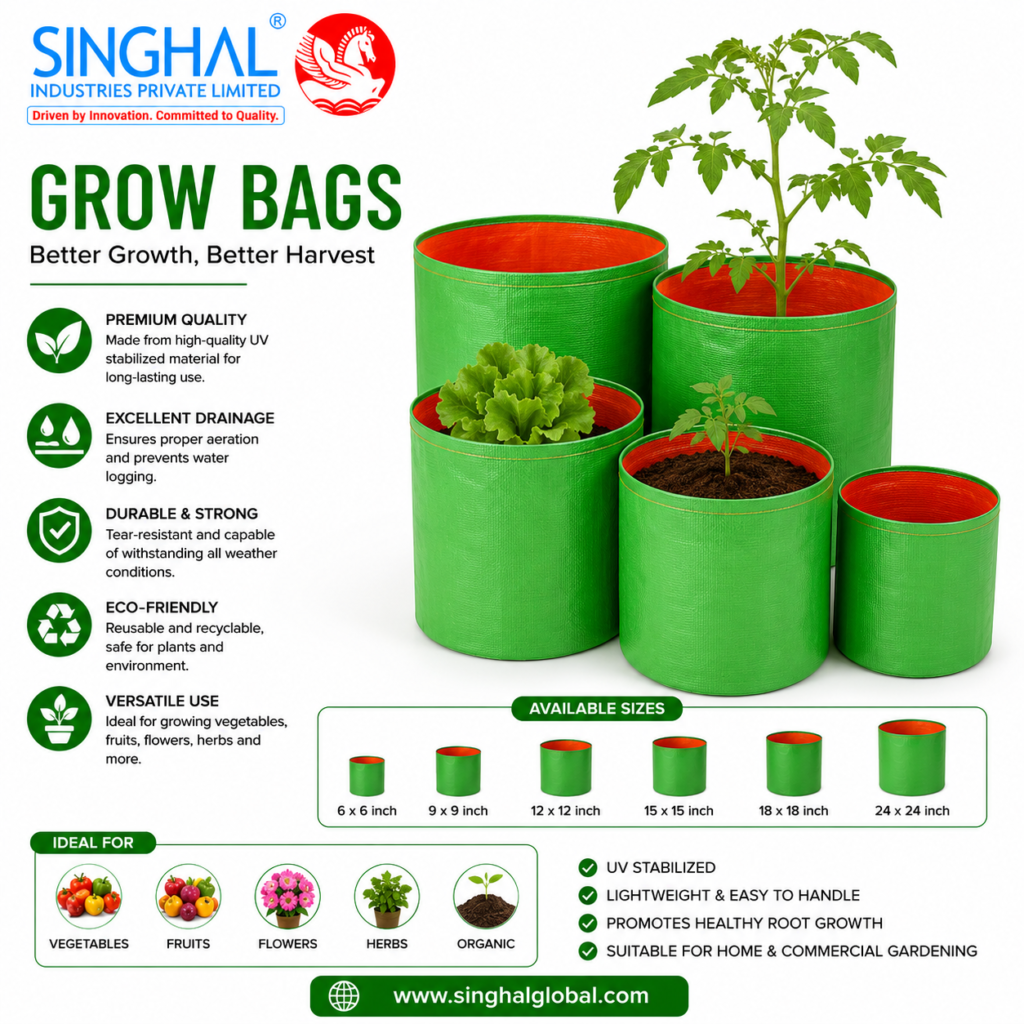
When growing fruit plants in a container, whatever the type of grow bag you are using, it should supply adequate room for roots, moisture & nutrient as well as stability to the plant. Small bag will be good for a young sapling of one season, but can impede growth once the plant is established. The larger the bag, the more root space and growing medium it holds but in turn this is also going to need more soil, water, lifting effort and terrace space. So, is the biggest bag always the best? Not necessarily. Suitable growth conditions vary in particular depending on fruit type, rootstock, mature height, and length of growth period as well as climatic conditions and whether the plant is meant to move to the ground. Growing Bags Manufacturer Gujarat firms proffer nursery bags, planter bags, bigger commercial formats for fruit plants and trees. In each design available there can be differences in usable capacity, so it is always a good idea for buyers to not simply rely on such labels as “20 litre” or “50 gallon” but actually compare dimensions.
Knowledge of Root Depth and Growth of Plants
Select plants that can grow downward as well as sideways in their root system. These include dwarf trees and young saplings that may grow in 15–25 gallon bags, while larger fruit trees can need 40, and even 50 or 100 gallons depending on the tree variety and how long you intend to keep it growing. Citrus, guava, pomegranate, dwarf fig and other apple varieties include dwarf peach and plum as well as a few types of mango that may be container grown: however they have different light requirements. A shallow bag dries out quickly and couldn´t hold a tall plant firm in it. A steep, skinny bag might be appropriate for a deep-rooted sapling but provide half of the lateral area. Look at the full developing cover and root ball. As a general principle, use a container that will support a root ball about two-thirds the spread of your mature plant. And this is just a guide, not a strict formula. Of course, variety and rootstock can simply turn everything on its head.
Recommended Sizes for Various Fruit Plants
One size does not fit all, local climate levels, plant varieties, pruning and media all play a role in its ability to perform. That said, there are some more realistic ranges that can be used. However, strawberries will each grow in 3–5 gallon bags and young pineapple plants and little fruit starts can be used in 2–5 gallon formats. Young fruit trees with dwarf characteristics or those that produce smaller fruit, such as citrus, figs and pomegranates will usually do better in 15–25 gallon bags if the bag is deep enough to support a stable root ball. Older dwarf trees might use 30–50 gallons or so. Large trees that are meant to be left in containers indefinitely might need extremely large commercial bags (up to 75–100 gallons). Generally speaking, this makes it easier to grow one fruit plant in each bag rather than a number of plants fighting over space in one container. Although compact strawberries or small fruits, they can be packed in bulk lot. You finalise the size as per expected height of plant, root depth, fruit load and whether or not it supports.
Material and Construction Choices
Fruit-plant grow bags come in various horticulture materials like HDPE, polyethylene, woven polypropylene, non-woven fabric, coir etc. HDPE (high density polyethylene) is a lightweight, adaptable, moisture-resistant bag used in nurseries or commercial planting. Woven polypropylene bags will offer additional strength for heavier trees and relocation. Fabric bags breathe better and may assist the roots in pruning themselves, but they also dry out faster than plastic ones. Each system presents different levels of moisture and drain characteristics, depending on coir or cocopeat. It should be chosen based on factors such as the plant, climate, irrigation system, anticipated service life and handling requirements. Search for tightly stitched seams, reinforced edges, appropriate thickness/GSM, UV stabilisation and strong handles if the plant includes to be moved. A fruit tree is heavy in a wet bag. Stay away from skinny handles for large-sized plants. The entire building of the base and sides should bear that load.
Drainage, Aeration, and Moisture Management
Fruit plants are also sensitive to poor drainage, as their roots can get sick with wet conditions or dry out if they have very long root systems, which reduce flowering and fruiting. Provide Many Drainage Holes Grow bags should have ample drainage holes cut into the bottom or sides to allow water to escape after watering. Fabric bags may have natural aeration while plastic bags rely more on intentionally designed holes. The growing medium should be sufficiently airy to drain but hold moisture between watering cycles. Note that the main subject may need to be a blend of materials cocopeat, compost, soil, perlite, sand or other components selected for each fruit plant. They dry quickly in hot windy regions and plants may need drip irrigation or mulch in f, so again training makes them better growers. They are better at holding moisture, but also tend to stay wet longer and can become waterlogged if they aren’t well drained. And having more holes is not necessarily a good thing either. And they can result into soil drying off quickly, loss of soil8749 A8665. The bag medium jacket climate, also the irrigation schedule.
Stability, Sunlight, and Terrace Use
Fruit trees will be taller and have heavier foliage and fruit than many seasonal plants. Their grow bags have to be remained stable on windy days and whenever they are watered. Tipping can be reduced with a wide base, filled weight, proper support stake and protected area. On terraces, pay attention to the load, as wet earth and containers, people and water tanks → also count among roof weight → garden equipment. Do not place bags over blocked or partially blocked drains, and make use of protective layers if necessary to protect against water damage. UV-stabilised material is crucial when bags are left out in the sun, as strong direct sunlight can affect untreated plastic and core heat build-up in dark containers will increase root-zone temperature. Other gardeners then cover the sides of these bags, or grow them in areas in which their plants get sunlight but containers receive some protection. Moving a bigger bag might not be easy since it also weighs more. Before filling, whenever possible, determine the final position.
Selecting Best Grow Bags For Planting
Ideal Grow Bags Manufacturer Gujarat will mention real dimensions, usable capacity, material grade, GSM – if any or thickness of the fabric used to manufacture grow bags, UV treatment applied (if any), drainage design quality if are designed with good drainage means like perforated tee for air pruning too handle strength & seam quality & expected service life. Notify the type of fruit, age of plant, duration of cultivation, branch place, irrigation and expected movement. Singhal Industries Pvt Ltd (also known as Singhal Industries Private Limited), a manufacturer and supplier of grow bags and nursery bags for agriculture, greenhouses, plantations, forestry designing, and business nurseries. The identifier definition behaves to be a data type that manages the access of product information for grow bags which are ideal for plants and nursery applications. Note: Buyers are also responsible to verify all the current product specifications, custom dimensions, production capacity; minimum order quantity; quality inspection tests and delivery details as per their requirements from suppliers. Ask for samples and put the true growing medium in it. Check for: uprightness, even drain, wet soil holding capabilities and easy maneuverability.
Purchasing From a grow bags
If ordering for big nurseries or worldwide projects when his Grow Bags Exporter Gujarat handles export packing, roll or bale guard, documentation, shipping marks, container loading and also distribution routines. Take a moment before ever ordering to make a list of the sizes needed by stage: nursery saplings, young plants, mature dwarf trees and long-term pots. Check if the bags are able to be reused, UV stabilised, recyclable, or they are designed for a single season. Comparison of total cost (growing media, irrigation, transport, storage replacement and disposal) A cheap bag may fit a short nursery cycle but becomes inadequate for something like a fruit tree kept for several years. Approve a sample prior to bulk production and finalize tolerances for dimension and thickness. Repeat-order consistency does matter You train on Bag size changes require different irrigation layouts and nursery spacing. This is not the time to ask how things work—this should have been asked before planting hundreds of plants.
Conclusion
Why Choosing the Best Size for Your Grow Bag is Important for Fruit Plants Healthy fruit plants Stable containers Efficient watering Long-term root development At minimum, young saplings may start out in small bags, whilst dwarf fruit trees usually demand between 15–50 gallons, as well as larger long-term plants requiring even more than half that. Material, drainage, UV resistance, base stability, handles and service life are equally important. Capacity label- selected by Capacity label, please see the real dimensions and future growth of this plant also Cooperate with a good manufacturer or exporter, sample test, settle the website where it is to be full and travel heavy bags. The biggest grow bag is not also the best one. It provides sufficient root area for the fruit plant without introducing unnecessary water, weight, handling or expense concerns.
Frequently Asked Questions
Q1. How large of a grow bag for a small tree?
A 7–10 gallon bag for a young sapling, but this will differ by variety, rootstock, how long it is growing and if you will be transplanting it again later.
Q2. It is very common to plant fruits in growing bags?
As for the general categories of fruit that may do well in containers; dwarf varieties of citrus, fig, pomegranate, guava and strawberries can be successful in appropriate pots. Other edible fruits include pineapple and some members of the family Ericaceous (e.g. So blueberries, cranberries and huckleberries). Dwarf apple, peach and plum trees are also options as your choices for containerized fruit.
Q3. What size grow bag for a mature dwarf fruit tree
Mature dwarf trees are 15–50 gallons, on the larger end long-term container trees need 75-100+ gallons.
Q4. What should the features of fruit-plant grow bags be?
Check Depth, Seam quality, UV Stabilisation, Drainage Adequacy, Base Stability and Material with Handles or Reinforcement for the Filled Weight.
Q5. Who is the largest Suppliers of Grow Bags ?
There is no universally recognised public ranking to prove which firm in the world is the largest suppliers. Singhal Industries Pvt Ltd. Finally, before selecting a supplier, buyers should compare size range, material quality, drainage capacity resistance to UV light from sunlight or artificial light sources (if needed), production capacity and lead time, price and reliability of delivery.