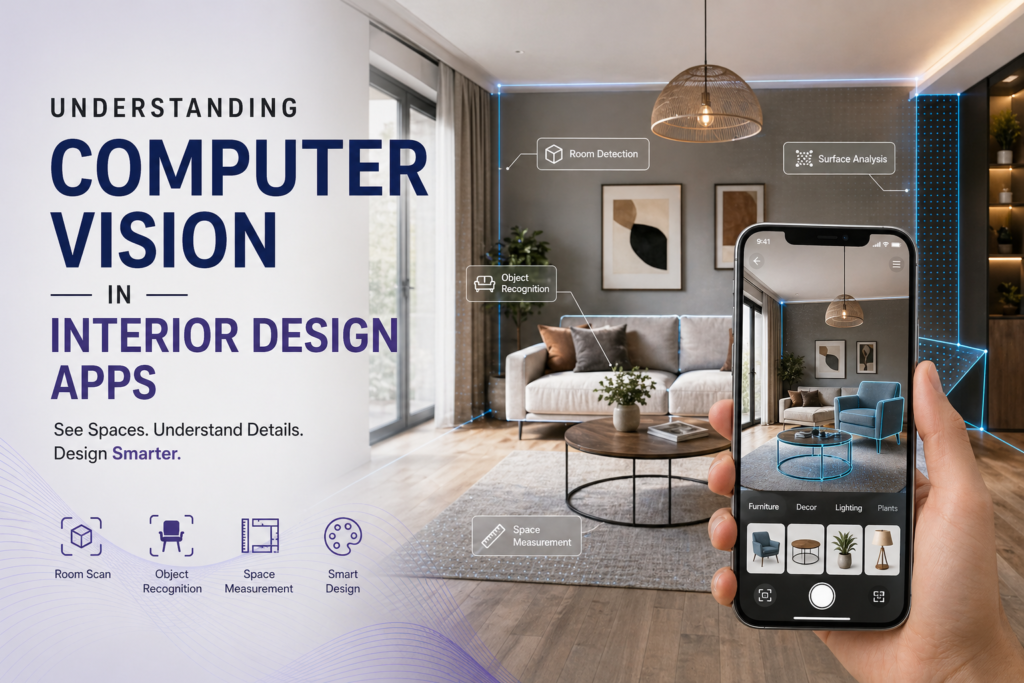
Designing a space has always been a mix of imagination, experience, and trial-and-error. But today, that process is undergoing a quiet revolution. With the rise of computer vision, interior design apps are no longer just digital catalogs, they’re becoming intelligent assistants that can see, interpret, and transform spaces in real time.
The challenge many homeowners, designers, and real estate professionals face is simple: visualizing how a space will look before making costly decisions. Traditional tools often fall short, relying heavily on manual inputs or static templates. This is where computer vision steps in, enabling apps to understand room dimensions, detect objects, and suggest design improvements with remarkable accuracy.
In this blog, you’ll explore how computer vision works within interior design apps, why it’s becoming essential in modern design workflows, and how businesses can leverage it to build smarter, more intuitive platforms. Whether you’re a product owner, developer, or entrepreneur exploring AI interior design app development, this guide will give you the clarity and strategic insight you need.
What Is Computer Vision and Why It Matters in Interior Design Apps
At its core, computer vision is a branch of artificial intelligence that enables machines to interpret and understand visual data from the real world. In the context of interior design apps, it allows software to analyze images or live camera feeds and extract meaningful information, such as room layout, furniture placement, lighting conditions, and spatial dimensions.
What makes this technology particularly powerful is its ability to bridge the gap between imagination and visualization. Instead of asking users to manually input room sizes or guess placements, computer vision can automatically map a space using a smartphone camera. This reduces friction and significantly improves user experience.
More importantly, computer vision introduces a level of personalization that wasn’t possible before. By analyzing user preferences, existing décor, and spatial constraints, apps can offer highly relevant design suggestions. This not only enhances creativity but also builds trust, as users can see realistic previews before committing to any changes.
The growing demand for immersive and accurate design tools has made computer vision a key differentiator in modern applications. Businesses that fail to adopt it risk falling behind in a market that increasingly values precision, automation, and user-centric experiences.
How Computer Vision Powers Smart Interior Design Features
Computer vision isn’t just a backend technology, it directly fuels the most impactful features users interact with in modern design apps. From real-time room scanning to intelligent object recognition, it transforms static applications into dynamic design environments.
Real-Time Room Detection and Mapping
One of the most valuable capabilities is real-time spatial mapping. By using a device’s camera, the app can detect walls, floors, and ceilings, creating a digital model of the room. This allows users to experiment with layouts without physically moving furniture.
For example, a user can scan their living room and instantly generate a 3D model. The app then understands proportions and spatial relationships, ensuring that any suggested furniture fits accurately within the environment.
Object Recognition and Furniture Placement
Another key feature is object detection. Computer vision models can identify existing furniture, décor items, and even structural elements like windows and doors. This enables apps to recommend complementary items rather than generic suggestions.
Instead of suggesting random sofas, the app might recommend a style that matches your existing coffee table or fits the available space. This level of contextual awareness significantly improves user satisfaction and decision-making.
Augmented Reality (AR) Integration
Computer vision also plays a crucial role in AR-based design experiences. Users can place virtual furniture into their real-world environment through their phone screens, seeing exactly how it will look and fit.
This isn’t just a visual gimmick, it’s a practical tool that reduces uncertainty. Users can test multiple layouts, color schemes, and décor styles in minutes, making faster and more confident decisions.
Style Recognition and Personalization
Advanced systems go a step further by identifying design stylesmodern, minimalist, rustic, or industrialbased on visual cues. This allows apps to tailor recommendations that align with a user’s taste.
For businesses investing in AI powered interior design app development, these capabilities are no longer optional; they’re becoming baseline expectations in a competitive market.
Key Benefits of Computer Vision in Interior Design Applications
The integration of computer vision delivers tangible advantages for both users and businesses. It’s not just about making apps smarterit’s about making them more useful, efficient, and engaging.
One of the biggest benefits is accuracy. By analyzing real-world visuals, computer vision eliminates guesswork. Users can rely on precise measurements and realistic simulations, reducing costly design mistakes.
Another major advantage is time efficiency. Traditional design processes can take days or even weeks. With computer vision, users can scan a room and receive design suggestions almost instantly. This speed is particularly valuable in industries like real estate, where quick decision-making is critical.
User engagement also improves significantly. Interactive features like AR visualization and real-time recommendations keep users actively involved in the design process. This leads to longer app sessions, higher retention rates, and better overall satisfaction.
From a business perspective, these benefits translate into competitive differentiation. Companies that integrate computer vision can offer premium experiences, justify higher pricing, and build stronger brand loyalty. This is why many organizations partner with an experienced AI development company to implement these advanced capabilities effectively.
Challenges and Considerations in Implementing Computer Vision
Despite its advantages, integrating computer vision into interior design apps isn’t without challenges. It requires careful planning, technical expertise, and a clear understanding of user needs.
Data Quality and Training Models
Computer vision models rely heavily on data. Poor-quality images or insufficient training datasets can lead to inaccurate results. For example, misidentifying furniture or failing to detect room boundaries can negatively impact user trust.
To overcome this, developers must invest in high-quality datasets and continuously train models to improve accuracy across different environments and lighting conditions.
Device Compatibility and Performance
Another challenge is ensuring consistent performance across devices. Not all users have high-end smartphones capable of handling complex image processing tasks. Developers must optimize applications to deliver smooth experiences even on mid-range devices.
This often involves balancing performance with functionality ensuring that features remain powerful without compromising speed or usability.
Privacy and Data Security
Since computer vision involves capturing and analyzing images of personal spaces, privacy concerns are inevitable. Users need assurance that their data is handled securely and not misused.
Implementing strong data protection measures, transparent policies, and on-device processing can help address these concerns and build user trust.
Integration with Existing Systems
For businesses, integrating computer vision into existing platforms can be complex. It requires aligning new technologies with current infrastructure, which may involve significant development effort.
However, with the right strategy and technical partner, these challenges can be managed effectively, paving the way for scalable and future-ready solutions.
The Future of Computer Vision in Interior Design Apps
The evolution of computer vision is far from over in fact, it’s just getting started. As AI models become more advanced, interior design apps will move beyond visualization into fully autonomous design assistance.
In the near future, we can expect apps to generate complete room designs based on a single scan, including furniture selection, color palettes, and lighting recommendations. These systems will not only understand space but also anticipate user preferences, delivering highly personalized results.
Another emerging trend is the integration of generative AI with computer vision. This combination allows apps to create entirely new design concepts rather than simply recommending existing products. Users could experiment with unique layouts and styles that are generated in real time.
Voice interaction and multimodal interfaces will also play a role. Imagine describing your ideal room while the app simultaneously visualizes it using computer vision and AIturning abstract ideas into tangible designs instantly.
For businesses, the opportunity is immense. Companies that invest early in advanced technologies will lead the next wave of innovation in digital design. The key lies in building solutions that are not only technologically advanced but also intuitive and user-focused.
Conclusion
Computer vision is redefining how we approach interior design, transforming apps into intelligent systems that understand, analyze, and enhance physical spaces. It removes uncertainty, accelerates decision-making, and delivers highly personalized experiences that were once unimaginable.
As the demand for smarter, more immersive design tools continues to grow, integrating computer vision is no longer a luxury, it’s a necessity. Businesses that embrace this technology today are positioning themselves at the forefront of a rapidly evolving industry.
The real value lies not just in adopting computer vision, but in using it strategically to create meaningful user experiences. When combined with strong design thinking and technical expertise, it has the potential to reshape the future of interior design entirely.