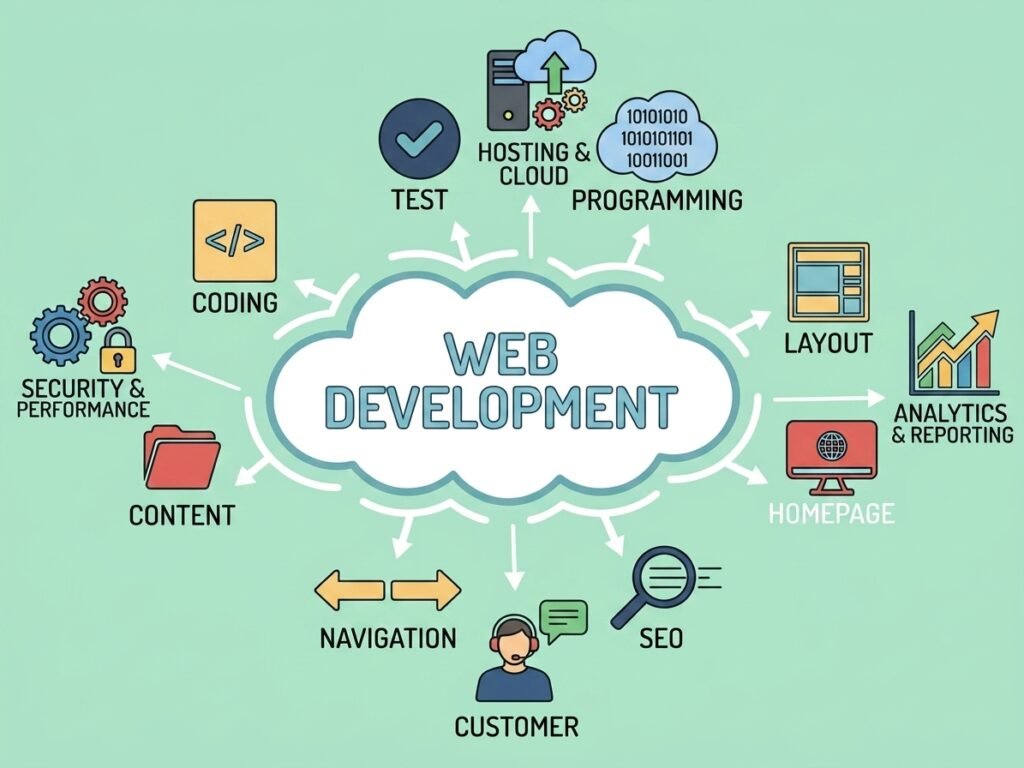
Best Web Development Services in Pakistan
Best Web Development Services in Pakistan can help businesses build websites that are responsive, secure, easy to navigate, and designed around clear business goals. A professional website is more than an online page with a company name, images, and contact details. It should provide useful information, work properly across different devices, and give visitors a clear path toward the next step.
For that reason, effective website development requires more than attractive design. A useful business website should be easy to navigate, responsive on different devices, secure, fast enough for a comfortable browsing experience, and structured so that both visitors and search engines can understand its content.
For businesses in Pakistan, these factors are particularly important because companies operate across different industries, locations, customer groups, and business models. A well-planned website can provide a clear foundation for presenting services and supporting future online growth.
What Makes a Business Website Effective?
An effective business website combines design, functionality, usability, performance, security, and clear content.
A professional website should answer basic customer questions quickly:
- What does the business offer?
- Who are the services for?
- How can someone contact the business?
- Where does the business operate?
- Why should a visitor explore the services?
- What should the visitor do next?
When these answers are easy to find, visitors can move through the website with less confusion.
Website development therefore needs to start with business goals rather than simply choosing colors, fonts, and layouts.
1. Start With Clear Website Goals
Before development begins, a business should determine what the website is supposed to achieve.
For example, one business may need a website primarily to generate inquiries, while another may need an online store, booking functionality, customer accounts, or a web application.
The development approach should reflect these requirements.
A simple service website may need:
- Home page
- About page
- Service pages
- Contact page
- Frequently asked questions
- Blog or resources section
An e-commerce business may require additional functionality such as product management, shopping carts, checkout, order management, and customer accounts.
Defining the purpose first helps prevent unnecessary features and gives developers a clearer direction.
2. Make the Website Easy to Navigate
Website visitors should not have to search through multiple pages to understand what a business provides.
Clear navigation helps users find important information without unnecessary effort. Main services should be easy to access, and related information should be organized logically.
For example, a web development business could organize its navigation around:
Home → Services → Web Development → About → Blog → Contact
The exact structure depends on the business, but the principle remains the same: visitors should understand where they are and where they can go next.
A clean navigation structure can also make website content easier for search engines to crawl and understand.
3. Use Responsive Web Development
People access websites from desktop computers, laptops, tablets, and smartphones. A website that works properly only on a large screen can create a poor experience for visitors using smaller devices.
Responsive development allows website layouts to adapt to different screen sizes.
This includes making sure that:
- Text remains readable
- Buttons are easy to tap
- Images fit the screen
- Menus work properly
- Forms remain usable
- Content does not require unnecessary horizontal scrolling
Mobile-friendly development should therefore be considered during the initial design and development process rather than treated as an afterthought.
4. Focus on Website Performance
Website performance affects how comfortably visitors can use a website.
Large images, unnecessary scripts, poorly optimized code, excessive plugins, and unsuitable hosting configurations can contribute to performance problems.
Developers can improve performance by considering areas such as:
- Image optimization
- Efficient code
- Browser caching
- Appropriate hosting
- Reduced unnecessary scripts
- Optimized page structure
- Lightweight website components
Performance should also be tested after development because a website that appears fast during development may behave differently when more content, plugins, images, or functionality are added.
5. Build With Website Security in Mind
Security is another essential part of professional web development.
A business website may contain contact forms, customer information, login systems, product information, or other important data. Poor security practices can expose websites to unnecessary risks.
Basic security considerations can include:
- HTTPS implementation
- Strong authentication
- Secure passwords
- Regular software updates
- Reliable backups
- Safe handling of forms and user data
- Appropriate access permissions
Security requirements depend on the type of website. A simple informational website and a platform handling customer accounts may have very different security needs.
Businesses should discuss security requirements with their developer before development begins.
6. Create SEO-Friendly Website Structure
Search engine optimization should not be added only after a website has been completed.
A search-friendly website starts with a logical structure and useful content.
Developers and content teams can consider:
- Clear page titles
- Proper heading structure
- Descriptive URLs
- Internal linking
- Mobile responsiveness
- Image alt text
- Crawlable navigation
- Useful page content
- Appropriate metadata
The goal is not to repeat a keyword on every page. Instead, each page should serve a clear purpose and provide useful information related to the visitor’s search intent.
Businesses looking for Best Web Development Services in Pakistan should therefore consider whether a development provider understands both technical website structure and the practical needs of users and search engines.
7. Give Each Service Its Own Purpose
Many business websites make the mistake of placing every service into one general page.
Separate service pages can make the website easier to understand when a business offers multiple solutions.
For example, a technology company might have separate pages for:
- Website development
- E-commerce development
- Web applications
- Website maintenance
- Custom software solutions
Each page can then explain the specific service, who it is for, what it involves, and what the visitor can do next.
This approach can also create a stronger content structure for SEO because each page has a clear subject.
8. Work With the Right Development Provider
Choosing a development provider should involve more than looking at visual designs.
Businesses should ask practical questions about the development process.
For example:
Will the website be responsive?
The provider should explain how the website will work across different devices.
Who owns the website after completion?
Clarify access to the domain, hosting, website files, CMS, and other relevant assets.
What happens after launch?
Ask whether updates, maintenance, troubleshooting, or technical support are available.
Can the website be expanded later?
If the business expects new services or features in the future, scalability should be discussed before development begins.
For businesses that prefer working with a provider in the same city, a Web Development Company in Lahore can be considered based on its ability to understand the project’s requirements, communicate clearly, and provide the technical functionality the business needs.
The location of a developer is only one factor, however. Technical ability, communication, project requirements, maintenance, and website ownership are also important.
9. Keep the User Experience Simple
Good web development does not mean adding as many features as possible.
Sometimes a simpler website provides a better experience.
Visitors should be able to identify important information without dealing with unnecessary pop-ups, confusing menus, excessive animations, or complicated forms.
Calls to action should also be clear.
Depending on the business, useful calls to action might include:
- Contact Us
- Request a Quote
- Book a Consultation
- View Services
- Shop Now
- Send an Inquiry
The right call to action depends on what the business wants visitors to do.
10. Plan for Future Growth
A website should be developed with reasonable future requirements in mind.
A business may begin with a small website and later need additional service pages, a blog, an online store, customer accounts, integrations, or other functionality.
This is why scalability should be discussed during planning.
A development approach that supports future changes can make it easier to expand the website instead of rebuilding everything from the beginning.
Businesses considering Best Web Development Services in Pakistan should therefore evaluate not only what a provider can build today, but also whether the proposed website structure can support reasonable future requirements.
Why Professional Web Development Matters for Pakistani Businesses
Businesses in Pakistan serve customers across many industries, including retail, education, professional services, technology, manufacturing, hospitality, healthcare, and e-commerce.
Each business has different website requirements.
A local service provider may need a simple lead-generation website, while an online retailer may require a complete e-commerce system. A growing company may need a custom web application rather than a traditional business website.
Professional development helps align the website’s technical structure with these specific requirements.
For example, BeTec Host provides web development services in Pakistan, making it an option for businesses looking for website development support.
The important point is that businesses should choose a development approach according to their actual goals, audience, functionality, and future needs rather than selecting a solution simply because it looks attractive.
What Should You Check Before Launching a Website?
Before publishing a new website, businesses should perform a basic launch review.
Check that:
- All important pages are available.
- Navigation links work correctly.
- Contact forms function properly.
- Website content is free from obvious errors.
- Pages work on mobile and desktop screens.
- Images are properly displayed.
- Page titles and metadata are configured.
- HTTPS is working.
- Important buttons and calls to action work.
- Website backups and access details are properly managed.
A final review can identify small problems before customers encounter them.
Final Thoughts
An effective business website is built around a combination of clear goals, useful content, responsive design, performance, security, SEO-friendly structure, and good user experience.
There is no single website structure that is perfect for every business. The right solution depends on what the business offers, who its customers are, what functionality is required, and how the website may develop in the future.
Businesses searching for professional Web Development Company in Lahore should compare providers based on technical requirements, communication, ownership, maintenance, scalability, and the overall development process.
A well-planned website can provide a strong digital foundation while giving a business room to add content, services, and functionality as its needs change.
FAQs About Web Development for Businesses
1. What is web development for a business?
Web development is the process of creating and maintaining a website or web-based application. It can include website structure, coding, databases, integrations, security, responsive design, and other technical functionality.
2. Why is responsive web development important?
Responsive development allows a website to adapt to different screen sizes, including smartphones, tablets, laptops, and desktop computers. This helps provide a more consistent user experience across devices.
3. What should I look for in web development services in Pakistan?
Look at the provider’s ability to understand your requirements, develop responsive and secure websites, create useful website structures, communicate clearly, and provide an approach that can support future changes.
4. How much does website development cost in Pakistan?
There is no single price for website development. The cost depends on factors such as website size, design requirements, functionality, e-commerce features, integrations, custom development, content, and ongoing maintenance.
5. Should every business have a custom website?
Not necessarily. The right approach depends on the business’s requirements. Some businesses may need a relatively simple website, while others may require custom functionality or web applications.
6. How can a website be made SEO-friendly?
An SEO-friendly website can use clear page structures, descriptive URLs, useful content, proper headings, responsive design, optimized images, internal links, crawlable navigation, and relevant metadata.
7. What is the difference between web design and web development?
Web design generally focuses on the visual appearance and user experience of a website, while web development focuses more on the technical implementation and functionality. In practice, both areas often work together.
8. Why is website security important?
Security helps protect websites, business information, and users from common technical risks. Security requirements vary depending on whether a website is informational, handles forms, processes transactions, or provides user accounts.
9. Can a business website be expanded later?
Yes. A website can be planned with scalability in mind so that additional pages, features, integrations, or other functionality can be added as the business grows.
10. What is the most important thing to consider before developing a website?
Start by defining the website’s purpose. Once the business knows what it wants the website to achieve, it becomes easier to determine the required pages, features, design, technology, content, and development approach.