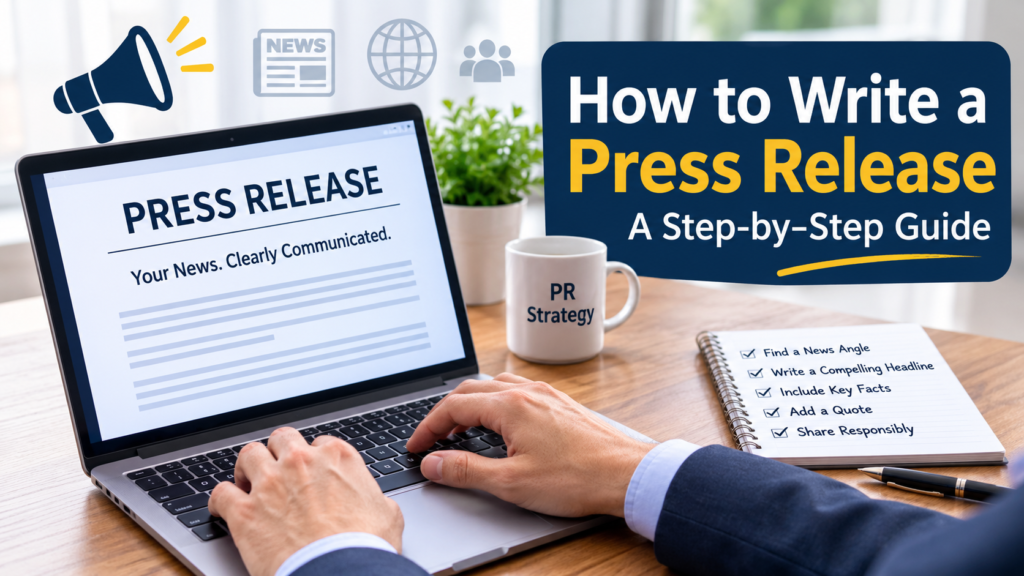
A press release is a structured announcement that organizations use to share important news with journalists, media outlets, customers, and the public. It can communicate a product launch, company expansion, new partnership, research finding, leadership appointment, or upcoming event. When written effectively, a press release presents the facts in a format that helps readers quickly understand what happened and why it matters.
For businesses in the United States, press releases remain one of several tools available for professional communication and media relations. However, publishing an announcement does not automatically guarantee media coverage. Its effectiveness depends on the relevance of the news, the accuracy of the information, the quality of the writing, and the suitability of the distribution approach.
Understanding how to write a press release can help businesses communicate more clearly, establish credibility, and provide journalists with useful information. This guide explains the essential steps, standard formatting practices, and common mistakes to avoid when preparing a professional announcement.
1. Determine Whether Your News Is Worth Announcing
The first step is identifying whether the information offers genuine news value. A press release should communicate a meaningful development rather than serve as an advertisement for a company.
Examples of potentially newsworthy announcements include opening a new business location, introducing a product that addresses a specific need, publishing original research, forming a significant partnership, or announcing an initiative that affects a local community.
Before writing, consider three questions:
- What exactly has happened?
- Why would the intended audience care about it?
- What reliable information supports the announcement?
These questions help distinguish an informative announcement from a general promotional message.
For example, a company announcing a new office could explain where the office is located, when it will open, and how the expansion relates to its operations. Simply stating that the company is growing may not provide enough information to interest journalists.
The strongest announcements communicate a clear development and explain its relevance without exaggerating its importance.
2. Identify Your Target Audience
A press release should be written with a specific audience in mind. The intended readers influence the language, supporting details, distribution strategy, and overall presentation.
A local business announcing a new facility might focus on community benefits, employment opportunities, or regional investment. A technology company announcing a software update might emphasize technical improvements, intended users, and practical applications.
Consider the publications and journalists most likely to cover the subject. A national business publication may prioritize market developments, while a local newspaper may focus on community events and regional economic activity.
Understanding the audience also helps writers decide which information belongs near the beginning of the release and which details can appear later.
Avoid trying to address every possible audience in a single announcement. A focused message is generally easier to understand and more useful to journalists working within a particular beat or industry.
3. Write a Clear and Specific Headline
The headline is one of the first elements journalists and readers see. It should summarize the central announcement accurately and make the subject immediately understandable.
A useful headline generally identifies the development and, where appropriate, the organization or location involved.
For example:
Weak headline: Company Announces an Exciting New Development
Stronger headline: Austin Technology Firm Opens New Software Research Center
The stronger example communicates a specific event and gives readers a clearer reason to continue reading.
When preparing a headline, use direct language and avoid unnecessary adjectives, vague expressions, and unsupported claims. Words such as “revolutionary,” “unmatched,” and “world-leading” should not replace evidence.
A relevant keyword may be included when it fits naturally. However, keyword repetition can make a headline awkward and reduce readability. The primary goal is to communicate the news, not to force search terms into every sentence.
4. Prepare an Informative Opening Paragraph
The opening paragraph, commonly called the lead, summarizes the announcement’s most important information. It should answer the central questions of who, what, when, where, why, and how, as relevant to the story.
For example:
Austin, Texas, October 21, 2026 — ABC Technologies announced plans to open a software research center in Austin in January 2027, expanding its product development operations and creating a dedicated space for engineering collaboration.
This illustrative example identifies the organization, the development, the location, and the expected timing. A real announcement should contain only verified details.
Keep the lead concise. Readers should understand the main news without needing to work through a long introduction or several paragraphs of company background.
Additional explanations, statistics, quotations, and historical context can follow in the body of the release.
5. Follow a Standard Press Release Format
A consistent structure makes a press release easier to read, edit, and distribute. One widely used approach is the inverted pyramid, which places the most important information first and supporting details afterward.
A typical press release contains these elements:
- Headline: Summarizes the announcement.
- Subheadline: Adds useful context when necessary.
- Dateline: Identifies the location and release date.
- Opening paragraph: Presents the main news.
- Supporting paragraphs: Explain the development and provide evidence.
- Quotation: Adds an informed perspective from an authorized spokesperson.
- Background information: Supplies relevant context.
- Company boilerplate: Briefly describes the organization.
- Media contact: Provides a way to request additional information.
Not every announcement requires every element. An event release, for example, may need a date, venue, and registration details, while a research announcement may require more supporting data.
The structure should serve the story rather than force every type of announcement into an identical template.
6. Support the Announcement With Accurate Facts
Accuracy is central to effective press release writing. Information about company performance, market conditions, scientific findings, financial results, and projected outcomes should be supported by reliable evidence.
Before publication, verify names, job titles, dates, locations, figures, product specifications, and other factual details. Where external research is used, identify the source when appropriate and ensure that the information accurately supports the claim.
For example, instead of describing a product as the most effective solution in the industry, explain its documented features or cite credible evidence that supports the comparison.
Writers should also distinguish between confirmed results and future expectations. If a company expects a new facility to create employment opportunities, that should be presented as an expectation unless the number of jobs has been confirmed.
This approach reflects the principles of experience, expertise, authoritativeness, and trustworthiness often associated with Google’s EEAT framework. In practice, credible content demonstrates its reliability through accurate reporting, relevant expertise, transparent sourcing, and clear distinctions between facts and opinions.
7. Include a Meaningful Quote
A quotation can explain why the announcement matters or provide insight that would be difficult to communicate through factual statements alone.
Suitable sources may include an executive, project manager, researcher, technical expert, or event organizer who has direct knowledge of the announcement.
For example:
“The new research center will help our engineering team collaborate more closely with development partners and investigate solutions to emerging industry challenges,” said the company’s chief technology officer.
This is an illustrative quotation, not a statement from a real spokesperson. Actual quotations should be accurate and approved by the person being quoted.
Avoid generic statements that merely express excitement without adding information. A meaningful quote explains the motivation, expected impact, or broader significance of the development.
Quotes should also be concise enough to maintain the reader’s attention. Long statements containing repeated promotional language can weaken an otherwise factual release.
8. Write the Body in Plain, Professional Language
The body expands on the lead and provides the information needed to understand the announcement. It should answer likely questions, explain relevant context, and present supporting facts in a logical order.
Use short paragraphs and straightforward sentences. Technical language may be appropriate for specialized audiences, but unfamiliar terms should be explained when necessary.
Depending on the announcement, the body might cover:
- The background behind the development.
- Important dates, locations, and milestones.
- Relevant data or research findings.
- The people and organizations involved.
- The potential effects on customers, employees, or communities.
- Next steps and practical information.
Each paragraph should contribute something new. Repeating the headline in several different ways wastes space, while lengthy company histories can distract readers from the central announcement.
For a US audience, consistent American English spelling and familiar terminology can improve readability. Writers should also consider the publication’s preferred style and submission guidelines.
9. Add a Company Boilerplate and Media Contact
The company boilerplate is a short description placed near the end of the release. It provides consistent background information about the organization, including what it does, whom it serves, and where it operates.
For example:
About ABC Technologies: ABC Technologies is an Austin-based technology company that develops software tools for business operations and digital collaboration.
This is a fictional example. In an actual release, use accurate, approved company information.
The media contact section should identify the person responsible for responding to journalists. It commonly includes a name, professional title, email address, and telephone number where appropriate.
Make sure the contact details are current and that the person listed can respond to inquiries. A clear contact channel helps journalists request clarification, arrange interviews, and verify additional information.
10. Choose an Appropriate Distribution Method
After the release has been written and reviewed, decide how to make it available to the intended audience. The right approach depends on the announcement, the target publications, the geographic market, and the organization’s communication objectives.
Businesses may send releases directly to relevant journalists, publish them in their online newsroom, or use a press release distribution service. Some organizations combine these methods.
For example, Vertex News Wire operates in the press release distribution space. When assessing a distribution provider, businesses should review its audience reach, submission requirements, publication policies, reporting features, and pricing before deciding whether it meets their needs.
Distribution should be treated as a way to make information available, not as a guarantee of editorial coverage. Journalists independently decide whether an announcement fits their audience and editorial priorities.
For better targeting, identify publications that regularly cover the relevant industry, region, or subject. A focused approach is often more useful than sending the same announcement to a large list of unrelated contacts.
11. Improve Online Readability and Search Visibility
When a press release is published online, formatting and discoverability can influence how easily readers access and understand it.
Use a descriptive headline, short paragraphs, meaningful subheadings where appropriate, and links to relevant supporting resources. If the release includes photographs, charts, or downloadable reports, ensure that the material is accurate and authorized for publication.
Search engine optimization can help readers discover relevant announcements, but it should not compromise the quality of the writing.
Choose a primary phrase that describes the announcement and incorporate it naturally where appropriate. For website publication, write a useful page title and meta description, and use descriptive link text that tells readers what they will find.
Links should support the story. An announcement about research might link to the original report, while an event release might link to an official registration page.
Avoid excessive keyword repetition, unrelated backlinks, and claims that imply a release will automatically improve rankings. Search visibility, website traffic, and editorial coverage are separate outcomes and should be evaluated accordingly.
12. Proofread Before Publication
Proofreading is an essential part of the writing process. A small factual error can create confusion, require corrections, or undermine confidence in the announcement.
Review the document for spelling, grammar, punctuation, sentence structure, and consistency. Confirm that the headline accurately reflects the body and that all important information appears in the correct order.
Check names, dates, addresses, quotations, statistics, email addresses, and links. Verify that quotations have been approved and that supporting documents are accessible.
It can also help to ask a colleague who was not involved in drafting the release to review it. A fresh reader may notice unclear wording, missing context, or assumptions that the original writer overlooked.
Before distribution, confirm that the final document follows the recipient’s submission requirements and includes the appropriate media contact details.
13. Measure the Results
After publication, evaluate whether the press release achieved its intended communication goals.
Useful measurements depend on the purpose of the announcement. A release about a local event might be evaluated through local media mentions and event registrations. A research announcement might be assessed through relevant coverage, visits to the report, and inquiries from industry stakeholders.
Possible indicators include the quality and relevance of media coverage, referral traffic, engagement with supporting materials, journalist inquiries, and actions directly connected to the announcement.
Interpret results carefully. A high number of online placements does not necessarily mean that a release generated meaningful editorial attention. Similarly, increased website traffic does not prove that the announcement alone caused the change.
Establish objectives before distribution and compare the results against those goals. This makes it easier to identify which topics, audiences, and communication methods deserve further consideration.
Common Mistakes to Avoid
Several avoidable problems can reduce the effectiveness of a press release.
- Making the announcement too promotional: Focus on verifiable news rather than unsupported marketing claims.
- Burying the main point: Put the central development near the beginning.
- Using vague headlines: Describe the announcement specifically and accurately.
- Including unsupported statistics: Verify figures and identify relevant sources.
- Using unnecessarily complex language: Write for the intended audience.
- Neglecting proofreading: Check factual details, links, and contact information.
- Expecting guaranteed coverage: Distribution cannot ensure that journalists will publish a story.
- Ignoring performance data: Evaluate results against the release’s original objectives.
Addressing these issues makes an announcement clearer, more credible, and more useful to readers.
Conclusion
Writing an effective press release begins with a meaningful news angle and continues through accurate research, clear writing, careful formatting, and appropriate distribution. A strong headline, informative opening paragraph, relevant supporting details, approved quotations, and reliable contact information help readers understand the announcement quickly.
Businesses should also consider their target audience, follow publication guidelines, and measure results against realistic objectives. Rather than relying on exaggerated language or assuming that distribution guarantees coverage, organizations should prioritize facts, relevance, and transparency.
By following these practices, businesses can prepare professional press releases that communicate important developments clearly and support long-term relationships with journalists, customers, and other stakeholders.