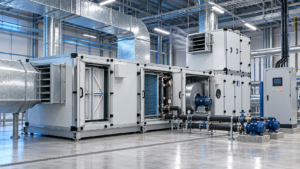
Modern industrial and commercial facilities need reliable air management to maintain comfortable temperatures, control airborne contaminants, and support consistent production conditions. An Air Handling Unit (AHU) plays an important role in achieving these objectives by circulating, filtering, cooling, heating, and conditioning air. From pharmaceutical plants and hospitals to manufacturing facilities and offices, AHUs help maintain indoor environments suited to specific operational requirements. Understanding their components, applications, energy efficiency, and maintenance needs helps businesses make informed equipment decisions.
What Is an Air Handling Unit?
An Air Handling Unit is an essential component of a heating, ventilation, and air conditioning (HVAC) system. It conditions and distributes air throughout a building or industrial facility to meet ventilation, temperature, and indoor air quality requirements.
A typical AHU contains a casing, fans, air filters, cooling or heating coils, dampers, and control equipment. Depending on the application, it may also incorporate heat recovery devices, humidifiers, and advanced automation systems.
Unlike standalone air-conditioning units designed for individual rooms, an AHU can serve multiple spaces through a connected duct network. Its configuration depends on the building layout, airflow demand, thermal loads, and environmental conditions.
How Does an Air Handling Unit Work?
An AHU operates through several coordinated stages. First, outdoor air, return air, or a mixture of both enters the unit through an intake section. Dampers regulate airflow according to ventilation requirements.
The air passes through filters that remove dust and other airborne particles. It then moves across cooling or heating coils to achieve the required supply temperature. Cooling coils may use chilled water or direct-expansion refrigerant, while heating coils use an appropriate heat source.
Correct airflow balancing, suitable control settings, and regular maintenance are important for achieving reliable performance.
What Are the Main Components of an Air Handling Unit?
Understanding the main components helps buyers evaluate equipment specifications and compare available configurations.
Casing and insulation: The casing protects internal components, while insulation helps reduce unwanted heat transfer and condensation risks.
Air filters: Filters capture airborne particles according to their rated efficiency. The required filtration level depends on the facility’s cleanliness and indoor air quality requirements.
Cooling and heating coils: These components regulate air temperature. Their selection depends on airflow, thermal loads, available utilities, and desired supply conditions.
Fans and motors: Fans move air through filters, coils, and ducts. Efficient motors and appropriate fan selection can help reduce electricity consumption.
What Are the Common Applications of Air Handling Units?
Air Handling Units are used across industries with different ventilation, temperature, and filtration requirements.
In pharmaceutical manufacturing, AHUs support controlled environmental conditions and filtration strategies established by the facility’s quality requirements. Cleanrooms may require specialized airflow patterns, pressure relationships, and high-efficiency filtration.
Hospitals use air handling equipment to manage ventilation and indoor air quality according to the function of individual spaces. Food processing facilities may require controlled temperature and humidity to support production and packaging operations.
How Do You Choose the Right Air Handling Unit?
Selecting suitable equipment begins with evaluating the facility’s operating requirements.
Airflow capacity: Determine the required airflow using room dimensions, occupancy, ventilation rates, and process conditions.
Cooling and heating loads: Assess equipment heat, outdoor temperatures, lighting, occupancy, and other relevant thermal loads to avoid undersized or oversized equipment.
Installation space: Ensure sufficient room for installation, filter replacement, coil cleaning, inspection, and repairs.
Operating environment: Consider humidity, ambient temperature, corrosion exposure, and casing material requirements.
Consulting experienced Air Handling Unit Manufacturers can help businesses assess these factors and identify an appropriate configuration.
How Can an Air Handling Unit Improve Energy Efficiency?
Energy efficiency depends on equipment selection, system design, and maintenance. Correctly sized fans and efficient motors can reduce electricity demand, while variable-speed drives may help match airflow to changing requirements.
Clean filters and coils are equally important. Dirty filters increase resistance to airflow, potentially increasing fan energy consumption. Contaminated coils can also reduce heat-transfer performance.
Regularly inspecting sensors, dampers, duct connections, and control sequences helps identify operating problems. Where appropriate, heat recovery systems can reduce the energy needed to condition incoming air.
Monitoring electricity consumption, airflow, and filter pressure drop allows facility managers to identify performance deterioration and schedule maintenance before it causes significant disruption.
Why Is Preventive Maintenance Important?
Preventive maintenance helps maintain indoor air quality, equipment reliability, and operating efficiency. Maintenance schedules should reflect operating hours, environmental conditions, manufacturer recommendations, and application requirements.
Routine tasks include inspecting filters, cleaning coils, checking fans and motors, testing sensors, and examining condensate drains. Electrical components and control systems should also be inspected by qualified personnel.
Facilities with strict cleanliness requirements may need documented inspection procedures and specialized maintenance practices. A planned maintenance programme can reduce unexpected downtime, identify faults early, and extend equipment service life.
Frequently Asked Questions (FAQs)
What is the main purpose of an Air Handling Unit?
An Air Handling Unit circulates, filters, heats, cools, and conditions air within a building or industrial facility. It helps maintain suitable ventilation, indoor air quality, and temperature according to the application’s requirements.
Which industries commonly use Air Handling Units?
AHUs are widely used in pharmaceutical manufacturing, hospitals, food processing, laboratories, cleanrooms, commercial buildings, data centres, and industrial facilities. The required configuration depends on the airflow, filtration, and environmental conditions.
How often should an Air Handling Unit be maintained?
Maintenance frequency depends on operating conditions, filter loading, environmental cleanliness, and manufacturer recommendations. Regular inspections should cover filters, coils, fans, drains, sensors, and controls.
Can an Air Handling Unit improve indoor air quality?
Yes. An appropriately designed AHU can improve indoor air quality by filtering airborne particles and supplying suitable outdoor air. Its effectiveness depends on filter selection, ventilation design, maintenance, and correct operation.
What should buyers consider when selecting an Air Handling Unit?
Buyers should evaluate airflow capacity, cooling and heating loads, filtration requirements, energy efficiency, installation space, maintenance access, and after-sales support. Reviewing these factors helps ensure that the equipment matches the facility’s needs.
Conclusion
An Air Handling Unit is a vital part of modern HVAC systems, supporting air circulation, filtration, temperature regulation, and ventilation across industrial and commercial environments. Choosing the right equipment requires careful consideration of airflow, thermal loads, filtration, energy consumption, and maintenance requirements. With appropriate system design and preventive maintenance, businesses can improve operational reliability, manage energy use, and maintain suitable indoor conditions for their applications.