uPVC doors
Installing new windows and doors involves more than just choosing a style to complement the house. Installation affects the system’s performance, functionality, and fit within the opening. A checklist should include dimensions, opening type, glass, hardware, drainage, sealing, and installation.
It is essential to establish the specifications for each room before the work begins. The opening of uPVC windows depends upon factors such as ventilation, placement of furniture, natural light, and available space. Door installations should also be planned, as their size, opening direction, threshold, and frequency of use could influence movement within the room.
Check Measurements and Openings Before Installation
Accurate measurements form the foundation for any successful installation. The dimensions of the existing opening must be checked for width, height, level, and squareness prior to fabrication. Any inconsistencies can be detected early on, instead of being corrected during installation.
The opening style must be suitable for the room:
- Room clearance: Ensure there is ample room for the sash or door to move without colliding with any furniture, wall or fixture.
- Opening direction: Choose the appropriate opening direction, whether inward, outward, sliding or otherwise.
- Ventilation: See which rooms require ventilation, and whether the particular configuration offers ventilation.
- Access: Confirm that the door openings provide access from one room to another, or to balconies, terraces, or exterior spaces.
Select Glass and Hardware for Everyday Use
Glass and hardware can affect more than just aesthetics. Consider things like natural lighting, privacy, and the intended function of the opening. The hardware must serve its purpose and be secure. Handles, hinges, locks, and other moving parts must match the profile selected and the opening configuration.
Regarding uPVC doors, one has to check locks, hinges, handles, and the threshold as these are used all the time and must function effectively.
Check Sealing, Drainage and Finishing
The well-installed system will need more than a properly sized profile. It must have continuous sealing on all openings to prevent unnecessary entry of air and water. The drainage route needs to be kept clear for the water to drain out of the system.
Homeowners can inspect:
- Perimeter sealing: Look for continuous, neat sealing around the installation.
- Drainage: Confirm that drainage routes are not blocked during fitting or finishing work.
- Alignment: Open and close each sash or panel to check that movement is smooth.
- Surface finish: Inspect profiles, glass, hardware, and surrounding walls for scratches or installation damage.
Do all these before the installation team leaves, as corrections can then be done immediately.
Confirm the Installation Quality
Even if the best product is made, it may still perform poorly if the installation procedure is done incorrectly. The profile should be installed perfectly within the opening and should be aligned and installed as per system requirements. There should be free and effortless movement of the sashes and panels.
In the case of windows, it becomes apparent whether there is any alignment issue by opening and closing each one. The threshold and opening path for a door also need to be examined properly.
Koemmerling: Manufacturing High-Quality uPVC Windows and Doors for Different Home Requirements
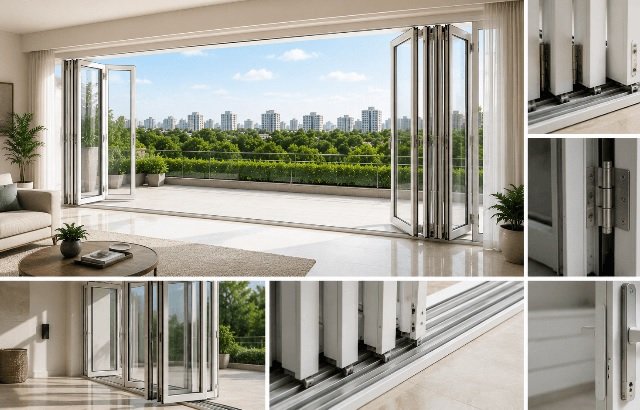
Koemmerling offers a broad range of window and door systems, including casement, sliding, tilt and turn, top hung, lift and slide, and sliding folding configurations. In this way, homeowners can pick systems based on their room designs, ventilation needs, accessibility, and architectural designs, rather than relying on one opening style.
Casement door systems include inward- and outward-opening options, multi-point locking, thermal insulation, and more. There are single- and double-glazed variants available in the range as well. These choices make it possible to plan uPVC windows and doors around the practical requirements of different areas of a home.
Conclusion
Before giving final approval for the installation, the homeowner must ensure that all openings are checked and that the seals, drainage points, glass, profiles, hardware, and surrounding finishes are also checked. This allows you to identify any alignment or functionality problems before the installation is complete.
The diverse selection of systems provided by Koemmerling makes it possible to choose window and door systems that suit the specific layout of a room and the desired access and ventilation. With proper measurement, correct hardware, proper sealing, and a complete final check, the chosen systems can be ready for use.