A freshly stamped part is rarely the finished article, and that’s exactly where industrial metal plating enters the picture. It’s the step that protects, strengthens, and prepares components for real-world use. Yet despite how critical it is, plating often gets treated as an afterthought — something to sort out after the stamping is done. That approach costs manufacturers time, money, and quality. In this guide, we’ll explain why plating matters, how it fits alongside the die stamping press, and why an integrated partner like Eigen Engineering can save you time and hassle. Here’s what every manufacturer should understand about finishing.
Why Industrial Metal Plating Matters
A bare stamped part is rarely finished. Most need a protective or functional coating, and that’s where industrial metal plating comes in. Plating guards against corrosion, boosts conductivity, and extends the working life of a component — which is critical for electronics and automotive parts.
Think about what a stamped connector or terminal actually goes through in service. It might sit inside an engine bay where temperatures swing wildly, or inside a consumer device that gets handled dozens of times a day. Without the right plating, that part degrades. Contacts oxidise. Surfaces pit. Performance drops. The plating isn’t decorative — it’s doing real work, holding the part together in conditions the raw metal alone couldn’t handle.
Different plating materials serve different purposes. Tin is popular for electronics because it solders well and resists oxidation. Nickel adds hardness and stands up to heat. Zinc is a go-to for steel parts that need basic corrosion protection. Choosing the right option depends on the part’s end use, the environment it’ll operate in, and the performance standards it has to meet. Getting that decision right at the start saves a lot of rework later.
How Plating Fits Into the Stamping Workflow
Here’s where it gets practical. A part comes off the die stamping press, but it’s not ready to ship yet. It still needs plating. When a single supplier runs both the die stamping press and the plating line, you skip the delays of shipping parts between vendors.
That might sound like a minor convenience, but in practice it changes the whole production rhythm. When parts travel between separate suppliers, you’re adding transit time, handling risk, and another set of lead times to manage. You’re also splitting accountability — if something goes wrong with the plating, is it a stamping defect or a finishing problem? When both operations sit under one roof, that question doesn’t arise.
There’s also a quality argument. A supplier who handles stamping and plating together can control the condition parts are in before they hit the plating line. Surface cleanliness, part geometry, any residual oils from the press — all of it gets managed as part of the same process rather than handed off blind to another facility.
Eigen Engineering offers exactly this. Their Bangalore facility pairs a high-speed die stamping press operation with in-house barrel electroplating, so components go from raw coil to plated, finished part under one roof. That integration is a real advantage in industrial metal plating, and it’s not something every supplier can offer.
Common Industrial Metal Plating Methods
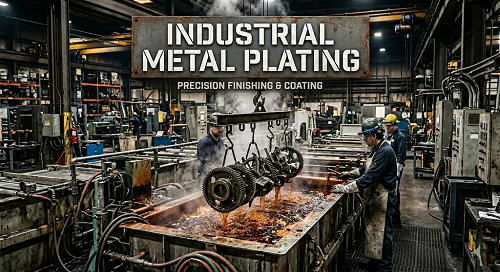
Barrel plating — the method Eigen uses — tumbles small parts together in a rotating barrel for even coating, ideal for high volumes of stamped components. It pairs naturally with die stamping press output, where parts come off in large batches needing uniform industrial metal plating.
The barrel method works well precisely because stamped parts tend to be small and produced in large numbers. Rather than plating each piece individually, the rotating drum ensures every surface gets consistent exposure to the plating solution. The result is even coverage across the whole batch, with very little variation from part to part. For manufacturers producing thousands or tens of thousands of identical components, that consistency matters a great deal.
Choosing an Integrated Partner
For manufacturers, the smartest move is a supplier handling both stamping and finishing. Fewer handoffs mean fewer opportunities for delays, damage, or miscommunication. The production schedule becomes more predictable. Quality stays consistent because the same team owns the process end to end.
With its die stamping press capacity and integrated industrial metal plating, Eigen gives clients a true one-stop solution — fewer vendors, faster turnaround, and consistent quality from start to finish. In a supply chain where every day counts, that kind of partnership isn’t just convenient. It’s a genuine competitive edge.