Thinking about getting solar panels fitted? Before you agree to a quote or book an installation date, check whether your home needs planning permission.
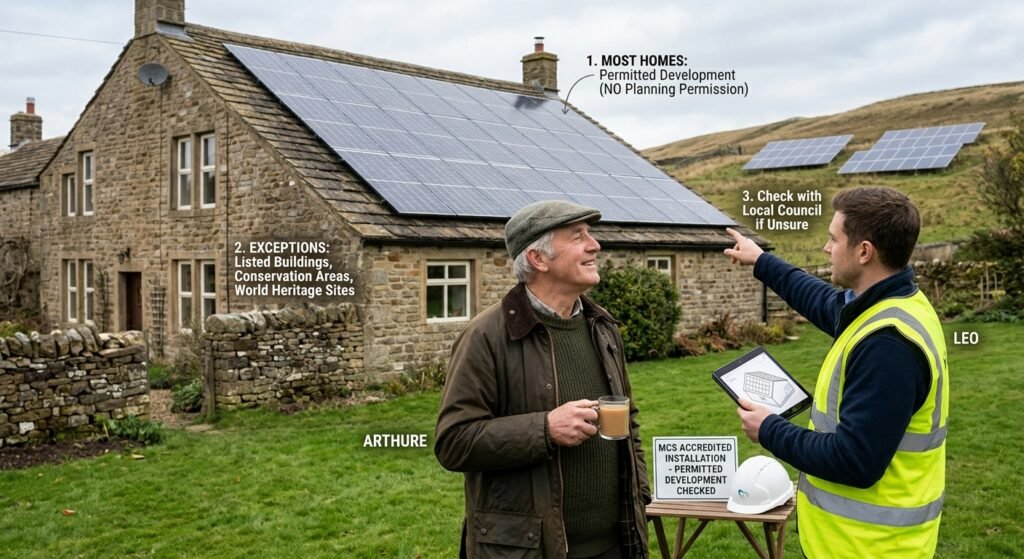
For many homeowners in the UK, the answer is no. Standard solar panels fitted to a house roof often fall under permitted development rights. This means you can usually go ahead without making a planning application.
But there are exceptions. A listed building, a conservation area or a flat can bring extra rules. The position of the panels can matter too.
It is worth checking before the installers arrive. A quick call to your local council could save you delays, extra costs and a fair bit of stress.
Here is what to check before having solar panels fitted.
1. When Can You Fit Solar Panels Without Planning Permission?
In England, many roof-mounted solar panel installation services on houses are covered by permitted development rights. These rights allow certain home improvements without a separate planning application.
However, the panels must meet the rules. Their height, position and distance from the roof surface can all matter.
There is also a recent change to be aware of. England updated its permitted development rules for solar equipment on 27 August 2026. A transition period runs until 27 August 2027, during which homeowners can follow either the previous rules or the updated rules. Check which set applies to your planned work before you start.
Under the updated rules, key points for houses include:
-
Panels on a pitched roof must not rise above the highest part of the roof, excluding the chimney.
-
They must not project more than 200mm from the roof slope.
-
On a flat roof, panels must not rise more than 600mm above the highest part of the roof, excluding the chimney.
-
The installation should have as little effect as possible on the building and the surrounding area.
-
Equipment should be removed when it is no longer needed.
These are not the only rules. Your property may have extra planning restrictions, so do not assume that every roof installation is automatically allowed.
2. When Might You Need Planning Permission?
Some homes have extra restrictions. If yours falls into one of these groups, speak to your local planning authority before arranging the installation.
Listed buildings
If your home is listed, do not order the panels until you have checked the rules.
In England, solar panels on a listed building or within its grounds are not covered by the usual householder permitted development rights. You may need planning permission and listed building consent.
Listed building consent is separate from planning permission. One does not replace the other.
The council will look at how the panels could affect the building’s historic features. It may suggest a less visible position or ask you to change the design.
Conservation areas
Living in a conservation area does not mean you cannot have solar panels. However, the location of the panels can affect whether you need permission.
For example, restrictions may apply to panels fitted on a wall or roof that faces a road. The rules can also depend on the type of property and the local area’s planning controls.
Ask your council before choosing where the panels will go. A small change in position could make a difference.
Flats and leasehold homes
If you live in a flat, there is another issue to consider: who owns the roof?
The roof may belong to the freeholder or be shared by the building’s residents. Even if planning rules allow solar panels, you may still need written permission from the freeholder, landlord or management company.
Check your lease and speak to the building manager before paying a deposit. It is much easier to get permission sorted out before the work is booked.
3. Do the Rules Differ Across the UK?
Yes. Planning rules are not the same across England, Wales, Scotland and Northern Ireland. Where you live can affect what you are allowed to install.
England: Many standard roof-mounted systems on houses can go ahead under permitted development rights. Listed buildings, conservation areas and local restrictions can change this. The updated rules introduced on 27 August 2026 also have a transition period running until 27 August 2027.
Wales: Many domestic roof installations are also allowed without a planning application, as long as they meet the relevant limits. Listed buildings and certain protected areas may need extra approval.
Scotland: Some home solar installations fall under permitted development. However, the rules depend on the building and its location. Listed status and conservation area restrictions may affect your plans.
Northern Ireland: There are separate permitted development rules for solar panels. Limits can apply to panel height and position, with extra checks for listed buildings and conservation areas.
Do not rely on advice written for another part of the UK. Check the rules with your own local planning authority before work begins.
4. What If You Want Ground-Mounted Solar Panels?
Solar panels do not have to go on your roof. If you have a large garden or suitable land, a ground-mounted system may be another option.
These systems have their own planning rules. The height, size and position of the panels can all affect whether permission is needed.
Before choosing this type of system, check:
-
How close the panels will be to your property boundary.
-
Whether they will be visible from a nearby road.
-
How much land the installation will use.
-
Whether your property is in a protected area.
-
Whether your local council has placed extra restrictions on the site.
Ground-mounted panels can be useful when your roof has limited space or receives too much shade. But do not assume the rules are the same as those for roof-mounted panels.
Ask your installer to check the position and size of the proposed system with your council.
5. How Can You Check Your Property’s Planning Rules?
You do not need to work through pages of planning documents on your own. Start with your local council and explain what you want to install.
Here is a simple way to check:
-
Find your local planning authority. Use the Planning Portal’s council search.
-
Check your property’s status. Find out whether it is listed or sits in a conservation area.
-
Ask about permitted development. Tell the council where the panels will go and share the proposed design if you have one.
-
Check for local restrictions. Some homes have had permitted development rights removed by an earlier planning decision.
-
Keep the council’s reply. Save any written advice with your installation documents.
If you want formal proof that your project is lawful, ask the council about a lawful development certificate. This can be useful if you sell your home later or simply want written confirmation that the work did not need planning permission.
6. Could Planning Permission Add to Your Costs?
It might. If your project needs a planning application, you may have to pay an application fee. You may also need to wait for the council to make a decision before the installation can begin.
The cost of the solar system itself is separate. It depends on the number of panels, the inverter, battery storage, roof access and the work involved.
Before accepting a quote, ask whether it includes:
-
Solar panels and the inverter.
-
Scaffolding and fitting.
-
Electrical work.
-
Battery storage, if required.
-
Help with planning applications.
-
Any extra work needed to meet property restrictions.
Make sure you know who will deal with the council. Some installers may offer help, while others expect the homeowner to handle the application.
Get this agreed in writing. You do not want to find out halfway through the process that an important task has been left to you.
7. Do You Need Building Regulations Approval Too?
Yes, building regulations are a separate matter from planning permission.
Planning rules deal with whether you are allowed to carry out the work. Building regulations cover matters such as safety and construction standards.
Solar panels add weight to your roof. The installer should check that the roof can support the system and that the fitting work is safe.
The electrical side matters too. The system must be installed and connected correctly.
Before work starts, ask your installer:
-
Has the roof been checked for the extra weight?
-
Will the electrical work meet the relevant safety standards?
-
Are any building control checks needed?
-
What certificates will I receive when the job is finished?
Keep all the paperwork. You may need it if you sell your home, make an insurance claim or need repairs in the future.
8. Questions to Ask Your Installer Before Signing
Do not feel shy about asking questions. You are paying for the work, and you have every right to understand what will happen.
Before signing a contract, ask:
-
Have you checked whether my home needs planning permission?
-
Does my property have any local restrictions?
-
Do the proposed panels meet the permitted development rules?
-
Will you contact the council if approval is needed?
-
Are building regulations and electrical safety covered?
-
Will I receive the relevant certificates after installation?
A good installer should give you clear answers. If the company is unsure about the planning rules, check with the council yourself before paying a deposit.
Conclusion
Most homeowners can fit standard roof-mounted solar panels without applying for planning permission. But there are exceptions, and the rules depend on your property and where you live.
Check your home’s status, speak to your local council and ask your installer to confirm that the proposed system meets the rules. Do this before signing a contract or paying a deposit.
If you are comparing Solar Panel Installation Cost, remember to allow for any planning fees, surveys or extra building work your property may need. A little checking now can save you time, money and a lot of bother later.
FAQs
1. Do I need planning permission for solar panels on my roof in the UK?
Many standard home installations do not need planning permission because they fall under permitted development rights. However, listed buildings, flats, conservation areas and homes with local restrictions may need extra approval.
2. Can I install solar panels on a listed building?
You will need to check with your local planning authority first. Planning permission and listed building consent may be required. The council will consider how the panels could affect the building’s historic character.
3. Can I fit solar panels in a conservation area?
In many cases, yes. But restrictions may apply to the position of the panels, especially if they face a road. Check with your council before arranging the work.
4. Do ground-mounted solar panels need planning permission?
Some ground-mounted systems may be allowed under permitted development rules. The limits depend on their size, height and position, as well as where you live. Ask your local council before installation.
5. Can my solar installer deal with planning permission?
Some installers can help with planning checks or applications. Ask what their service includes. It is still wise to confirm the position with your local planning authority.