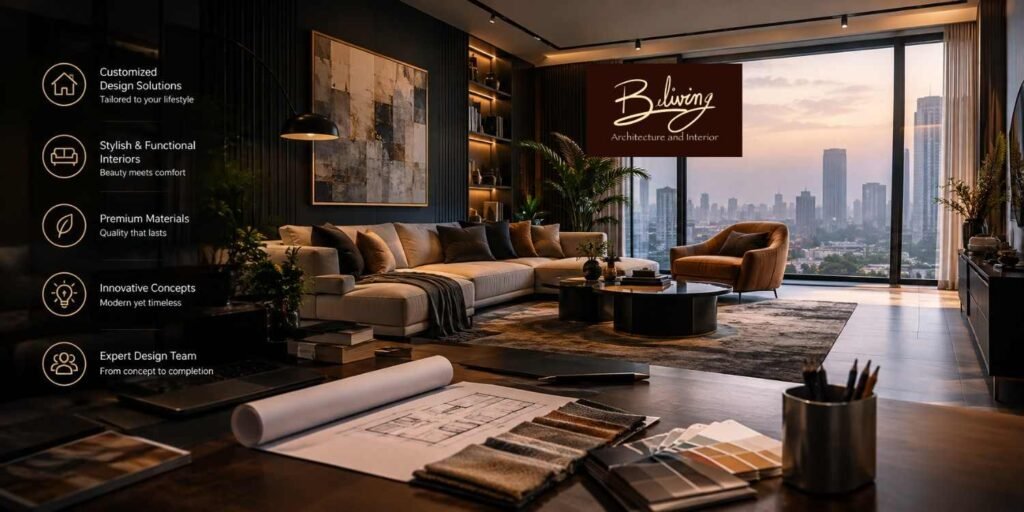
Choosing the best Home Interior Designer in Delhi NCR is not merely about choosing furniture or colors or paints. A premium home requires good planning, storage solutions, good materials, lighting, furniture making, and an interior vocabulary which reflects the people who live there. In Delhi NCR, where the properties can vary from flats and builder floors to villas, farmhouses, and independent houses, the design philosophy needs to address the architecture of the property as well as the lifestyle of the people.
A good plan for a premium interior will be one which looks good without being too hard to maintain. It should also be able to withstand the test of time rather than being dependent completely on trends. This is precisely why Beliving Interior concentrates on creating interiors which focus on aesthetics, functionality, sustainability, storage planning, natural light, and execution.
What Makes a Premium Home Interior Different?
Luxury interior design is not just a matter of spending more. One may generally see it in terms of planning, choice of materials, detailing, craftsmanship, and coordination of various parts of the house.
The luxury interior must be designed to make life easier and give the house a unique look. For instance, the kitchen must cater to real cooking practices, the wardrobe must store clothes effectively, lighting must give varying feelings, and furniture must help move around easily.
In the case of homes in Delhi NCR, one needs to take into account heat, dust, sunlight, ventilation, maintenance, as well as connection between indoor and balcony, terrace, garden, or any outside space.
Design Around Lifestyle, Not Just Appearance
Before deciding on colours or furniture, the designer should understand how the family uses the home.
Important questions include:
- How many people live in the house?
- Does the family entertain frequently?
- Is a separate home office required?
- How much concealed storage is needed?
- Are there elderly family members or children?
- Does the kitchen require heavy daily use?
- Are guest bedrooms used regularly?
- Is the home intended for everyday living or occasional use?
Beliving Interior specifically describes its residential approach around understanding a client’s vision, requirements, personality, storage needs, natural light, functionality, and maintenance considerations.
Where Luxury Interior Designers in Delhi Add Real Value
A luxury interior design project demands even more coordination than usual. This might include coordination of layout, electrical sockets, lights, ceiling, floor, cabinet design, furnishings, color scheme, materials, hardware, and décor.
Here lies another added value that can be provided by Luxury Interior Designers in Delhi beyond just visual aesthetics. The right design team will maintain unity of design language through the whole property and yet ensure that individual rooms perform well in their function.
For instance, the living room should provide formal sitting area for the guests as well as be comfortable for daily usage within the family. Master bedroom would require a different approach: calm palette of materials, built-in storage, layers of light fixtures, and convenient dressing area.
That’s exactly the kind of luxury residential design Beliving Interiors is specialized in. It features luxurious residential interior design, reflecting personality of our clients and matching their lifestyle and values.
Areas That Deserve Extra Planning
A premium home normally benefits from detailed attention to:
- Living and dining room proportions
- Modular kitchen workflow
- Wardrobes and concealed storage
- Bedroom lighting
- Custom furniture
- False ceiling and electrical planning
- Flooring and wall finishes
- Bathroom materials and fittings
- Curtains and upholstery
- Artwork and accessories
- Smart-home requirements
- Indoor-outdoor visual connection
The objective is not to make every room look expensive. It is to make the entire home feel considered and coherent.
Home Interior Design for Different Delhi NCR Properties
There is no common interior template for Delhi NCR since there are different kinds of properties.
An apartment in Gurgaon might have to have very efficient storage space and furniture arrangement due to lack of available space. A builder floor in South Delhi might be able to accommodate custom furniture and entertaining space. The villa might have to have better indoor-outdoor connection, while the farmhouse might have entertainment spaces, landscaping, guest room, and outdoor seating.
Hence, a good interior designer starts from the property itself.
Apartments and Builder Floors
The importance of space and storage is highlighted here. Even large houses may seem crammed and cluttered if there is too much bulky furniture.
Wardrobes, multiform furniture, concealed storage areas, use of mirrors at appropriate places and proper lighting techniques are some ways to create an illusion of ample space.
Villas and Independent Homes
However, more freedom is also accompanied by greater complexity because there are many variables such as the varying floor levels, double levels, staircases, balconies, terraces, as well as larger spaces to consider.
The interior design of Villa that Beliving uses combines comfort, practicality, aesthetics, storage space, flexibility, materials, colour and texture of the building.
How Much Does Premium Home Interior Design Cost in Delhi NCR?
Interior design costs in Delhi NCR vary considerably because “interior design” can mean anything from basic modular furniture to a fully customised turnkey project.
Current 2026 Delhi cost references put premium interiors broadly in the ₹3,000–₹4,000+ per sq. ft. range, while luxury and highly customised projects can move to ₹3,500–₹6,000+ per sq. ft. or higher depending on materials, customisation and scope.
These figures should be treated as planning ranges rather than fixed quotations.
For a premium home, the final budget is influenced by:
- Carpet area and property configuration
- Number of bedrooms and bathrooms
- Kitchen size and specification
- Wardrobe quantity
- Custom furniture
- Veneer, PU, stone or premium laminate finishes
- Hardware quality
- Lighting and electrical work
- False ceilings
- Civil modifications
- Appliances
- Curtains and upholstery
- Decorative elements
- Smart-home integration
- Site conditions and execution requirements
A 1,500 sq. ft. apartment with carefully selected premium finishes can therefore have a very different budget from a 1,500 sq. ft. home containing extensive custom joinery, imported finishes, automation, and bespoke furniture.
How to Control a Luxury Interior Budget
A premium budget does not imply that all the elements need to be the costliest available in the market.
Instead, invest in elements that have an impact on daily utility and longevity. Kitchen hardware, wardrobes, mattresses, lighting fixtures, plumbing fixtures, and furniture that is used often should get preference over decorative elements.
Before finalizing the quotation, make sure to inquire from the designer about the details of what is covered. The design fee, civil work, electrical work, false ceiling, appliances, loose furniture, décor, taxes, installation, and post-handover help may otherwise become unforeseen extras.
[Read More – Beliving Interior Medium Article]
A Step-by-Step Process for Designing a Premium Home
A structured process reduces design changes and makes budget control easier.
1. Initial Consultation
The first discussion should establish the property type, location, family requirements, preferred design direction, approximate budget, timeline, and expected scope.
This is also the stage to discuss whether you need complete interiors, selected rooms, renovation, custom furniture, or turnkey execution.
2. Site Visit and Measurement
The designer studies the actual property instead of relying only on floor plans.
Dimensions, columns, windows, doors, plumbing points, electrical provisions, ceiling heights, natural light, ventilation, and existing finishes can all influence the design.
3. Space Planning
Furniture placement, circulation, storage, room functions, and zoning are established before detailed styling.
This stage is particularly important because many expensive problems originate from poor planning rather than poor materials.
4. Concept Development
The designer develops the visual direction through colours, materials, textures, furniture language, lighting concepts, and reference imagery.
At this point, the client should understand how the overall home will feel rather than choosing isolated products room by room.
5. 3D Visualisation and Design Refinement
Three-dimensional views help homeowners understand proportions, finishes, furniture placement, and lighting before execution.
Changes are much easier to make at the design stage than after carpentry, electrical, or civil work has started.
6. Material and Finish Selection
Materials are selected according to appearance, durability, maintenance, budget, and application.
For example, a kitchen surface needs to withstand heat, moisture, stains, and frequent cleaning. A decorative wall finish may have different requirements from a high-contact wardrobe surface.
7. Working Drawings and Execution Planning
Detailed drawings help translate the concept into buildable work.
Electrical layouts, ceiling plans, furniture details, storage dimensions, material specifications, and installation requirements should be coordinated before execution begins.
8. Execution and Project Management
Once work starts, coordination becomes critical. Civil contractors, carpenters, electricians, painters, installers, furniture suppliers, and other specialists need to follow the approved design.
Beliving Interior states that its turnkey approach covers the process from concept and 3D design through material selection, execution, supervision, and final handover.
9. Styling and Handover
The final stage brings together furniture, lighting, curtains, accessories, artwork, and other finishing elements.
A professional handover should also include checking finishes, hardware, fittings, electrical points, storage functionality, and outstanding corrections.
Designing a Farmhouse Requires a Different Strategy
A farmhouse is not just a bigger version of an urban house. It usually includes both indoor spaces and gardens, terraces, lawns, entertainment zones, guest zones, and outdoor seating.
Thus, the design must include an interface between architecture, interior, landscape, natural light, and movement.
While choosing Best Farm House Interior Designers in Delhi for yourself, don’t base your choice only on the images from the portfolio of the designer. See if the designer knows how to work with large-scale circulation, indoor-outdoor interface, customized furniture, entertainment zones, lighting, storage, integration of landscape, and turnkey implementation.
The interior design service of Beliving includes living rooms, modular kitchens, bedrooms, dining rooms, entertainment zones, outdoor seating, walk-in wardrobes, false ceilings, lighting, customized furniture, integrated landscapes, and turnkey farmhouse interiors.
Farmhouse Interior Priorities
A well-planned farmhouse can include:
- Large family and entertainment areas
- Indoor-outdoor seating
- Guest bedrooms
- A spacious kitchen
- Walk-in wardrobes
- Custom furniture
- Landscape-connected spaces
- Decorative and functional lighting
- Durable outdoor materials
- Flexible entertainment areas
For properties around Chhatarpur and other farmhouse belts of Delhi, this connection between the interior and surrounding landscape can become one of the strongest design features.
[Client–Designer Conversation]
Client: I want an elegant, comfortable and practical home.
Designer: Custom design would ensure a blend of your lifestyle, spatial planning, storage as well as aesthetic needs.
Client: Can Beliving Interior Design achieve this for my home?
Designer: Sure, Beliving Interior Design can help you plan your Home Interior Designer in Delhi NCR journey.
How to Choose the Right Interior Designer in Delhi NCR
A designer should be evaluated on more than social-media photographs.
Before appointing a studio, ask about its process, previous project experience, execution capability, material specifications, project management system, and approach to revisions.
A useful shortlist should consider:
- Relevant residential project experience
- Experience with your property type
- Quality of previous work
- Design-to-execution capability
- Transparency of quotation
- Material and hardware specifications
- Site supervision
- Project timeline
- Communication process
- Warranty or post-handover support
- Ability to customise rather than reuse templates
Beliving Interior presents itself as a design-and-execution practice covering residential, luxury, villa, farmhouse, modular kitchen, office, and commercial interiors, with an emphasis on functionality, craftsmanship, premium materials, and end-to-end project management.
Why Beliving Interior Can Be Considered for Premium Homes
Beliving Interior designs homes in relation to its aesthetics and functionality. Its declared residential process takes into account lifestyle, personality, goals, space planning, colors, furniture, lighting, storage, finishes, daylight, maintenance, and sustainability.
The studio practices in various settings including apartments, standalone houses, builder floors, duplexes, villas, and farmhouses. Its Chhatarpur, New Delhi office also makes it near a prime farmhouse and premium housing area of Delhi.
For those looking for premium home interiors, this holistic approach may prove more helpful compared to choosing a designer in accordance with a specific decorating style.
Summary
What matters more to a good house is whether it functions well for living and storage, usability and personal connection to its inhabitants, and not just how grand it is on the day of completion.
This is why the ideal Home Interior Designer in Delhi NCR should combine creativity and design with proper planning, material selection, project management and understanding of local residential environment.
If you are planning to build a luxury apartment in Gurgaon, a builder floor in South Delhi, a villa in Noida, or a farmhouse in Chhatarpur area, then you need to see interior designing as a complete process, rather than just the purchase of decorative elements. The Beliving Interior’s concept of merging aesthetics, functionality, sustainability, premium material selection, customized solutions and project management can prove to be quite practical in this context.
Some Important Questions
1. How much does a luxury home interior cost in Delhi NCR?
Luxury home interiors can vary substantially depending on property size, materials, customisation, furniture, civil work, and execution scope. Current 2026 market references commonly place premium/luxury projects from around ₹3,500 per sq. ft. upward, with highly customised homes potentially exceeding ₹6,000 per sq. ft.
2. How long does a home interior project take in Delhi NCR?
The timeline depends on the property’s size and scope. Beliving states that most residential interiors are completed within approximately 6–12 weeks after design approval, although larger luxury homes, renovations, villas, and farmhouses can require additional time.
3. What should be included in a premium interior quotation?
A quotation should clearly identify design work, carpentry, kitchen, wardrobes, furniture, electrical work, false ceiling, painting, flooring, hardware, lighting, installation, civil modifications, taxes, and exclusions. Comparing quotes is difficult unless the scope and specifications are equivalent.
4. Is luxury interior design suitable for apartments?
Yes. Luxury design is not dependent on property size. In an apartment, luxury can come through intelligent space planning, high-quality materials, customised storage, refined lighting, carefully selected furniture, and consistent detailing.
5. What is important when designing a farmhouse interior?
A farmhouse needs stronger consideration of indoor-outdoor connections, large-scale circulation, entertainment spaces, landscape integration, outdoor seating, guest accommodation, lighting, storage, and durable materials. The interior should respond to the entire property rather than only individual rooms.
6. How do I select an interior designer for my Delhi NCR home?
Review relevant residential portfolios, understand the design and execution process, check what the quotation includes, discuss materials and timelines, and assess how well the designer understands your lifestyle and property. A good designer should be able to explain why a particular planning or material decision is suitable rather than simply showing attractive images.
About us –
Official No. – +91 9871678798