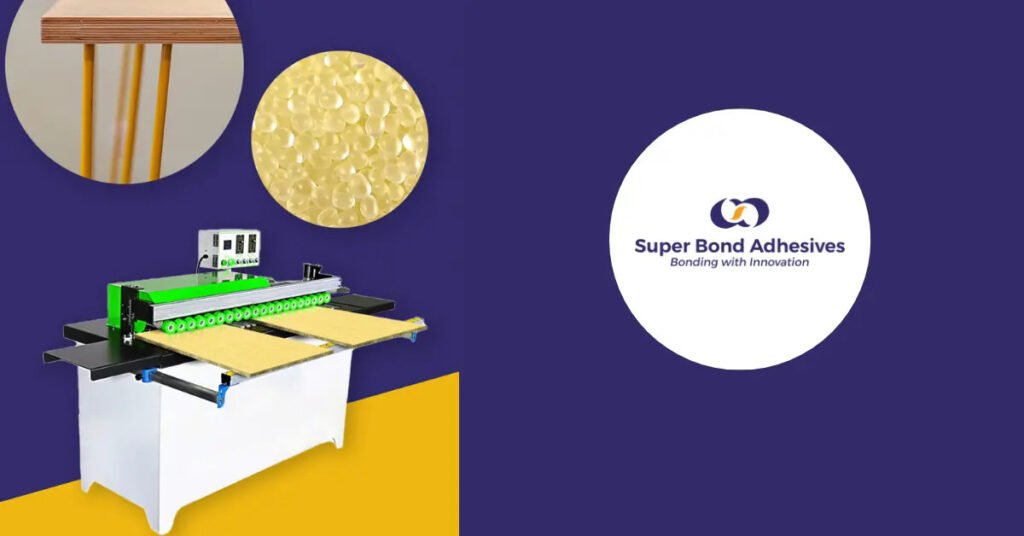
Discover industrial adhesive glue solutions for manufacturing, woodworking, packaging, and more. Learn how Super Bond Adhesives delivers reliable bonding since 1974.
Industrial Adhesive Glue: Applications, Benefits, and Selection Guide
Introduction
Adhesives have become an essential part of modern manufacturing, helping industries join different materials efficiently and reliably. From furniture and woodworking to packaging, automotive, footwear, construction, and general manufacturing, the right bonding solution can contribute to product quality and production efficiency.
Industrial adhesive glue is specially developed for demanding applications where strong, consistent, and durable bonding is required. Unlike general-purpose adhesives, industrial formulations are designed according to specific materials, production processes, application methods, and performance requirements.
With more than four decades of experience in adhesive manufacturing, Super Bond Adhesives has been developing adhesive solutions for diverse industries and applications. Established in 1974, the company has built its approach around innovation, quality, customer satisfaction, and continuous improvement.
What Is Industrial Adhesive Glue?
Industrial adhesive glue is a bonding material designed to join two or more surfaces in manufacturing and commercial applications. Depending on its formulation, an adhesive can provide properties such as strong adhesion, flexibility, fast setting, heat resistance, and compatibility with particular substrates.
Industrial adhesives are available in several technologies, including hot melt, water-based, rubber-based, pressure-sensitive, and other specialized formulations. Each technology is designed for particular applications and operating conditions.
For example, a furniture manufacturer may require an adhesive suitable for wood and decorative surfaces, while a packaging manufacturer may prioritize fast setting and compatibility with automated equipment. Therefore, selecting the right industrial adhesive glue requires an understanding of the complete bonding process.
Major Applications of Industrial Adhesive Glue
Industrial adhesives are used across many sectors because they provide an alternative or complement to mechanical fastening methods.
1. Woodworking and Furniture
Woodworking is an important application area for industrial adhesives. Manufacturers use adhesives for furniture assembly, wooden panels, decorative surfaces, laminates, and other components.
The right adhesive can help manufacturers achieve consistent bonding while supporting efficient production. Product selection should consider the type of wood, surface condition, manufacturing process, and required bond performance.
2. Packaging
The packaging industry relies heavily on adhesive technology. Adhesives can be used for carton sealing, paper products, corrugated packaging, bags, labels, and other packaging applications.
Fast-setting adhesive systems can be particularly useful in production environments where high processing speeds are required.
3. Footwear and Leather
Industrial adhesive glue is also used in footwear and leather applications. Depending on the materials and manufacturing process, adhesives can help bond soles, leather components, synthetic materials, linings, and other footwear parts.
Flexibility, tack, material compatibility, and durability are important considerations when selecting an adhesive for these applications.
4. General Industrial Manufacturing
Industrial adhesives can also be used for product assembly, component bonding, laminating, and other manufacturing processes. The appropriate adhesive depends on the substrates, production conditions, equipment, and performance requirements.
Types of Industrial Adhesive Glue
Different manufacturing requirements call for different adhesive technologies.
Hot melt adhesives are thermoplastic adhesives applied in a molten state and bonded as they cool. They are commonly considered for applications where fast setting and efficient processing are important.
Water-based adhesives use water as a carrier and are suitable for various applications involving compatible porous substrates such as wood and paper.
Rubber-based adhesives can provide tack and flexibility and may be used for applications involving materials that require flexible bonding characteristics.
The selection of a particular technology should always be based on the product specification and actual application requirements.
Benefits of Using Industrial Adhesive Glue
When the correct adhesive is selected and applied properly, it can provide several advantages to manufacturers.
Strong and Consistent Bonding
Industrial adhesive formulations can provide reliable bonding between compatible materials when used according to recommended application conditions.
Production Efficiency
Fast-setting adhesive technologies can support efficient manufacturing processes by reducing waiting or handling time in suitable applications.
Versatile Applications
Different adhesive technologies can be formulated for a wide variety of substrates and industries, allowing manufacturers to select solutions according to their specific requirements.
Improved Product Design
Adhesives can help create clean and less visible joints compared with certain mechanical fastening methods, which can be valuable in furniture, packaging, and product assembly.
How to Select the Right Industrial Adhesive Glue
Choosing an adhesive should involve more than simply comparing prices. Manufacturers should first identify the materials that need to be bonded and understand the conditions under which the finished product will be used.
Important factors include:
- Type and condition of the substrates
- Required bond strength
- Setting or curing time
- Application method
- Production speed
- Temperature and environmental conditions
- Flexibility requirements
- Equipment compatibility
- Storage and handling requirements
Manufacturers should also review the relevant technical documentation and, where appropriate, conduct application testing before implementing an adhesive in full-scale production.
Super Bond Adhesives: Four Decades of Adhesive Expertise
Super Bond Adhesives has a history spanning more than four decades in the adhesive industry. Since its establishment in 1974, the company has focused on developing innovative adhesive solutions for different industries and applications.
The company’s long-standing presence reflects its commitment to excellence, customer satisfaction, and continuous improvement. These principles are important in an industry where adhesive performance can directly influence manufacturing efficiency and finished-product quality.
For businesses evaluating industrial adhesive glue solutions, working with an experienced adhesive manufacturer can help simplify product selection and identify bonding technologies suited to specific manufacturing requirements.
Super Bond Adhesives aims to serve diverse industrial needs through its focus on adhesive innovation and customer-oriented solutions.
Conclusion
Industrial adhesive glue is an important component of modern manufacturing, supporting applications ranging from woodworking and furniture to packaging, footwear, and general industrial assembly.
The best adhesive solution depends on the materials being bonded, production process, application equipment, environmental conditions, and required performance. Therefore, manufacturers should carefully evaluate these factors before selecting an adhesive.
With a history dating back to 1974, Super Bond Adhesives brings more than four decades of experience to the adhesive industry. Its focus on innovation, excellence, customer satisfaction, and continuous improvement has helped establish a strong foundation for serving businesses seeking dependable adhesive solutions.
As industrial processes continue to evolve, selecting the right adhesive technology and working with an experienced manufacturer can help businesses achieve efficient, consistent, and reliable bonding results.