muriatic acid pool
Maintaining balanced pool water is one of the most important parts of keeping a swimming pool comfortable, clean, and protected from avoidable damage. When pH or total alkalinity moves outside the recommended range, muriatic acid can be an effective tool for bringing the chemistry back under control. However, it is a strong acid and should never be added based on guesswork or the appearance of the water. Proper testing, accurate measurements, and careful handling are essential for safe results. Understanding when and how to use muriatic acid pool treatment can make routine water maintenance much more manageable.
Understanding When Your Pool Needs Muriatic Acid
Muriatic acid is primarily used to lower high pH and can also help reduce total alkalinity when applied as part of a controlled adjustment process. Pool water with excessively high pH may contribute to scale formation, reduced sanitizer effectiveness, and uncomfortable swimming conditions. High alkalinity can make pH difficult to control because the water tends to resist changes. Before adding acid, test the water with a reliable testing method and compare the results with the recommended ranges for your pool system. Testing should always come before chemical treatment.
A high pH reading does not necessarily mean that a large amount of acid is required. The correct dose depends on factors such as pool volume, current pH, total alkalinity, and the concentration of the acid product. Different products can have different strengths, so dosage recommendations should be taken from the manufacturer’s label. Avoid copying a dosage from another pool without confirming that the water volume and product concentration are comparable. A measured, gradual approach is much safer than trying to correct the chemistry in one aggressive step.
Test pH and Total Alkalinity First
Accurate testing provides the information needed to decide whether muriatic acid is appropriate. Test both pH and total alkalinity because these measurements are closely connected and can influence how quickly the water responds to acid. Also check sanitizer levels and other important chemistry parameters when troubleshooting overall water quality. If the pH is high but alkalinity is already low, adding acid without careful consideration could create another imbalance. A complete picture of the water chemistry leads to better treatment decisions.
Testing should also be repeated after the acid has had sufficient time to circulate through the pool. Pool water does not instantly reach a uniform chemical balance the moment a product is added. Follow the manufacturer’s directions regarding circulation and retesting, and avoid making additional adjustments until the previous treatment has mixed adequately. Keeping a simple record of test results and chemical additions can be particularly helpful when pH repeatedly drifts upward. This information can reveal whether the issue is occasional or part of a recurring water-balance pattern.
How to Determine the Correct Acid Amount
There is no universal amount of muriatic acid that works for every swimming pool. The required quantity depends on pool size, starting chemistry, desired pH change, total alkalinity, and acid concentration. Manufacturer dosage charts are usually the best starting point because they are designed for the specific product being used. If the label provides a dosage for a particular water volume and pH adjustment, the recommendation can be proportionally adapted to a different pool volume when appropriate. When the chemistry is significantly out of range, smaller adjustments followed by retesting provide greater control.
For example, a homeowner may determine the pool volume and then compare the measured pH with the target range recommended for the pool system. Instead of estimating a large dose from memory, the homeowner can use the product’s dosage instructions and make the recommended adjustment carefully. After circulation, the water should be tested again before deciding whether additional acid is necessary. This process may take longer than pouring in a large quantity at once, but it substantially reduces the chance of overcorrecting the water. Precision is more valuable than speed when handling a strong pool chemical.
Safe Ways to Add Muriatic Acid
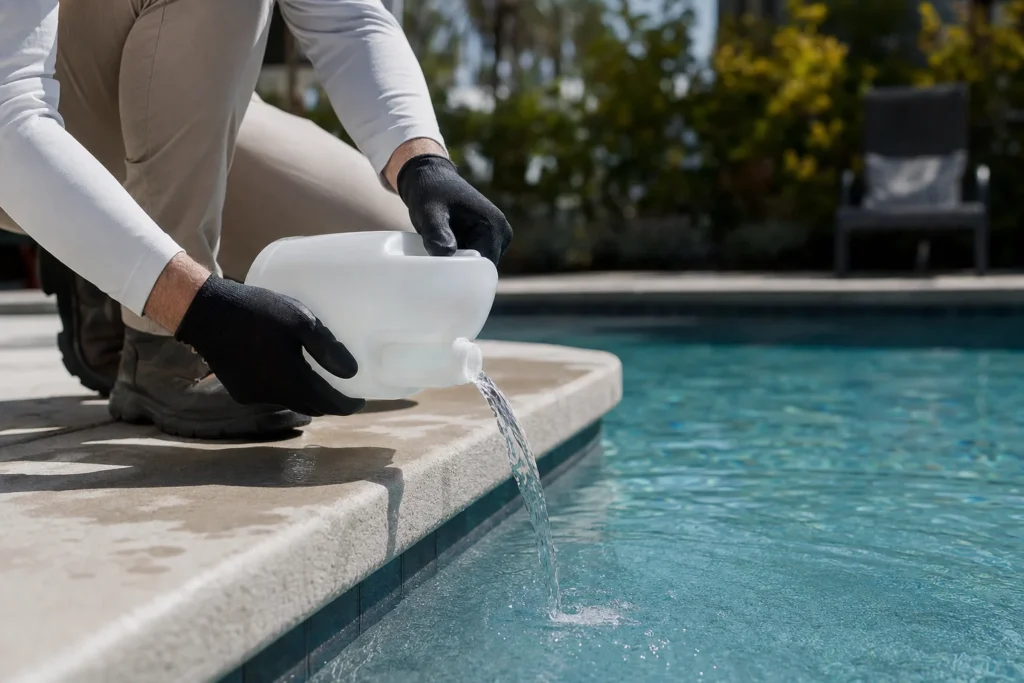
Muriatic acid should always be handled according to the product label and appropriate chemical-safety practices. Wear the protective equipment specified by the manufacturer, particularly suitable eye and skin protection, and work in a well-ventilated outdoor environment. Keep children, pets, and unnecessary bystanders away from the treatment area. Use the original labeled container and store the product securely according to the manufacturer’s instructions. Never transfer muriatic acid into an unlabeled container or another bottle that could be mistaken for a different household product.
Never mix muriatic acid directly with chlorine, shock products, or other pool chemicals. Combining incompatible chemicals can cause dangerous reactions and potentially hazardous fumes. Follow the product’s instructions for how and where the acid should be introduced into the pool. Avoid improvising dilution or application methods that are not supported by the label. If the instructions are unclear or the water chemistry is significantly abnormal, consulting a qualified pool professional is a safer choice than experimenting.
Muriatic Acid and Raising pH in a Swimming Pool
Muriatic acid lowers pH, so it should never be used for raising pH in swimming pool water. If testing shows that the pH is too low, a different treatment designed to increase pH is required. Using acid when the pH is already low can worsen the imbalance and potentially contribute to corrosion or swimmer discomfort. The correct chemical depends on the specific water chemistry and the product recommendations for the pool system. Always identify whether the water needs to move upward or downward before adding anything.
Total alkalinity also needs to be considered when correcting low or high pH. Alkalinity acts as a buffer that helps stabilize pH, meaning an unusual alkalinity reading can influence how easily pH changes. If pH repeatedly falls or rises despite reasonable chemical management, look beyond the immediate reading and investigate factors such as aeration, source water, sanitizer type, and pool usage. Making repeated chemical additions without understanding the underlying cause can create a cycle of instability. Good pool care focuses on correcting the chemistry while also identifying why the imbalance occurred.
Avoid Common Muriatic Acid Treatment Mistakes
One of the most common mistakes is adding acid without first testing the water. A second is assuming that every bottle of muriatic acid has the same concentration and therefore requires the same dosage. Another mistake is making repeated additions before allowing the previous treatment enough time to circulate. These habits can result in unnecessarily low pH or unstable alkalinity. Reading the product label and following a measured treatment process can prevent many avoidable problems.
Another important mistake is overlooking the effect of pool size on dosage. A quantity that may be appropriate for a large residential pool could be excessive for a smaller pool. Pool owners should also avoid using water appearance as a substitute for chemical testing because pH cannot be accurately judged by looking at the water. If the pool repeatedly requires significant acid adjustments, professional testing may help identify the reason. Reliable maintenance is based on measured chemistry, suitable products, careful application, and consistent monitoring.
Maintain Balanced Pool Water Long Term
Using muriatic acid correctly is only one part of maintaining healthy pool chemistry. Regularly test pH and total alkalinity, monitor sanitizer levels, maintain effective circulation, and keep the filtration system clean. The frequency of testing should reflect pool usage, weather conditions, water-source characteristics, and the type of sanitation system being used. Pools exposed to heavy swimming activity or significant rainfall may require closer monitoring. Preventive maintenance makes major chemistry corrections less likely.
If pH continues to rise or fall unusually quickly, do not simply increase the frequency of chemical additions without investigating the cause. Persistent imbalance may be related to alkalinity, aeration, source water, equipment, or other characteristics of the pool environment. A qualified pool professional can help evaluate the water and equipment together when routine adjustments are no longer producing consistent results. With accurate testing, manufacturer-guided dosing, safe chemical handling, and regular maintenance, muriatic acid can remain a useful part of a responsible pool-care routine.