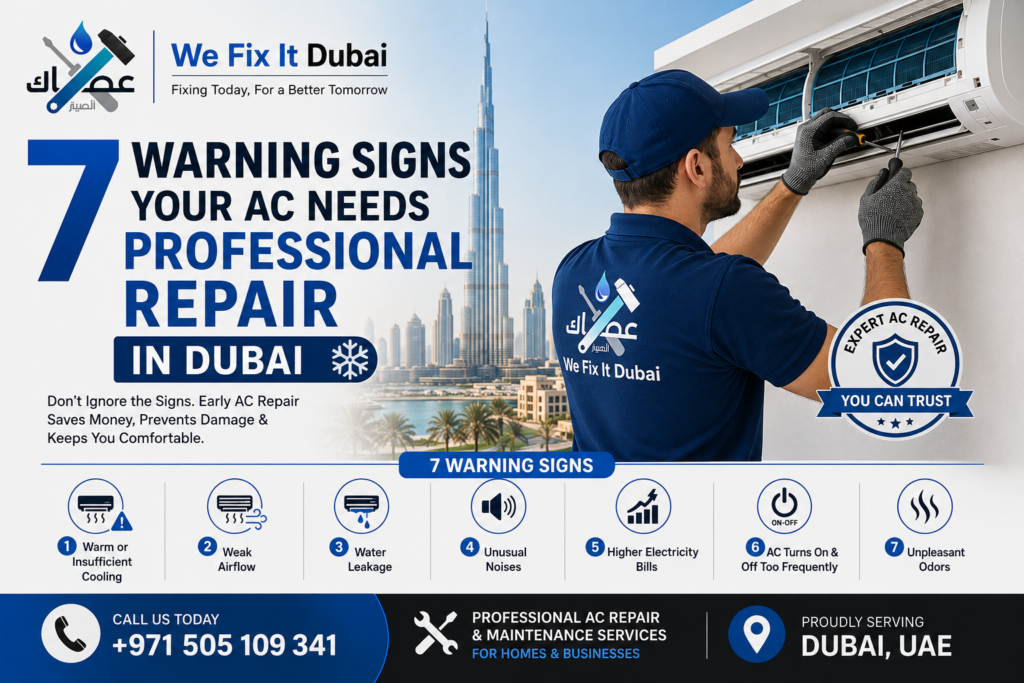
7 Warning Signs Your AC Needs Professional Repair in Dubai
7 Warning Signs Your AC Needs Professional Repair in Dubai
Introduction
In Dubai, an air conditioner is not something most homeowners can afford to ignore. With high temperatures for much of the year, cooling systems often operate for long periods, placing considerable demand on components such as compressors, fans, coils, thermostats, electrical connections, and drainage systems.
Because of this heavy use, small AC problems can develop into larger failures if they are overlooked. A system may continue running while gradually losing cooling performance, consuming more electricity, producing unusual sounds, or struggling to maintain a comfortable indoor temperature.
The challenge is knowing when an issue can be addressed through basic maintenance and when it requires professional AC repair.
Some warning signs are easy to recognize, such as warm air coming from the vents or water leaking from an indoor unit. Others can be more subtle, including frequent cycling, unusual odors, inconsistent airflow, or a gradual increase in energy consumption.
Recognizing these symptoms early gives homeowners an opportunity to investigate the problem before it develops into a more expensive breakdown. Regular AC maintenance can also help identify developing faults and keep the system operating efficiently.
In this guide, we’ll look at seven common warning signs that your air conditioner may need professional attention and explain what each symptom could mean.
Why AC Problems Shouldn’t Be Ignored in Dubai
An air conditioner that is struggling today may not necessarily stop working tomorrow. In many cases, equipment deterioration happens gradually.
A dirty filter can restrict airflow. Restricted airflow can place additional strain on the system. A drainage problem can cause water accumulation. A refrigerant issue can affect cooling performance. Electrical problems can prevent components from operating correctly.
Not every symptom means a major repair is required, but unusual changes in performance deserve attention.
Professional AC service can help determine whether the problem is related to routine maintenance, a specific component, or a more serious system fault.
Early diagnosis can also help property owners make a more informed decision about whether to repair the existing equipment or eventually consider AC replacement.
1. Your AC Is Blowing Warm or Insufficiently Cool Air
One of the clearest signs of an AC problem is when the system runs but fails to cool the room properly.
If the temperature setting appears normal but the air coming from the vents is noticeably warmer than expected, several issues could be involved. These may include restricted airflow, dirty components, thermostat problems, refrigerant-related issues, or a fault involving the compressor or another part of the cooling system.
Before arranging professional assistance, homeowners can check simple things such as the thermostat setting and whether the air filter is heavily blocked. If the problem continues, professional inspection is recommended.
Continuing to operate an underperforming AC for long periods may place additional strain on the equipment. Instead of allowing the system to run continuously while providing poor cooling, it is better to identify the underlying problem.
A professional AC repair Dubai technician can inspect the system and determine whether the issue requires cleaning, adjustment, component repair, or another solution.
What to watch for
- The AC runs continuously without cooling properly
- Some rooms remain warmer than others
- Air from the vents feels weak or warm
- The system takes much longer than usual to cool the property
These symptoms should not automatically be interpreted as a reason to replace the entire unit. A proper diagnosis should come first.
2. Airflow Has Become Noticeably Weaker
Good airflow is essential for effective cooling. If your AC is running but producing significantly less air than it used to, something may be restricting the system.
A heavily blocked filter is one possible cause. Dust accumulation, duct problems, blower issues, or other mechanical faults can also affect airflow.
Dubai’s dusty environment makes cleanliness particularly important for cooling systems. Filters and other accessible components can collect airborne particles over time, which may restrict the movement of air through the system.
Regular AC maintenance Dubai helps identify and address these issues before they become more serious.
If cleaning or replacing an accessible filter does not restore normal airflow, professional inspection is advisable. A technician can assess the blower, coils, ductwork, and other components to determine where the restriction is occurring.
Weak airflow should not simply be accepted as normal aging. A gradual reduction in performance can be an early indication that the system needs attention.
3. Your AC Is Leaking Water
Water around an indoor AC unit is another warning sign that should not be ignored.
Air conditioning systems naturally produce condensation during the cooling process. This moisture is normally collected and directed away through a drainage system. If the drain becomes blocked or another component develops a problem, water may accumulate or leak into the surrounding area.
Possible causes can vary depending on the system and installation, so homeowners should avoid assuming that every leak has the same solution.
Ignoring persistent water leakage can result in damage to nearby walls, ceilings, flooring, or furnishings. Moisture can also create an environment where unwanted biological growth may develop.
If you notice repeated dripping or water accumulation around the AC, turn the system off if appropriate and arrange a professional inspection.
A qualified technician can determine the source of the leak and recommend the appropriate AC repair.
Don’t confuse condensation with a serious leak
A small amount of condensation may be normal in some circumstances, but visible water pooling or persistent leakage should be investigated rather than ignored.
4. Your AC Makes Unusual Noises
Air conditioners produce some normal operating sounds, but a sudden change in noise can indicate a developing problem.
For example, homeowners may notice:
- Rattling
- Grinding
- Buzzing
- Hissing
- Clicking
- Vibrations
- Repeated knocking sounds
Different noises can have different causes. A loose component may create vibration, while a mechanical component experiencing wear may produce grinding or other unusual sounds.
Electrical issues can also create concerning sounds and should be assessed by a qualified professional rather than investigated by an inexperienced homeowner.
The important point is not to ignore a new or increasingly loud noise simply because the AC is still cooling.
A system can continue operating while a component gradually deteriorates. Arranging professional AC service when unusual sounds first appear may help identify the issue before it develops into a more serious failure.
5. Your Electricity Consumption Appears Higher Than Usual
An unexpected increase in electricity consumption does not automatically mean that your AC is faulty. Usage patterns, outdoor temperatures, thermostat settings, and other household equipment can all influence energy consumption.
However, if your cooling habits have remained relatively consistent while the AC seems to be working harder than before, the system may deserve an inspection.
Dirty filters, restricted airflow, dirty coils, thermostat problems, and certain mechanical or refrigerant-related issues can affect how efficiently an air conditioner operates.
When an AC struggles to achieve the desired temperature, it may need to operate for longer periods, increasing energy use.
Regular AC maintenance helps keep important components clean and operating correctly. Professional servicing can also identify issues that may be reducing system efficiency.
If increased electricity consumption occurs alongside weak cooling, long operating cycles, or unusual system behavior, these symptoms should be discussed with an HVAC professional.
6. Your AC Turns On and Off Too Frequently
An air conditioner normally cycles as it maintains the selected indoor temperature. However, if the system repeatedly starts and stops much more often than expected, there may be an underlying issue.
This behavior is sometimes called short cycling.
Several factors can contribute to frequent cycling, including thermostat problems, airflow restrictions, system sizing, component faults, or other operating conditions.
Repeated starting and stopping can be undesirable because the system is not operating through a normal cooling cycle.
If you notice that your AC switches on and off repeatedly without maintaining a stable indoor temperature, professional diagnosis can help determine the cause.
Avoid immediately replacing the thermostat or another component based solely on the symptom. The same behavior can result from different underlying problems, which is why proper diagnosis matters.
A professional AC repair technician can assess the system and determine whether maintenance, adjustment, component repair, or another solution is appropriate.
7. Your AC Produces Unpleasant or Unusual Odors
An unusual smell coming from an air conditioning system is another reason to investigate.
Different odors can have different causes. Dust accumulation, moisture, dirty filters, drainage issues, or contamination within parts of the system may contribute to unpleasant smells.
A persistent musty odor, for example, may indicate a moisture-related issue that needs attention. A burning or electrical smell should be treated more seriously because it may indicate an electrical or component-related problem.
Do not simply cover the smell with air fresheners.
The appropriate response is to identify its source.
Routine AC maintenance can help keep filters, coils, and other accessible areas clean. If an odor persists despite basic cleaning or if it is accompanied by unusual sounds, poor cooling, or other symptoms, professional inspection is recommended.
What Should You Do When You Notice an AC Warning Sign?
The first step is to avoid panicking or immediately assuming that you need a completely new air conditioner.
Some problems are relatively straightforward maintenance issues, while others require specific repairs.
A sensible approach is:
Step 1: Check the basics
Verify the thermostat setting and inspect the accessible air filter if your system allows you to do so safely.
Step 2: Observe the symptoms
Note when the problem occurs and whether it is constant or intermittent.
Step 3: Look for additional warning signs
Check whether the issue is accompanied by leaks, unusual noises, odors, weak airflow, or inconsistent cooling.
Step 4: Arrange professional inspection
If the problem persists or involves electrical, refrigerant, mechanical, or drainage components, contact a qualified HVAC professional.
Step 5: Ask for an explanation
Before approving expensive work, ask the technician what caused the issue and what repair is being recommended.
This approach can help homeowners make better decisions instead of guessing what the system needs.
AC Maintenance Can Help Catch Problems Early
Preventive maintenance and emergency repair serve different purposes.
AC maintenance focuses on keeping the system clean, inspected, and properly functioning. AC repair addresses a specific problem that has already developed.
Routine servicing may include tasks such as:
- Inspecting filters
- Cleaning appropriate components
- Checking airflow
- Inspecting electrical connections
- Checking drainage
- Testing system operation
- Inspecting coils
- Checking thermostat operation
- Looking for signs of component wear
The exact maintenance process depends on the AC system and manufacturer requirements.
For properties where air conditioners operate frequently, preventive servicing can be a practical way to identify developing problems before they result in an unexpected breakdown.
When Does an AC Problem Mean Replacement Is Necessary?
Not every AC problem requires AC replacement.
In many situations, repairing a specific component may be the most practical option, particularly when the system is otherwise in good condition.
However, replacement may become worth considering when an older system experiences repeated major failures, repair costs become significant, suitable replacement parts are difficult to obtain, or the equipment no longer meets the property’s cooling requirements.
The decision should be based on the overall condition and economics of the system rather than one isolated symptom.
A trustworthy HVAC professional should explain the available options and allow the property owner to make an informed decision.
Why Professional Diagnosis Matters
One of the most important lessons when dealing with AC problems is that symptoms do not always identify the cause.
For example, poor cooling could result from several different issues. Similarly, unusual noises do not necessarily mean that the same component has failed in every system.
Professional diagnosis helps separate the symptom from the underlying problem.
A technician should ideally:
- Inspect the system.
- Identify the likely cause.
- Explain the issue.
- Recommend an appropriate solution.
- Explain whether repair or replacement makes more sense.
- Test the system after completing the work.
This process is more reliable than replacing components based on guesswork.
Common AC Problems Homeowners Shouldn’t Ignore
While the seven warning signs above are among the most noticeable, several other changes can also indicate that your cooling system needs attention.
These include:
- Uneven room temperatures
- Excessive vibration
- Repeated circuit breaker trips
- Unusual increases in operating time
- Thermostat inconsistencies
- Persistent condensation problems
- A noticeable decline in cooling performance
- Recurring faults shortly after previous repairs
If multiple symptoms appear at the same time, professional inspection becomes even more important.
DIY AC Checks vs Professional AC Repair
There are a few basic checks homeowners can perform, but the line between simple maintenance and professional repair should be respected.
Homeowners can generally check:
- Thermostat settings
- Whether an accessible filter needs cleaning or replacement
- Whether vents are blocked
- Whether the outdoor unit has obvious airflow obstructions
Professional assistance is more appropriate for:
- Electrical faults
- Refrigerant-related work
- Compressor problems
- Motor issues
- Persistent leaks
- Mechanical faults
- Repeated system failures
- Internal component replacement
Attempting complex repairs without the appropriate technical knowledge can damage the equipment or create safety risks.
When a problem goes beyond basic maintenance, professional AC service is the better approach.
How to Choose an AC Repair Provider in Dubai
When you need professional assistance, don’t choose a provider based exclusively on price.
Consider:
Experience
Does the company regularly work with your type of AC system?
Diagnosis
Does the technician inspect the system before recommending a repair?
Transparency
Are the repair and associated costs clearly explained?
Workmanship
Does the company focus on solving the underlying problem rather than applying temporary fixes?
Maintenance
Can the provider also advise you on ongoing AC care?
Communication
Are questions answered clearly before work begins?
Service Coverage
Does the company serve your area and provide a suitable response time?
A good AC repair provider should make it easier for you to understand your options rather than making the decision more confusing.
Conclusion
Air conditioning problems rarely become convenient simply because they are ignored. In Dubai’s demanding climate, changes such as weak cooling, reduced airflow, water leakage, unusual noises, rising energy consumption, frequent cycling, and unpleasant odors can all indicate that a cooling system needs attention.
The presence of one of these symptoms does not necessarily mean that you need a new air conditioner. Sometimes the solution is simple AC maintenance; in other cases, professional AC repair may be required. For older or repeatedly failing systems, AC replacement Dubai may eventually provide better long-term value.
The key is to identify problems early and obtain an accurate diagnosis before making a major decision.
Regular AC service, combined with prompt attention to unusual changes in performance, can help homeowners maintain a more reliable cooling system and avoid unnecessary surprises.
For Dubai homeowners and businesses, taking AC warning signs seriously is not just about comfort—it is also about protecting the equipment, managing operating costs, and making informed maintenance and repair decisions.
Frequently Asked Questions
How do I know if my AC needs repair?
Poor cooling, weak airflow, water leaks, unusual noises, unpleasant odors, frequent cycling, and noticeable changes in energy consumption can all indicate that your AC needs professional attention.
Can regular AC maintenance prevent breakdowns?
Routine maintenance can help identify developing issues and keep components clean and operating correctly. It cannot guarantee that a system will never fail, but it can support more reliable operation.
Should I repair or replace an old AC?
Consider the system’s age, condition, repair history, repair cost, efficiency, and availability of parts. A professional assessment can help you compare repair and replacement options.
How often should AC service be performed in Dubai?
The appropriate frequency depends on the equipment, usage, environment, and manufacturer recommendations. Systems operating heavily may require more frequent attention.
Is weak airflow always a sign that the AC needs repair?
Not necessarily. A dirty filter or blocked vent can sometimes cause reduced airflow. If basic checks do not resolve the issue, professional inspection can identify whether another problem is involved.