Key Takeaways
- Automation services span workflow automation, RPA, CRM automation, marketing automation, AI-powered automation, and document processing
- The UAE’s National AI Strategy 2031 is accelerating enterprise adoption across every major industry
- Legacy system integration, data security, and bilingual (Arabic/English) support remain the biggest adoption gaps
- Choosing the right partner matters more than choosing the cheapest one — local compliance knowledge and post-deployment support are frequent points of failure
- Hyperautomation and AI agents are the clear direction for the next few years, not a distant trend
Every second business owner in Dubai is asking the same question this year: how do we do more with the same headcount? The answer, for a growing number of them, is automation services — and the UAE is moving faster on this than almost anywhere else in the region.
Dubai’s push toward becoming a fully digital economy isn’t just a government slogan. It’s showing up in how banks process loans, how hospitals manage patient records, and how logistics firms track shipments in real time. AI, robotic process automation (RPA), and workflow automation are no longer experimental add-ons — they’re becoming standard operating infrastructure.
This guide walks through what automation services actually cover, why automation Dubai adoption is accelerating, the gaps still holding businesses back, and how to pick a partner who can actually deliver.
What Are Automation Services?
Definition of Business Automation
Business automation means using software, AI, or robotic tools to handle repetitive tasks that would otherwise eat up human hours — data entry, invoice processing, customer replies, approval chains, and more. The goal isn’t to replace judgment; it’s to remove the busywork so people can focus on decisions that actually need a human.
Automation services are technology solutions — software, AI, and robotic tools — that handle repetitive business tasks like data entry, approvals, and customer communication without manual intervention, freeing teams to focus on higher-value work.
Types of Automation Services
Not all automation looks the same. Depending on what a business needs, it might involve:
- Workflow automation — routing approvals, tasks, and notifications automatically between teams
- Robotic Process Automation (RPA) — bots that mimic human actions across software systems
- CRM automation — auto-updating lead records, follow-ups, and pipeline stages
- Marketing automation — scheduled campaigns, lead scoring, and audience segmentation
- AI-powered automation — systems that learn from data and make context-aware decisions
- Document and invoice automation — extracting, verifying, and routing paperwork without manual keying
Most UAE businesses end up combining two or three of these rather than picking just one.
Why Automation Dubai Is Growing Faster Than Ever
UAE Market Growth Statistics
The UAE’s automation and AI spending has climbed steadily as enterprises move past pilot projects into full deployment. Banking, logistics, and government services are leading the charge, with retail and healthcare close behind.
National AI Strategy 2031
The UAE’s National AI Strategy set an ambitious target: make the country a global leader in artificial intelligence by 2031. That policy push trickles down directly into procurement decisions — government tenders increasingly favor vendors who can demonstrate AI and automation capability, not just software delivery.
Digital Transformation Across Industries
From free zones to federal ministries, digital-first mandates have pushed automation from “nice to have” to “required to compete.” A logistics company still running manual dispatch sheets is now visibly behind competitors using automated routing.
Increasing AI Adoption by UAE Enterprises
Enterprises that started with simple chatbots two years ago are now piloting agentic AI systems that can handle multi-step processes — approving expense reports, flagging compliance risks, or triaging customer tickets — with minimal human review.
Top Automation Trends in Dubai (2026)
A few trends are shaping what “automation services” means in the UAE this year:
- AI-powered workflow automation — systems that adapt routing rules based on live data, not fixed logic
- Robotic Process Automation (RPA) — still the backbone for high-volume, rules-based tasks
- WhatsApp Business automation — given how much of the UAE conducts business over WhatsApp, automated replies and order tracking here are now table stakes
- CRM and sales automation — lead routing, follow-up sequencing, and pipeline scoring
- Procurement automation — automated purchase orders, vendor matching, and approval chains
- Intelligent document processing — reading and validating invoices, contracts, and forms
- Predictive operations — forecasting demand, maintenance needs, or staffing gaps before they become problems
- AI proposal generation — drafting client-ready proposals from CRM and project data
- Secure AI governance — controls that keep automated decisions auditable and compliant
Businesses building any of these internally often look for a dedicated AI Governance Implementation Plan rather than bolting on controls after the fact.
Common Business Challenges Solved by Automation Services
Most companies don’t wake up wanting “automation” — they want a specific headache to go away. Automation services tend to solve a familiar set of problems:
- Manual processes that eat hours on repetitive, low-value work
- Slow customer response times that lose deals to faster competitors
- Data entry errors that cascade into billing disputes or compliance issues
- High operational costs from overstaffing routine functions
- Poor team productivity caused by context-switching between systems
- Compliance management that becomes unmanageable at scale without automated checks
The most common problems automation services fix in UAE businesses are slow customer response, manual data entry errors, high operating costs, and compliance tracking that’s grown too complex for spreadsheets.
Biggest Automation Gaps in the UAE Market
Adoption is growing, but it’s not frictionless. A few gaps show up repeatedly:
- Legacy system integration — older ERP or on-premise software that wasn’t built to connect with modern tools
- Data security and privacy — a genuine concern given UAE data protection rules and cross-border data flows
- SME awareness gap — many small and mid-size businesses still assume automation is only for large enterprises
- Lack of Arabic and English automation — bilingual support isn’t optional in this market, yet many tools are English-only
- Limited WhatsApp integration — few off-the-shelf platforms handle WhatsApp Business API well
- Post-deployment support — automation that works on day one but has no one maintaining it by month six
These gaps are exactly where a lot of automation projects quietly fail — not at launch, but a few months in.
Industries Benefiting Most from Automation Dubai
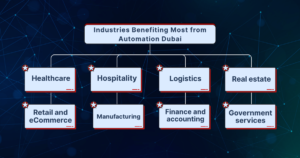
Some sectors are seeing outsized returns from automation right now:
- Healthcare — patient scheduling, records management, and insurance claims processing
- Hospitality — guest communication, booking management, and staff scheduling
- Logistics — route optimization, shipment tracking, and warehouse automation
- Real estate — lead qualification, listing management, and virtual tour scheduling
- Retail and eCommerce — inventory sync, order processing, and personalized marketing
- Manufacturing — production monitoring and predictive maintenance
- Finance and accounting — reconciliation, invoicing, and fraud detection
- Government services — citizen-facing portals and internal case management
How Advanced Integration Automation Improves Business Operations
The real value of automation shows up when systems talk to each other, not when they operate as isolated tools. Advanced integration automation connects ERP, CRM, and other business applications so data moves between them without manual re-entry.
This typically involves:
- Connecting ERP, CRM, and finance platforms into one data flow
- API integrations that let custom software talk to third-party tools
- Cloud automation for scalability without heavy infrastructure spend
- Data synchronization so every department works from the same numbers
- Cross-platform workflow automation that spans multiple departments in a single process
Businesses evaluating this layer of their stack often search for an Automation Integration System UAE that can sit across existing tools rather than replacing them outright.
Essential Features to Look for in Automation Services
Before signing with any provider, check that their offering actually includes:
- AI capabilities beyond basic rule-based logic
- CRM and ERP integration out of the box
- WhatsApp integration for the UAE market specifically
- Open API connectivity
- An analytics dashboard for visibility into what’s actually happening
- Low-code automation so business teams aren’t fully dependent on developers
- Role-based access controls
- Security and compliance certifications relevant to the UAE
- Scalability that doesn’t require a full rebuild as the business grows
How to Choose the Right Automation Partner in Dubai
Picking a vendor is where most automation projects succeed or stall. Look for:
- Industry experience — has this vendor actually built for your sector, or is this their first attempt?
- Custom development — can they go beyond templated workflows when your process doesn’t fit a standard mold?
- Local compliance knowledge — UAE-specific data and regulatory requirements matter more than generic best practices
- Integration expertise — can they connect to your existing ERP, CRM, and legacy tools without a rip-and-replace?
- Support and maintenance — what happens after go-live, not just during the sales pitch?
- ROI measurement — will they help you track actual cost savings and time recovered, or just deliver the tool and move on?
Automation Near Me: What UAE Businesses Should Consider
Searching “automation near me” usually means you want someone who understands the local market, not just a generic global vendor. A few things matter here:
- Local support — a team that responds during UAE business hours, in your time zone
- Faster deployment — proximity often means shorter onboarding cycles
- On-site consultation — some processes are easier to map out in person than over a video call
- UAE compliance expertise — familiarity with local data protection and industry regulations
- Industry-specific solutions — a partner who’s already solved your sector’s specific problems, not a one-size-fits-all package
Automation ROI: Measuring Business Success
Automation only earns its budget if it shows up in the numbers. The metrics that matter most:
- Reduced costs — fewer manual hours, fewer errors to fix
- Faster workflows — cycle times that shrink from days to hours
- Improved customer experience — faster responses, fewer dropped requests
- Better employee productivity — teams spending time on judgment calls, not data entry
- Higher revenue — faster sales cycles and fewer lost leads due to slow follow-up
Future of Automation Services in the UAE
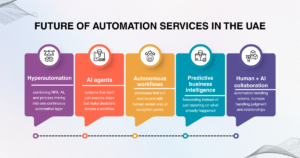
Where this is all heading over the next few years:
- Hyperautomation — combining RPA, AI, and process mining into one continuous automation layer
- AI agents — systems that don’t just execute steps but make decisions across a workflow
- Autonomous workflows — processes that run end-to-end with human review only at exception points
- Predictive business intelligence — forecasting instead of just reporting on what already happened
- Human + AI collaboration — automation handling volume, humans handling judgment and relationships
Businesses building toward this future are increasingly working with an AI agent development company Dubai rather than trying to assemble agentic systems from generic tools.
Why Businesses Are Choosing Advanced Integration Automation LLC Alternatives for End-to-End Implementation
When businesses compare providers like Advanced Integration Automation LLC against other automation partners, the decision usually comes down to a handful of factors rather than brand name alone. It’s worth evaluating any provider — this one included — against:
- Implementation depth — do they build end-to-end, or hand off partial solutions that need further work?
- Integration capabilities — can they connect cleanly with your existing ERP, CRM, and legacy systems?
- Ongoing support — is there a real team behind the tool after launch, or does support taper off once the contract is signed?
- Industry experience — have they delivered automation in your specific sector, with evidence to show for it?
This isn’t about ruling any one vendor in or out — it’s about applying the same checklist to every provider you’re considering, so the choice is based on capability rather than familiarity.
Why Choose SISGAIN for Automation Services in Dubai
Sisgain Technologies builds automation services for UAE businesses that need more than a templated workflow tool. That includes:
- AI-powered automation solutions built around real business processes, not generic templates
- Custom workflow development for teams whose processes don’t fit off-the-shelf software
- CRM and ERP integration that connects with what you’re already running
- WhatsApp automation built for how UAE customers actually communicate
- RPA implementation for high-volume, repetitive tasks
- Enterprise-grade security suited to regulated industries
- UAE-focused compliance built into the solution from day one, not added afterward
- End-to-end implementation and support that doesn’t disappear after go-live
Businesses looking to extend automation into customer-facing systems often pair this with CRM Development Company Dubai work, or start with broader AI Automation Services Dubai before scaling into specific departments.
FAQs
What are automation services?
Automation services use software, AI, and robotic tools to handle repetitive business tasks — like data entry, approvals, and customer replies — without manual effort at every step.
Why are automation services important for businesses in Dubai?
The UAE’s National AI Strategy 2031 and rapid digital transformation mean businesses that don’t automate routine work fall behind competitors on cost, speed, and customer experience.
Which industries benefit most from automation in the UAE? Healthcare, hospitality, logistics, real estate, retail, manufacturing, finance, and government services are seeing the strongest returns from automation right now.
How much do automation services cost?
Cost depends on scope — a single workflow automation project costs far less than a full ERP-CRM integration with AI-powered decision-making. Most providers scope pricing after an initial process audit.
What is workflow automation?
Workflow automation routes tasks, approvals, and notifications between people and systems automatically, based on rules or triggers, instead of relying on manual handoffs.
What is RPA?
Robotic Process Automation (RPA) uses software bots to mimic human actions — clicking, typing, copying data — across existing applications, without changing the underlying systems.
How long does automation implementation take?
Simple workflow automation can go live in a few weeks. Full integration across ERP, CRM, and custom AI systems typically takes a few months, depending on how many legacy systems are involved.
Can automation integrate with existing ERP or CRM systems?
Yes, most modern automation platforms use APIs to connect with existing ERP and CRM systems rather than requiring a full replacement.
Is WhatsApp automation suitable for UAE businesses?
Very much so. WhatsApp is a primary business communication channel in the UAE, and automating replies, order updates, and appointment reminders there tends to show fast, visible ROI.
How do I choose the right automation partner in Dubai?
Prioritize industry experience, integration expertise, local compliance knowledge, and clear post-launch support over the lowest quote — cheap automation that breaks in month three costs more than it saved.

Conclusion
The UAE’s automation opportunity isn’t hype — it’s showing up in procurement policy, enterprise IT budgets, and the National AI Strategy itself. Businesses that treat automation as core infrastructure, not a side project, are the ones pulling ahead on cost, speed, and customer experience.
If your business is still running manual processes that a competitor has already automated, the gap will keep widening. The businesses winning in this market are the ones choosing scalable, compliance-aware automation built for their specific industry — not a generic package that happens to be cheap.