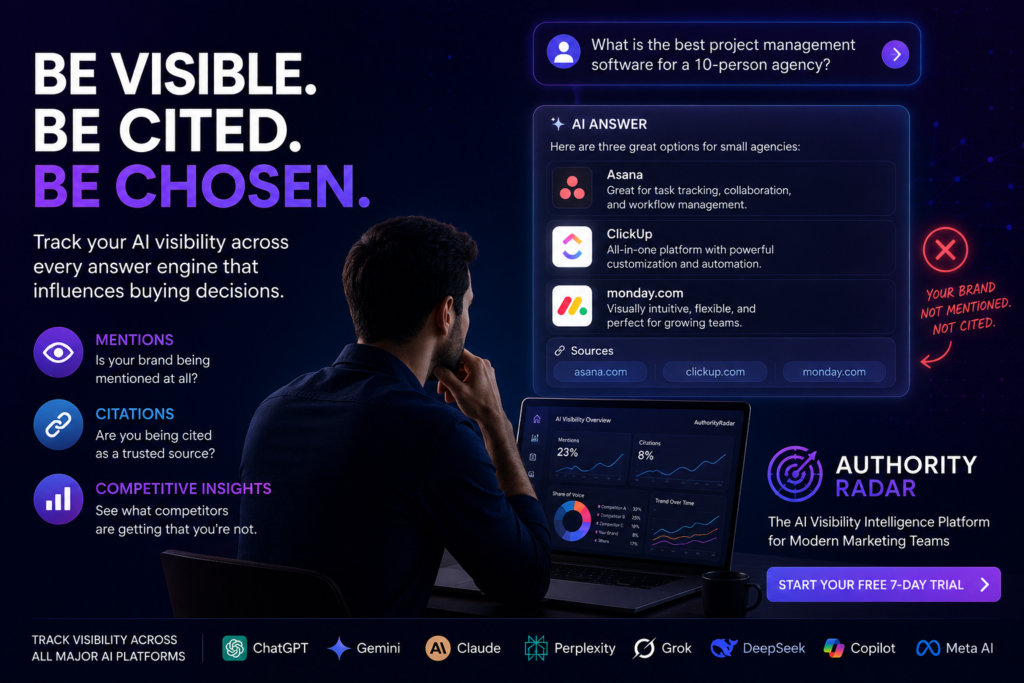
A potential customer opens ChatGPT and types: “What is the best project management software for a 10-person agency?”
ChatGPT generates a paragraph. It names three tools. Yours is not one of them.
That customer closes the tab, visits one of the named tools, and signs up for a free trial. Your Google ranking of #2 for “project management software agencies” did not matter. Your blog traffic did not matter. You simply did not exist in the moment the decision was forming.
This is the new visibility problem, and most marketing teams have no idea it is happening to them.
The Gap Between Traditional SEO and AI Search Visibility
Traditional SEO tells you what is happening in Google: impressions, rankings, clicks, CTR. These numbers are real and still matter. The problem is they tell you nothing about how your brand appears when a buyer asks ChatGPT, Perplexity, Gemini, Claude, or Google AI Overviews a question in your category.
AI answer engines do not serve a list of ten blue links. They synthesize a response from multiple retrieved sources and may or may not name your brand in that response. Whether you appear, how you are described, and whether you are cited as a source are three completely different outcomes, each requiring a different measurement approach.
Research published by Princeton, Georgia Tech, IIT Delhi, and the Allen Institute for AI found that generative AI visibility is measurable and improvable, and that content-level changes such as adding statistics, named sources, and structured FAQ sections can improve AI citation rates by up to 40 percent. But you cannot improve what you are not measuring.
This is exactly the gap that AI visibility tracking is built to close.
Three Things You Need to Know That Google Analytics Cannot Tell You
1. Are You Being Mentioned at All?
A mention is when your brand name appears anywhere in an AI-generated answer. It sounds like a low bar, but for brands with low entity recognition, it is the baseline that needs establishing before anything else. If AI systems do not recognize your brand as a distinct entity in your category, no amount of content optimization will fix the underlying problem.
The only way to know your mention rate is to run a consistent set of prompts across AI platforms and record what comes back. Not once. On a schedule. Because AI answers change as models update and competitors publish new content.
2. Are You Being Cited as a Source, or Just Named in Passing?
A citation is when your domain appears in the source references of an AI response, meaning the AI treated your content as something worth pointing to, not just a brand name it recognized. This is meaningfully different from a mention, and the gap between your mention rate and your citation rate is one of the most diagnostic signals in AI visibility.
High mentions, low citations usually means brand recognition without content authority. The fix is structural: your content needs to be more citable at the passage level, with direct answers, named statistics, and proper schema markup.
You can read the full framework for understanding the difference between a mention, a citation, and a link in AI search specifically, since the three behave differently across platforms.
3. What Are Competitors Getting That You Are Not?
AI search creates a zero-sum attention dynamic. When a buyer asks “what is the best X for Y,” the AI names a short list. Every brand on that list took a slot. Every brand not on it lost one. Knowing your citation share relative to competitors, by platform and by query type, tells you exactly where the gap is largest and which prompts are the highest priority to address.
Why the Gap Is Widening
AI Overviews now appear on a substantial share of all Google queries, and Perplexity has crossed 100 million monthly active users. These are not experimental features. They are the way a growing share of your buyers are researching, comparing, and shortlisting products right now.
The brands that are currently winning AI visibility did not get there by accident. They got there by building content that AI systems can retrieve, parse, and cite confidently: structured pages, consistent entity signals, third-party editorial presence, and schema markup that makes key facts machine-readable.
Traditional SEO alone is no longer sufficient to ensure your brand appears in the moments that matter. The tooling, the measurement approach, and the content strategy all need to account for AI search as a distinct surface, not a footnote to organic performance.
What Fixing This Actually Looks Like
The fix is not complicated in theory, but it requires a measurement foundation that most teams currently lack. You need to know your current citation rate across platforms before you can improve it. You need a consistent prompt set that represents how your buyers actually query AI systems. And you need trend data over time, not just a one-off snapshot, because a single check tells you the current state, not whether you are moving in the right direction.
Authority Radar was built specifically for this problem. It tracks brand mentions and citations across ChatGPT, Gemini, Claude, Perplexity, Grok, DeepSeek, Copilot, and Meta AI in a single platform, separates mentions from citations, tracks sentiment per platform, and gives you competitive share-of-voice data so you know exactly where you stand relative to the brands your buyers are comparing you against.
If your brand is not showing up in AI answers today, the gap is not going to close by itself. Start a free 7-day trial and see what AI is actually saying about you, before your competitor does.