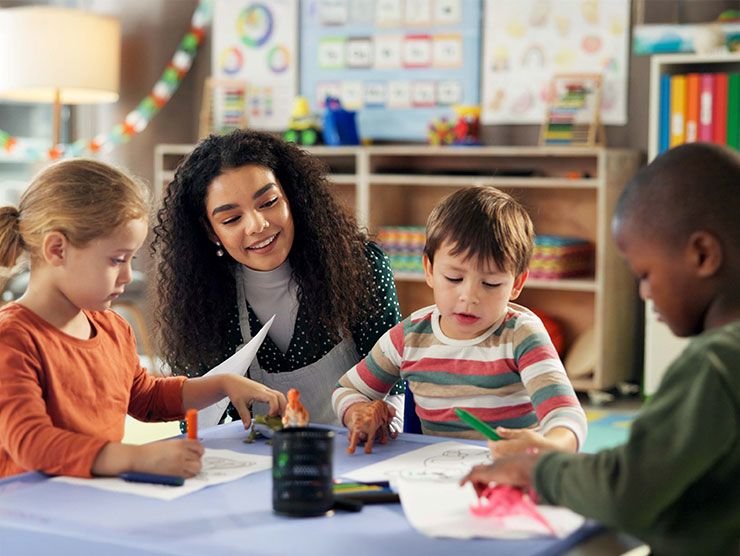
A cardboard box can become a spaceship, a handful of blocks can inspire a skyscraper, and a simple game can teach a child how to share. These everyday moments show why play is much more than entertainment during the early years. In a quality Davie Preschool, play-based learning gives children meaningful opportunities to explore ideas, practice essential skills, and develop confidence. By combining fun with purposeful activities, educators help young learners build a strong foundation for future academic and personal success.
What Is Play-Based Learning in Preschool?
Play-based learning is an educational approach that uses enjoyable, hands-on activities to help young children understand the world around them. Instead of relying mainly on worksheets, memorization, or formal lessons, teachers create experiences that encourage children to investigate, experiment, ask questions, and solve problems.
For example, children might learn counting by sorting toy animals, recognize shapes while building with blocks, or practice language skills during pretend grocery shopping. Although these activities may appear simple, each one offers opportunities to develop important abilities.
There are two common forms of play-based learning. In child-directed play, children choose activities according to their interests. In guided play, teachers introduce specific learning goals while allowing children to make decisions and explore independently.
Both approaches are valuable. Child-directed play encourages curiosity and independence, while guided play helps educators connect children’s interests with age-appropriate educational objectives.
Why Play-Based Learning Matters During Early Childhood
Young children learn best when they can interact with their surroundings. At the preschool age, they are naturally curious and eager to discover how things work. Play provides a comfortable environment where they can explore new concepts without feeling overwhelmed by expectations.
When children participate in meaningful activities, they can connect new information with experiences they already understand. For instance, pouring water into different containers introduces early ideas about volume, while arranging objects by size encourages comparison and classification.
Play also allows children to learn at their own pace. Some may quickly recognize numbers, while others need repeated opportunities to practice. Teachers can observe these differences and adapt activities to suit individual developmental needs.
Most importantly, play makes learning feel relevant. Rather than simply being told what something means, children experience it directly, helping them develop understanding through active participation.
How Play Supports Essential Academic Skills
Play-based learning does not mean that academic development takes a back seat. Instead, it introduces early literacy, mathematics, science, and other concepts through experiences that make sense to young learners.
Building Early Reading and Writing Abilities
Language develops naturally when children talk, listen, tell stories, and interact with others. During pretend play, children often create characters, invent situations, and explain what happens next. These conversations strengthen vocabulary, listening comprehension, and storytelling skills.
Books can also become part of play. After reading a story about animals, a teacher might invite children to act out the characters or create animal homes using craft materials. Such activities encourage children to recall details, sequence events, and express their understanding.
Early writing skills develop through activities such as drawing, tracing shapes, making signs for pretend shops, and writing their names on artwork. These experiences help children strengthen hand control while discovering that written symbols communicate meaning.
Introducing Mathematics Through Everyday Activities
Children encounter mathematical ideas throughout the preschool day. Building towers introduces height and comparison, while sorting buttons encourages classification. Counting snack items or dividing play food among toy characters provides practical experience with numbers and quantities.
Consider a pretend bakery activity. Children can count cupcakes, compare prices on picture menus, sort items by shape, and decide how many plates they need. One engaging activity can therefore support several mathematical concepts.
These early experiences help children recognize patterns, estimate quantities, and develop logical thinking. As they become comfortable with basic concepts, they enter kindergarten with a stronger foundation for more formal mathematics instruction.
Encouraging Scientific Thinking and Discovery
Young children frequently ask questions about nature, movement, weather, and everyday objects. Play-based activities give them opportunities to investigate these questions rather than simply memorize answers.
A water table, for example, can introduce concepts such as floating, sinking, and displacement. Children might predict which objects will float, test their ideas, and discuss what they observe.
Gardening offers another useful learning experience. By planting seeds and observing changes over time, children begin to understand plant growth, develop patience, and recognize relationships between living things and their environment.
These experiences encourage observation, prediction, experimentation, and reflection. They also help children understand that making mistakes is a normal part of discovering something new.
Developing Social and Emotional Skills Through Play
Academic knowledge is only one part of a child’s education. Children also need to learn how to communicate, manage emotions, cooperate with others, and respond to everyday challenges. Play offers a natural setting for practicing these skills.
Learning Cooperation and Communication
Group activities require children to listen, express ideas, negotiate roles, and work toward shared goals. When building a pretend town, for example, one child might construct roads while another creates houses. They must communicate to make their plans work together.
Conflicts may arise when two children want the same toy or disagree about the rules of a game. With patient guidance, teachers can help them use words to explain their feelings, listen to another perspective, and find a fair solution.
These experiences teach children that cooperation involves more than taking turns. It also requires patience, flexibility, respect, and an understanding that other people may have different ideas.
Strengthening Emotional Awareness and Self-Regulation
Preschool children are still learning how to manage frustration, disappointment, excitement, and impatience. Play creates opportunities to practice these abilities in a supportive environment.
A child who loses a simple board game may feel disappointed. With encouragement, the child can learn to acknowledge that feeling, calm down, and try again. Similarly, waiting for a turn on the playground helps children practice patience and impulse control.
Pretend play can also help children explore emotions. Acting out a doctor’s visit or a story about friendship may allow them to express concerns and better understand how others feel.
Over time, these experiences can support emotional resilience and help children approach unfamiliar situations with greater confidence.
Improving Creativity, Problem-Solving, and Independence
Children do not always follow a predictable path when they play. A block tower might collapse, a puzzle piece might not fit, or a pretend restaurant might run out of supplies. These small challenges encourage children to think creatively and look for solutions.
Instead of immediately correcting every problem, teachers can ask questions such as, “What else could you try?” or “How might we make the tower stronger?” Such prompts encourage children to consider alternatives and test their ideas.
Open-ended materials are particularly useful because they can serve many purposes. Blocks, recycled cardboard, clay, fabric, and loose natural materials allow children to invent their own projects rather than follow one fixed set of instructions.
Play also encourages independence. Children practice choosing activities, gathering materials, making decisions, and cleaning up afterward. These routines build responsibility and help them understand that their choices have consequences.
When educators give children room to experiment while offering support when needed, they nurture a positive attitude toward challenges and learning.
The Role of Teachers in Effective Play-Based Education
Successful play-based learning requires thoughtful planning. Teachers do more than provide toys and supervise activities; they create an environment where children can explore safely and develop specific skills.
Educators observe how children use materials, communicate with classmates, and respond to challenges. These observations help them identify interests, recognize developmental progress, and decide when additional guidance might be helpful.
For example, if children show an interest in construction vehicles, a teacher could introduce picture books about buildings, provide measuring tools, and encourage children to design roads with blocks. This approach connects children’s curiosity with opportunities to explore language, measurement, and collaboration.
Teachers must also balance freedom with structure. Children need enough independence to direct their play, but they benefit from clear boundaries, accessible materials, and occasional prompts that extend their thinking.
An effective learning environment includes activities for different interests and abilities. Art areas, reading corners, construction spaces, outdoor play areas, and imaginative-play centers give children several ways to participate and express themselves.
Play-Based Learning Compared With Traditional Instruction
Both play-based learning and direct instruction can contribute to early education. The most appropriate approach depends on the learning objective, the child’s developmental stage, and how the teacher structures the experience.
| Learning Area | Play-Based Approach | Direct Instruction Approach |
|---|---|---|
| Early literacy | Acting out stories, exploring books, and creating signs | Introducing letters, sounds, and vocabulary explicitly |
| Mathematics | Counting toys, sorting objects, and building patterns | Practicing number recognition and guided counting |
| Science | Testing objects, observing plants, and exploring materials | Explaining scientific concepts and demonstrating processes |
| Social development | Sharing materials, negotiating roles, and solving disagreements | Discussing classroom rules and modeling expected behavior |
| Problem-solving | Trying different strategies during games and construction | Following a teacher-demonstrated method |
| Independence | Choosing activities and managing materials | Completing structured tasks with teacher guidance |
Neither approach needs to exclude the other. Children benefit when teachers combine purposeful explanations with opportunities to apply ideas through hands-on exploration.
For example, a teacher can demonstrate how to recognize a particular shape and then invite children to find that shape in the classroom, build it with craft sticks, or use it in an artwork. This combination reinforces understanding while keeping learning engaging.
Practical Play-Based Activities Parents and Teachers Can Try
Play-based learning does not require expensive equipment or elaborate lesson plans. Everyday materials and familiar routines can provide valuable learning opportunities when adults encourage children to think, communicate, and explore.
Create a Pretend Grocery Store
Set up a small shop using empty food containers, reusable bags, toy money, and picture labels. Children can take turns being shoppers and cashiers while practicing counting, sorting, conversation, and cooperation.
Adults can introduce simple challenges, such as finding three red items or placing five pretend fruits in a basket. Keep the activity flexible so children can develop their own ideas.
Build With Blocks and Recycled Materials
Provide blocks, cardboard tubes, small boxes, and other safe construction materials. Invite children to build a bridge, create a house, or design a playground for toy figures.
Ask open-ended questions about their designs. If a structure falls, encourage children to consider what they could change rather than rebuilding it for them.
Explore Nature Outdoors
Collect safe natural materials, observe insects from a respectful distance, examine leaves, or compare the shapes of stones. Children can group their findings, describe textures, draw observations, and discuss similarities and differences.
Outdoor exploration supports movement and curiosity while introducing early science concepts. Adults should supervise closely and prevent children from tasting unknown plants or handling potentially hazardous objects.
Turn Everyday Routines Into Learning Moments
Cooking with adult supervision, setting the table, sorting laundry, and organizing toys can all support early learning. Children can count spoons, compare sizes, identify colors, or follow simple sequences.
These everyday tasks are especially helpful because they show children that learning happens beyond the classroom. They also encourage responsibility and give children opportunities to participate meaningfully in family routines.
How to Recognize a Quality Play-Based Preschool
Parents who want a balanced early education should look beyond the number of toys or the appearance of a classroom. The quality of the learning environment depends on how teachers use activities to support children’s development.
When visiting a preschool, observe whether children have opportunities to make choices, ask questions, explore different materials, and interact positively with classmates. A strong program should offer a thoughtful balance of child-directed play, teacher-guided experiences, outdoor movement, creative activities, and quiet time.
It is also worth asking how teachers assess progress. In a developmentally appropriate classroom, educators may use observations, conversations, children’s projects, and examples of their work to understand emerging skills.
Consider these practical questions during a school visit:
- Do teachers encourage children to explain their thinking rather than simply provide answers?
- Are materials accessible, age-appropriate, and suitable for different interests and abilities?
- How do educators help children resolve disagreements and manage strong emotions?
- Does the daily schedule provide enough time for uninterrupted exploration?
- How does the school communicate children’s progress and learning goals to families?
Parents should also look for a safe, welcoming atmosphere where children feel comfortable asking for help and trying unfamiliar activities. A quality program recognizes that children develop at different rates and adapts its teaching accordingly.
Preparing Children for a Confident Start in Kindergarten
Kindergarten readiness involves more than recognizing letters and counting to a particular number. Children also need to follow routines, communicate their needs, manage personal belongings, cooperate with classmates, and approach new challenges with a willingness to learn.
Play-based experiences help children practice these skills in meaningful situations. A group game may teach them to listen to directions, while a pretend classroom activity can introduce routines such as organizing supplies and following a sequence of tasks.
Children also learn to persist when an activity becomes challenging. Completing a puzzle, revising a block structure, or learning the rules of a new game encourages patience and flexible thinking.
A Davie Preschool that incorporates purposeful play into its daily curriculum can help children develop these interconnected abilities while respecting their individual learning styles. However, readiness is not a race, and children do not need to master every academic skill before kindergarten.
The goal is to help young learners feel capable, curious, and comfortable participating in a classroom community. These qualities provide a valuable starting point for continued academic and social development.
Conclusion
Play-based learning gives preschool children a meaningful way to develop the academic, social, emotional, and practical skills they need for future success. Through storytelling, construction, imaginative games, outdoor exploration, and everyday activities, children learn to solve problems, communicate ideas, manage emotions, and approach challenges with curiosity. The best early learning environments combine child-led discovery with thoughtful teacher guidance, creating experiences that are both enjoyable and educational. When choosing a preschool, parents should look for a program that values purposeful play, individual development, and positive relationships. By supporting learning through play, families and educators help children build confidence and establish a strong foundation for kindergarten and beyond.
Frequently Asked Questions
1. What is the main purpose of play-based learning in preschool?
The main purpose is to help children develop important skills through enjoyable, hands-on experiences. Play supports early literacy, mathematics, communication, creativity, emotional regulation, and problem-solving while encouraging curiosity and active participation.
2. Does play-based learning prepare children academically for kindergarten?
Yes. Well-planned play can introduce letters, numbers, patterns, shapes, vocabulary, and early scientific concepts. It also helps children practice following directions, cooperating with classmates, and persisting through challenges, all of which support kindergarten readiness.
3. How is guided play different from free play?
Free play allows children to choose their activities and direct their own experiences. Guided play includes a learning goal introduced by a teacher, who may ask questions or provide materials while allowing children to explore and make decisions independently.
4. What can parents do to encourage play-based learning at home?
Parents can read stories together, build with blocks, play counting games, create pretend shops, explore nature, and involve children in simple household routines. Asking open-ended questions and allowing children to experiment can make these activities more educational.
5. How can parents tell whether a preschool uses play-based learning effectively?
Look for a classroom where children actively explore materials, engage in imaginative play, communicate with classmates, and receive supportive guidance from teachers. Ask how activities connect with learning goals, how educators track development, and how the school balances play with structured instruction.