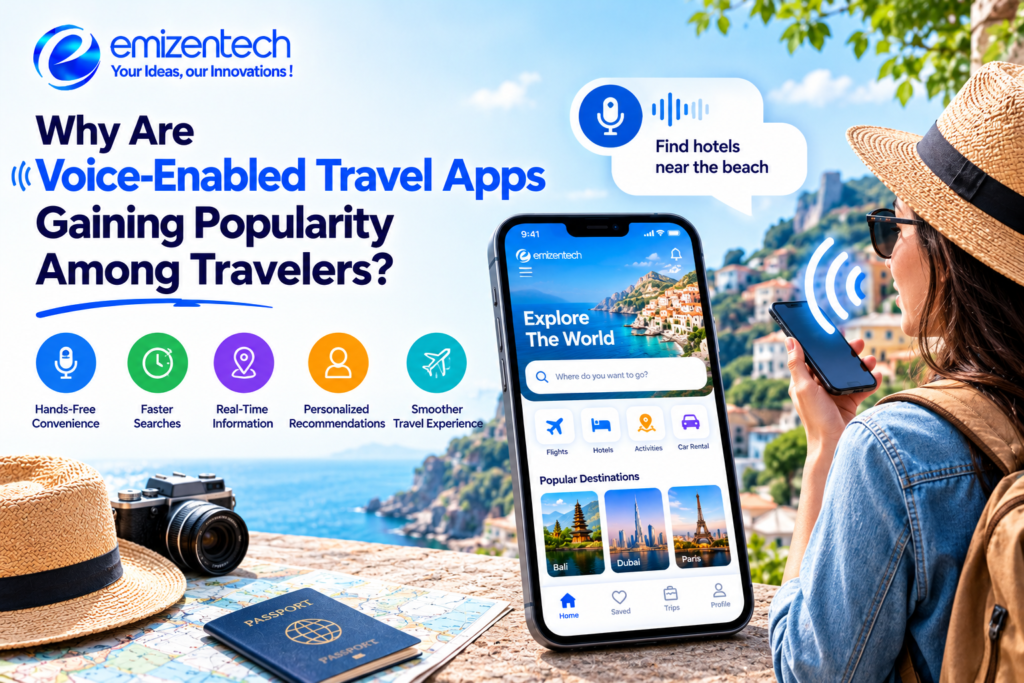
Travel involves a lot of small tasks that happen while hands are busy: pulling a suitcase, holding a coffee, carrying a child, or walking through a crowded station. Typing on a small screen during these moments is slow and frustrating. Voice-enabled travel apps offer a simpler option. A traveler can speak a question, get an answer, and keep moving. This article looks at why voice features are becoming popular, how they are used across a trip, and what developers should keep in mind.
What Are Voice-Enabled Travel Apps?
A voice-enabled travel app lets users speak instead of type or tap. They can ask for flight status, search for hotels, request directions, or translate a phrase. The app listens, understands the request through speech recognition and language processing, and replies with text, audio, or both.
Many people already use voice assistants such as Siri, Google Assistant, and Alexa for everyday tasks. Travel apps build on that habit. Expedia and Kayak, for example, have offered Alexa skills for checking trip details, and Google Translate includes a conversation mode that translates speech between two people in real time.
Key Reasons Travelers Are Adopting Voice Features
Voice is not popular because it is new. It is popular because it solves problems that travelers face repeatedly. The reasons below explain most of the growth, and each one reflects a real situation that people deal with during a trip.
Hands-Free Convenience on the Go
Travelers are often carrying bags, driving a rental car, or walking in unfamiliar places. Speaking a request is safer and easier than looking down at a screen. Voice navigation in Google Maps and Apple Maps is a common example of this.
Faster Search and Booking
Speaking is usually faster than typing, especially on a phone. Saying “find a hotel near the airport under 150 dollars” can replace several taps and filters. This helps most when time is short, such as when a flight is cancelled and a new booking is needed quickly.
Better Support for Multilingual Travel
Language barriers are a major source of travel stress. Voice translation lets people ask for directions, order food, or talk to a taxi driver without knowing the language. Apps like Google Translate and iTranslate have made this widely available.
Improved Accessibility
Voice interfaces help people with visual impairments, limited mobility, or difficulty typing. Built-in tools like VoiceOver and TalkBack already work with many apps. Travel apps that support voice make planning and navigation easier for a wider group of people.
How Voice Technology Improves the Travel Experience?
Beyond convenience, voice changes how people interact with a trip. Instead of searching through menus, they can ask direct questions in natural language, such as “Is my flight on time?” or “What is the closest pharmacy?” The app can then pull data from several sources and answer in one response.
Voice also reduces stress at difficult moments. During delays, gate changes, or missed connections, travelers can get help without stopping to type. When combined with real-time data, voice assistants can offer proactive alerts, like telling a user that their gate has changed.
Personalization improves as well. If a traveler often asks for vegetarian restaurants, the app can remember that preference and suggest suitable places without being asked again.
Popular Features in Voice-Enabled Travel Apps
Not every voice feature is equally useful. Travelers tend to rely on the ones that save time or reduce confusion. The features listed below appear most often in successful travel apps and match the tasks people perform most during a trip.
- Voice search for flights, hotels, and activities
- Spoken navigation with turn-by-turn directions
- Real-time translation for conversations and signs
- Itinerary queries, such as asking for check-in time or tomorrow’s schedule
- Flight and gate updates delivered by voice alerts
- Voice-based customer support for changes and cancellations
Real-World Use Cases Across the Travel Journey
Voice fits into almost every stage of a trip, from the first idea to the journey home. The examples below show where it makes the biggest difference and how travelers use it in everyday situations.
Before the Trip
People use voice to research destinations, compare prices, and ask for packing suggestions. A parent might ask a voice assistant for family-friendly activities in Lisbon while cooking dinner.
At the Airport
Travelers check gate numbers, security wait times, and baggage claim details without stopping to scroll. Airline apps that support voice make these checks faster during busy moments.
During the Stay
Some hotels, including properties that use Alexa for Hospitality, let guests control lights, request towels, or ask about breakfast hours by speaking to a device in the room.
While Exploring
Voice guides and translation tools help visitors navigate local areas, find restaurants, and understand signs. This is especially useful in places where the traveler does not speak the language.
Making these moments work smoothly depends on solid travel mobile app development, because speech recognition has to be paired with live flight, hotel, and map data before a spoken question can produce a correct answer.
Best Practices for Building Voice-Enabled Travel Apps
A voice feature that works poorly is worse than no voice feature at all. Misheard words or slow replies quickly frustrate users. These practices help teams build voice tools that people trust and keep using.
- Support many accents and languages, since travelers speak differently from region to region.
- Work in noisy places, like airports and streets, by testing in real conditions.
- Offer a text fallback so users can switch when speaking is not appropriate.
- Handle privacy carefully, with clear consent for recordings and compliance with GDPR and CCPA.
- Keep responses short, because long spoken answers are hard to follow.
Future Outlook: What’s Next for Voice in Travel
Voice assistants are becoming more conversational. With improvements in AI, a traveler could soon describe a trip in plain language and receive a complete itinerary, then adjust it by speaking. Assistants may also handle changes automatically, such as rebooking a connection after a delay and confirming the new details by voice.
Other developments include better offline voice recognition for areas with weak signals, more accurate real-time translation, and integration with wearables and car systems. At the same time, accuracy and privacy will remain central concerns. Apps that handle both well are likely to earn lasting trust.
Conclusion
Voice-enabled travel apps are growing because they fit how people actually travel: on the move, often tired, and usually busy. Hands-free control, faster search, language support, and better accessibility all solve everyday problems. For businesses, the lesson is to start with a few reliable voice features rather than many unfinished ones, test in real conditions, and treat privacy as a basic requirement. EmizenTech follows this same approach when working on travel app projects, focusing on voice tools that fit naturally into the journey and simply help the traveler get where they are going.
FAQs
- What is a voice-enabled travel app?
It is a travel app that lets users speak to search, book, get directions, or translate, instead of typing or tapping. - Why are travelers choosing voice features?
Voice is hands-free, faster than typing, and useful while carrying bags, driving, or walking in unfamiliar places. - Can voice travel apps help with language barriers?
Yes. Many apps offer real-time voice translation, which helps travelers ask for directions, order food, or talk to local people. - Are voice-enabled travel apps safe to use?
Reputable apps follow privacy laws like GDPR and CCPA and ask for consent before recording. Users should still review permissions and avoid speaking sensitive details in public. - Do voice travel apps work offline?
Some features, such as saved translations and offline maps, can work without internet. Most search and booking features still need a connection.