Energy costs have a way of getting everyone’s attention.
When energy bills rise, production teams notice. Maintenance teams notice when equipment uses more power than expected. Management notices when energy targets are missed.
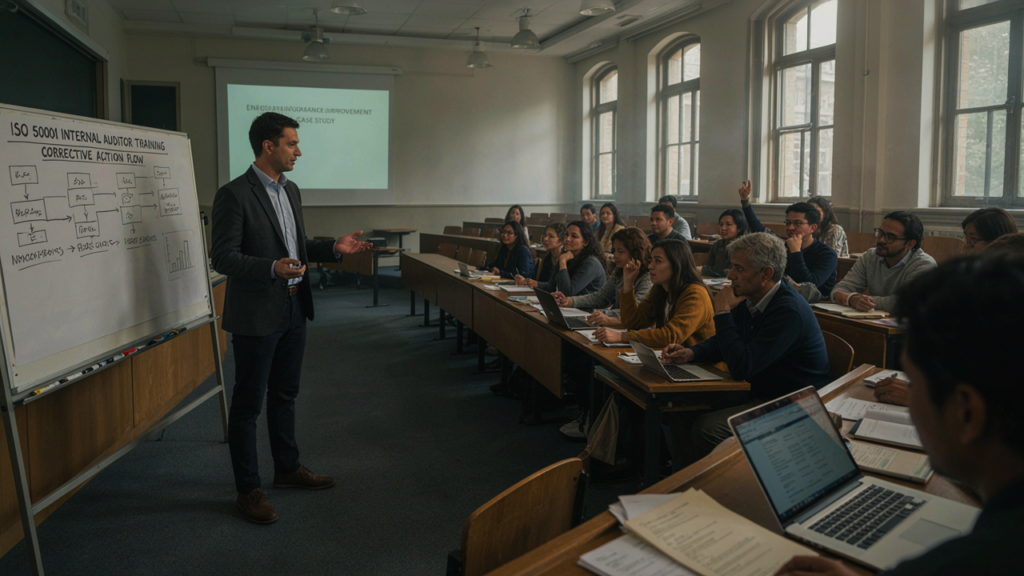
That’s why ISO 50001 internal auditor training can be useful for more people than you might think.
ISO 50001 gives organizations a clear framework for managing energy. It covers energy use, energy consumption, energy performance, monitoring, targets, and continual improvement.
But who should learn to audit an ISO 50001 Energy Management System (EnMS)?
The answer isn’t limited to energy managers.
Engineers, facility teams, maintenance staff, sustainability professionals, quality auditors, production managers, EnMS coordinators, and ISO consultants can all benefit from this training.
So, let’s look at who should attend — and why the training can matter in their day-to-day work.
Why Is ISO 50001 Internal Auditor Training Important?
An Energy Management System can look good on paper.
There may be an energy policy, targets, records, energy data, performance indicators, and improvement plans. But here’s the real question:
Does the system actually work?
That’s what an internal audit helps determine.
ISO 50001 gives organizations a structured way to manage energy performance. It helps them set objectives, use energy data, measure results, review performance, and improve over time.
Internal audits provide a way to check whether these activities are working as planned.
But auditing isn’t only about reading clauses and ticking boxes.
A good auditor needs to understand the process, review evidence, ask clear questions, and notice when something doesn’t make sense.
For example, imagine that a factory reports lower electricity use this year.
That sounds good.
But what if production also fell by 30%?
Suddenly, the number needs more context.
This is why an ISO 50001 auditor looks at more than one figure. They consider energy performance, relevant variables, significant energy uses, monitoring methods, targets, and improvement actions.
Good internal auditing can help an organization find weak points before they become bigger problems. It can also support preparation for an external certification audit.
More importantly, it can make energy management part of normal business activity instead of treating it as another pile of paperwork.
Energy Managers Are a Natural Fit
Let’s start with the obvious group: energy managers and energy management teams.
These professionals often work directly with energy performance, energy data, targets, and improvement projects.
They may already understand electricity, fuel, steam, compressed air, HVAC systems, boilers, motors, or other major energy users.
ISO 50001 Internal Auditor Training adds another skill to that technical knowledge.
It teaches them to look at the management system behind the numbers.
Instead of asking only, “How much energy are we using?” they can ask:
- Are energy objectives clearly defined?
- Are significant energy uses being monitored?
- Are relevant variables being considered?
- Is energy performance being reviewed?
- Are improvement actions working?
- Are records properly maintained?
That’s an important shift.
An energy manager may know the equipment extremely well. With audit skills, they can also check whether the processes around that equipment are working properly.
Engineers Can Bring Strong Technical Knowledge
Engineers are another strong audience for ISO 50001 internal auditor training.
Mechanical, electrical, energy, process, and facility engineers often understand equipment and systems in great detail.
They know how machines should operate. They understand loads, efficiency, maintenance, controls, and process conditions.
An ISO audit looks at these areas from a different angle.
Suppose an engineer finds that a compressor is using more energy than expected.
Their first thought may be maintenance, pressure settings, air leaks, or equipment condition.
An auditor asks a few more questions.
Was the compressor identified as a significant energy use?
Was its performance being monitored?
Were operating controls defined?
Did someone review the data?
Was action taken when performance changed?
See the difference?
Technical knowledge can help find a problem. Audit knowledge helps uncover the system behind that problem.
Facility and Maintenance Professionals Should Consider It
Buildings and facilities can consume a surprising amount of energy.
Think about lighting, air conditioning, refrigeration, pumps, elevators, ventilation, heating systems, and compressors. Each one can affect energy performance.
This makes facility managers, maintenance managers, and technical maintenance staff useful candidates for ISO 50001 internal auditor training.
These professionals work close to the equipment every day.
They often notice small changes before anyone else does.
A maintenance technician may notice that a machine runs longer than normal. A facility manager may see unusual HVAC demand. An electrical technician may spot a strange load pattern.
Training helps turn these observations into audit evidence.
Instead of saying, “This machine seems to use too much power,” the auditor can check operating records, monitoring data, maintenance information, and controls.
That gives the organization something it can act on.
Sustainability and Environmental Professionals
Energy management and sustainability often overlap.
For that reason, professionals working in sustainability, environmental management, carbon reduction, and corporate responsibility can also benefit from ISO 50001 internal auditor training.
Energy performance can support wider environmental goals. Lower energy consumption may also help reduce greenhouse gas emissions, depending on the energy source.
A sustainability professional who understands ISO 50001 can connect energy goals with wider environmental plans.
Still, there is an important difference.
ISO 50001 is an energy management system standard. It isn’t simply a carbon reporting standard.
An auditor should therefore keep the audit focused on the requirements of the EnMS.
That distinction matters. Otherwise, an energy management audit can quickly turn into a general environmental review.
Quality and Internal Audit Professionals
Here’s a group that is sometimes overlooked.
Professionals who already work in quality management or internal auditing may find ISO 50001 training a natural next step.
They may already know how to:
- Plan an audit
- Gather evidence
- Interview employees
- Review records
- Identify nonconformities
- Write audit findings
- Follow up on corrective actions
Those skills transfer well.
The main new area is energy management.
A quality auditor may already know how to ask whether a process is controlled. After ISO 50001 training, they can apply that same thinking to energy performance, energy data, significant energy uses, monitoring, and operational controls.
This can be especially useful in companies that use several ISO management systems.
For example, a company may already work with ISO 9001 or ISO 14001. Adding ISO 50001 audit skills can help professionals understand how energy management fits into the wider management system.
EnMS Coordinators and Management Representatives
Every management system needs someone to keep things moving.
The role may be called an EnMS coordinator, energy management representative, or management representative, depending on the organization.
People in these roles can gain a lot from internal auditor training.
They often need to understand how different departments support the Energy Management System. They may also review audit findings, track corrective actions, and communicate system requirements.
Training gives them a better view of what a useful audit looks like.
And that matters.
A report that lists ten problems isn’t automatically a good audit report.
A useful finding explains what was found, what evidence supports it, and why it matters. That gives the organization a clearer path forward.
Production and Operations Teams Matter Too
Don’t overlook the people who run the process.
Production managers, operations managers, supervisors, and process professionals can have a direct effect on energy performance.
Consider a manufacturing plant.
Production schedules, machine settings, shutdown routines, operating hours, and operator practices can all affect energy use.
Internal auditor training helps production professionals see how these daily activities connect with the EnMS.
They can ask practical questions such as:
Are operating controls being followed?
Are energy measures being monitored?
Do operators understand their responsibilities?
What happens when energy performance falls below expectations?
These questions connect the management system to what happens on the factory floor.
That’s where an audit becomes much more useful.
ISO Consultants Can Benefit Too
ISO consultants who help organizations build or maintain management systems may also benefit from ISO 50001 internal auditor training.
It gives them a better understanding of how an EnMS is checked after implementation.
This can be useful for consultants who already work with ISO 9001, ISO 14001, ISO 45001, or integrated management systems.
However, there is one thing to remember.
Implementing a system and auditing a system are not the same job.
An auditor needs objectivity and independence.
If a person helped create a process, they may not be the right person to audit that same process. A fresh perspective can sometimes reveal issues that the original team missed.
Sometimes, the most useful audit question is very simple:
“Can you show me the evidence?”
New to Energy Management? You Can Still Attend
You don’t need ten years of experience in energy management before taking internal auditor training.
Professionals who are new to the field can also benefit.
This can be especially useful if your new role involves supporting an EnMS, monitoring energy performance, or taking part in internal audits.
Basic knowledge of energy concepts and ISO management systems can make the training easier to follow.
Still, training itself is there to build your knowledge.
So, if you’re moving into energy management, internal auditing can be a useful skill to add to your professional toolkit.
Don’t Treat the Certificate as the Finish Line
Here’s the thing: the certificate is useful, but it isn’t the whole story.
Someone can complete a training course and still need plenty of practice before becoming a strong auditor.
Real auditing involves reviewing evidence, following an audit trail, interviewing people, checking records, identifying gaps, and writing clear findings.
Those skills improve with experience.
A certificate shows that you completed the training.
It doesn’t automatically mean you can walk into a complex facility and conduct a great audit.
Practice makes the difference.
What Will You Learn During the Training?
Course content can vary between training providers, but ISO 50001 internal auditor training commonly covers areas such as:
- Understanding ISO 50001 requirements
- Understanding the Energy Management System
- Planning and preparing internal audits
- Creating audit checklists
- Gathering objective evidence
- Interviewing employees and process owners
- Reviewing energy data and records
- Checking energy performance processes
- Identifying nonconformities
- Writing audit findings
- Reporting audit results
- Following up on corrective actions
- Checking whether corrective actions were effective
The best learning usually combines theory with practical work.
Reading about an audit is one thing.
Conducting a mock audit is another.
That practical experience helps connect the standard with real workplace situations.
Energy Audit or Internal Audit? They’re Not the Same
These two terms can sound similar.
They aren’t interchangeable.
An energy audit generally looks at energy use and opportunities to improve energy performance.
An ISO 50001 internal audit checks the organization’s Energy Management System against defined audit criteria.
There can be overlap. Both may involve energy data, equipment, processes, and performance.
But the purpose is different.
This distinction is worth understanding, especially for professionals who work with both activities.
ISO has also developed newer energy-audit standards, including ISO 50002-1:2025 for general energy-audit requirements. There are also separate parts for buildings and processes.
Knowing which activity you are performing helps keep the audit focused.
What About the 2024 Climate Action Amendment?
There is another update that ISO 50001 auditors should know about.
ISO 50001:2018/Amd 1:2024 added climate-action changes to ISO 50001:2018.
The amendment was published in February 2024.
For anyone taking internal auditor training, this is a useful reminder: always check which version of the standard and amendments apply to your organization.
Standards change.
Energy technology changes. Business needs change. Regulations change, too.
A good auditor keeps learning rather than treating training as a one-time event.
So, Who Should Attend ISO 50001 Internal Auditor Training?
The answer is fairly broad.
If your work involves energy management, engineering, facilities, maintenance, production, sustainability, quality, compliance, or management systems, the training may be relevant to you.
It can be especially useful for:
- Energy managers and energy teams
- Mechanical and electrical engineers
- Facility and maintenance professionals
- Sustainability and environmental professionals
- Quality and internal audit professionals
- EnMS coordinators
- Management representatives
- Production and operations managers
- ISO consultants
- Professionals moving into energy management
You don’t need a particular job title.
What matters more is your role in maintaining, monitoring, reviewing, or improving the organization’s Energy Management System.
The Bottom Line
ISO 50001 internal auditor training isn’t only for people who spend their day checking energy meters.
It’s for professionals who need to understand whether an organization’s energy management system is actually working.
Engineers bring technical knowledge. Energy managers bring energy performance experience. Quality professionals bring audit skills. Facility teams bring hands-on knowledge.
Put those skills together, and an internal audit becomes more than a checklist.
It becomes a practical look at how an organization manages one of its most important resources.
And that’s the real value.
A good internal auditor doesn’t walk into a facility looking for faults.
They walk in looking for evidence.
They ask sensible questions. They listen to the people doing the work. They follow the audit trail. Then they help the organization see what is working, what needs attention, and where energy performance can improve.
That makes ISO 50001 internal auditor training useful far beyond the training room.
It can become a practical professional skill — one that connects technical knowledge with better energy management.