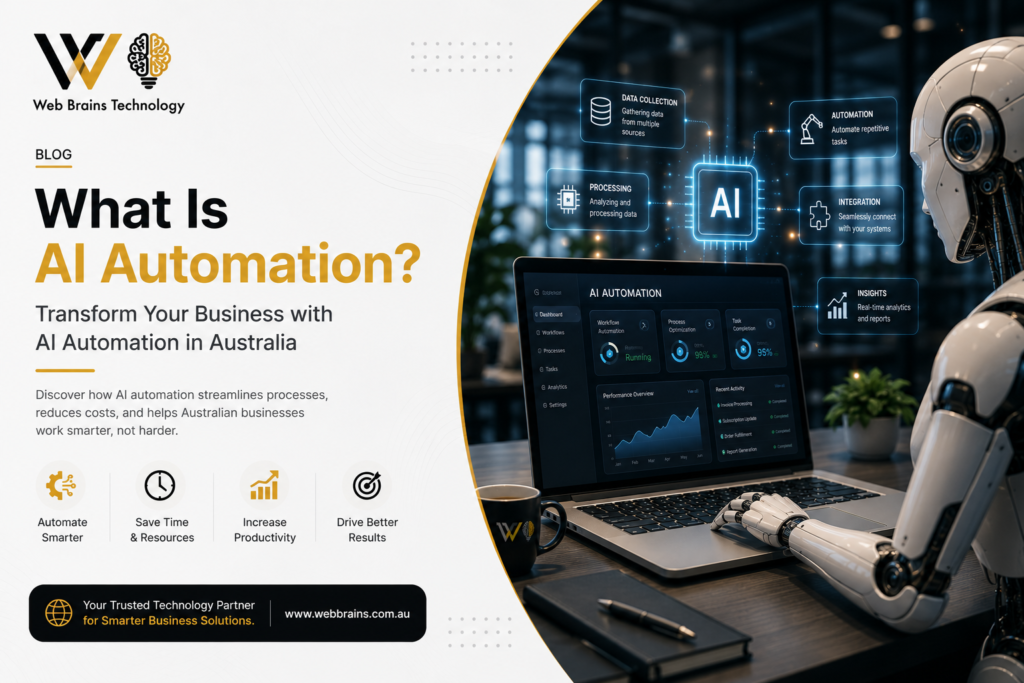
Artificial Intelligence (AI) is no longer a futuristic concept—it has become a practical business tool that is transforming how organisations operate. Across Australia, businesses of every size are embracing AI automation to eliminate repetitive tasks, improve productivity, enhance customer experiences, and make smarter decisions using real-time data.
Whether you’re a startup looking to automate customer support, an eCommerce retailer aiming to streamline order processing, or a large enterprise modernising legacy workflows, AI automation can help your business work faster, smarter, and more efficiently.
Unlike traditional automation, which follows fixed rules and predefined workflows, AI automation combines machine learning, natural language processing (NLP), computer vision, and predictive analytics to analyse data, understand context, and make intelligent decisions. This allows businesses to automate more complex processes that previously required human judgement.
According to industry reports, Australian organisations are rapidly increasing investment in AI technologies to remain competitive, reduce operational costs, and improve customer satisfaction. As AI capabilities continue to evolve, automation is becoming a strategic necessity rather than a competitive advantage.
In this guide, you’ll learn:
- What AI automation is and why it matters
- How AI automation works
- Different types of AI automation
- Real-world AI automation examples
- Business benefits for Australian organisations
- The future of AI-powered business automation
Whether you’re exploring AI for the first time or planning your digital transformation strategy, this guide will help you understand how AI automation can create measurable business value.
What Is AI Automation?
AI automation is the use of artificial intelligence technologies to automate business processes, repetitive tasks, and decision-making activities with minimal human intervention.
Instead of simply following a predefined sequence of rules, AI-powered systems can analyse information, recognise patterns, learn from historical data, and continuously improve their performance over time.
For example:
- Automatically responding to customer enquiries using AI chatbots.
- Reading and processing invoices without manual data entry.
- Predicting customer demand before inventory runs low.
- Routing support tickets based on urgency and sentiment.
- Detecting fraudulent financial transactions in real time.
This makes AI automation far more flexible than conventional automation software.
Traditional Automation vs AI Automation
Traditional automation works best when every step follows predictable rules. If a process changes or an unexpected scenario occurs, human intervention is often required.
AI automation, on the other hand, can adapt to changing conditions by analysing data and making informed decisions. It can understand language, recognise images, predict future outcomes, and continuously optimise workflows based on new information.
This capability allows Australian businesses to automate complex operations while improving speed, accuracy, and customer experiences.
Connect us: https://webbrainstechnologies.com.au/ai-consulting/