Walk through the soap aisle and you’ll find a dozen brands claiming environmental credentials. Read the fine print and you’ll find that almost none of them mean the same thing by it.
This isn’t always deception. More often it’s genuine confusion. The vocabulary of sustainable packaging is technical, overlapping, and frequently misused even by people selling it.
Here’s what the terms actually mean, and which ones are worth pursuing.
Recyclable
Means the material can technically be reprocessed into new material. It does not mean it will be.
Plain paperboard is widely recyclable in curbside programs across most of the US and Europe. That’s a real advantage. But recyclability is destroyed by certain additions:
- Plastic lamination (gloss or matte film) makes the board non-recyclable in most streams
- Foil stamping over large areas
- Heavy plastic windows glued into die-cuts
A kraft box with soy-based ink and no lamination is genuinely recyclable. A “sustainable” box with full plastic lamination is not, whatever the marketing says.
Compostable
Means the material will break down into non-toxic components under composting conditions. Critically, there are two very different conditions:
Industrially compostable requires a commercial facility with sustained high temperatures. Most consumers don’t have access to one. A product labeled industrially compostable that goes into a home bin will behave roughly like ordinary waste.
Home compostable breaks down in a garden compost heap. This is a much higher bar and a much more meaningful claim.
Uncoated paperboard is generally home compostable. Coated and laminated board is not.
Biodegradable
The weakest of the terms and the most frequently abused. Nearly everything biodegrades eventually. Without a specified timeframe and specified conditions, the word carries almost no information. Several jurisdictions now restrict unqualified “biodegradable” claims for precisely this reason.
FSC certified
Indicates the paper came from responsibly managed forests, verified through a chain-of-custody system. This is a supply-chain claim, not an end-of-life claim FSC board still needs to be recyclable or compostable on its own merits.
It’s a credible, auditable certification, and it’s one of the easier meaningful upgrades to make. Most established suppliers can source FSC-certified stock, often at little or no premium.
PCW content
Post-consumer waste content tells you what proportion of the board was made from recycled material rather than virgin fiber. Higher is better. Board with substantial PCW content typically has a slightly grayer tone and more visible fiber, which some brands embrace aesthetically.
What this means practically for soap brands
Soap is unusually well positioned here. Unlike liquid products, bar soap doesn’t require a barrier layer, doesn’t need a pump or a plastic closure, and doesn’t need to be airtight. A bar of soap can be packaged in plain paperboard and nothing else.
That means a soap brand can make genuinely strong environmental claims without complex material engineering. The most defensible specification is straightforward:
- Uncoated kraft or FSC-certified paperboard
- No lamination
- Soy or vegetable-based inks
- Minimal ink coverage
- No plastic window
- Sized closely to the product
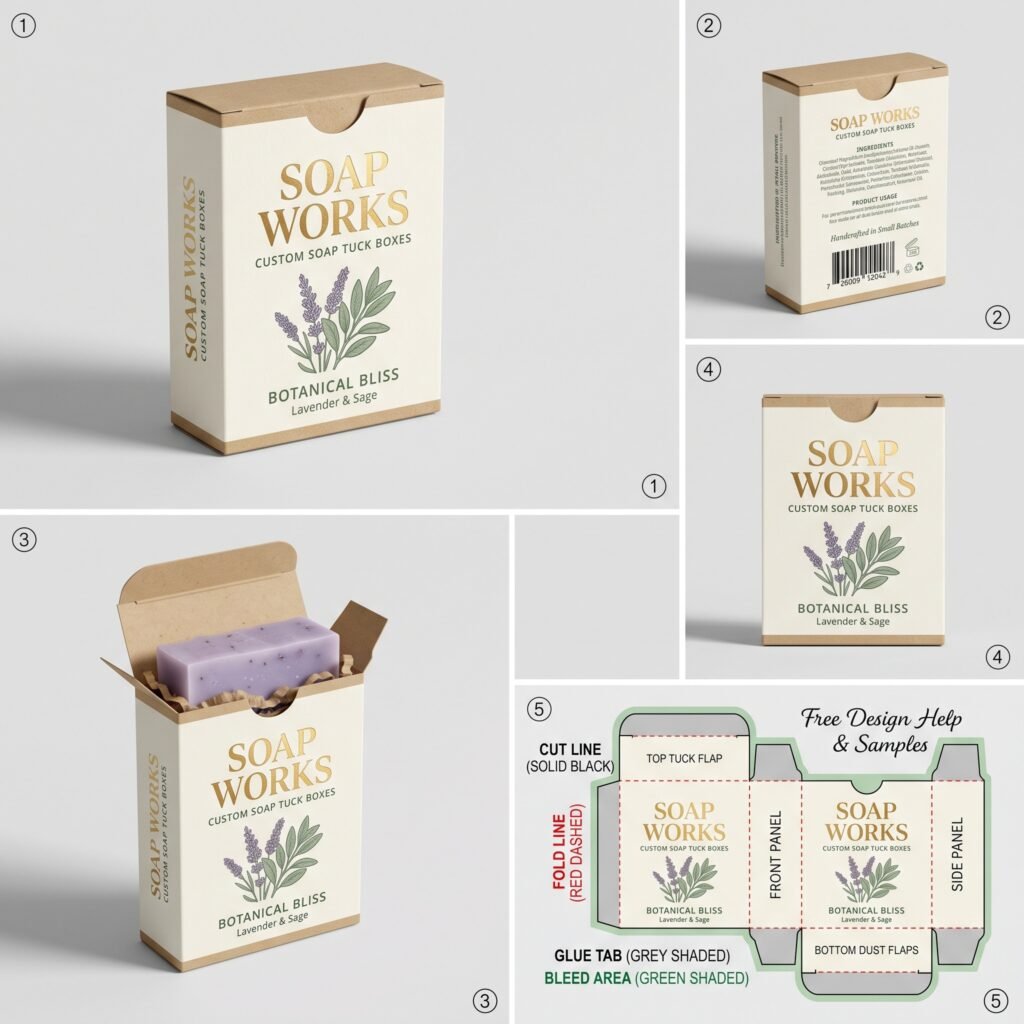
Suppliers who work regularly with this category can quote eco-friendly soap boxes to exactly this spec, and it’s typically no more expensive than a conventional laminated box often less, since you’re removing a finishing step.
The tradeoffs you should know about
Removing lamination reduces scuff resistance and moisture tolerance. In humid climates or long shipping routes, that matters.
Uncoated stock prints with less vibrancy, which constrains your design options.
Higher PCW content sometimes brings slight color variation between batches.
None of these are dealbreakers, but they should be conscious choices rather than surprises.
On making claims
Whatever you decide, say it precisely. “Printed on FSC-certified paperboard with soy-based inks. Recyclable and home compostable” is specific, verifiable, and credible.
“Eco-friendly packaging” is vague enough that increasingly skeptical customers will discount it entirely and regulators in several markets are now actively pursuing unsubstantiated environmental claims.
Specificity is both the honest choice and, in this market, the more persuasive one.