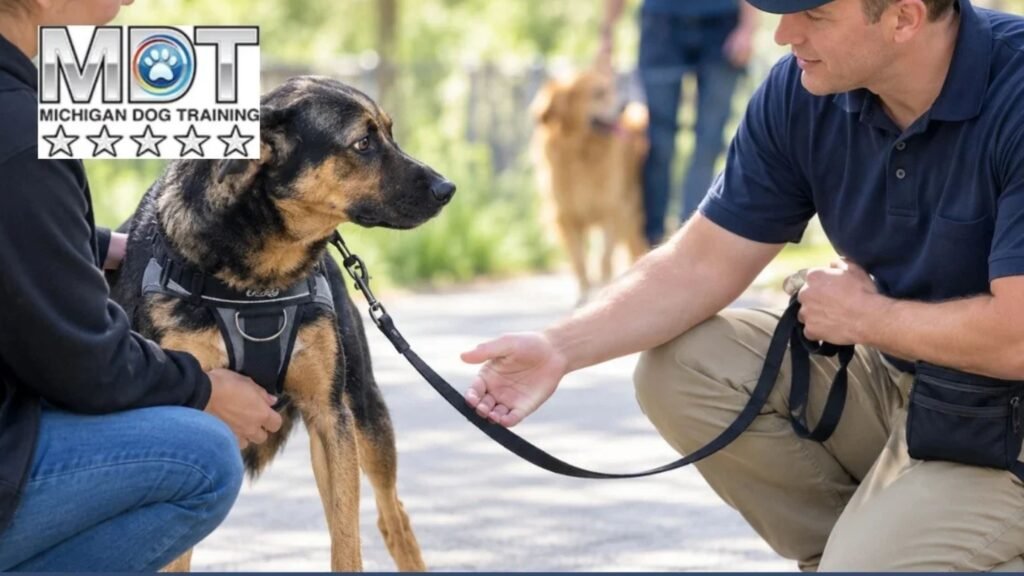
A service dog needs more than the ability to sit, stay, or walk beside its handler. Those foundational behaviors are important, but working dogs also need consistency, focus, impulse control, and the ability to perform trained tasks in appropriate environments.
A Michigan dog trainer working with service-dog candidates may begin with basic obedience before progressing toward task work and public-access skills. The goal is to develop behaviors that remain dependable as the surroundings become more challenging.
For example, a dog may need to remain settled around people, ignore common distractions, respond to its handler, and transition between different environments without losing focus. These abilities develop through structured practice rather than a single training session.
Why does the dog’s temperament matter so much?
Temperament is one of the foundations of service-dog work because not every dog is suited to the same responsibilities. A candidate needs to demonstrate qualities that support focused, controlled work.
Professional evaluation can consider how a dog responds to people, unfamiliar environments, distractions, handling, and new situations. Health, learning history, and the specific assistance required by the handler also matter.
This is one reason service-dog training should not be treated as a standard obedience package. A trainer needs to determine whether the individual dog can progress toward the intended role and what type of training structure is appropriate.
How does service-dog training prepare dogs for public environments?
A dog can perform beautifully in a quiet room and still struggle when exposed to the movement and noise of everyday life. Public-access preparation helps bridge that gap.
Training may involve gradually introducing appropriate distractions while reinforcing calm behavior and attention to the handler. Depending on the dog’s stage of development, this can include working around people, traffic, other animals, unfamiliar sounds, and different physical environments.
The purpose is not to overwhelm the dog. It is to build reliable responses through structured exposure and repetition. A professional trainer can adjust distance, difficulty, and expectations according to the dog’s progress.
What tasks can a service dog be trained to perform?
Service dogs can be trained to perform specific tasks related to a person’s disability. The appropriate tasks depend on the handler’s individual needs.
Michigan Dog Training identifies service-dog training programs involving areas such as mobility assistance, hearing alerts, diabetic alerts, and assistance related to PTSD, panic, or anxiety. Training can combine foundational obedience, task development, handler instruction, and work in appropriate real-world environments.
Task training is different from teaching a general trick. The behavior needs to have a practical purpose for the handler and become sufficiently reliable to support that purpose.
Why is handler training part of the process?
The relationship between a working dog and its handler does not end when professional instruction is complete. The handler must understand how to communicate with the dog, reinforce trained behaviors, recognize changes in performance, and continue appropriate practice.
That makes owner education a significant part of service-dog development. Michigan Dog Training offers both an intensive service-dog board and train option and a Train Your Own Service Dog program, allowing different levels of owner participation.
The latter approach places the handler directly into the learning process. Instead of simply receiving a trained dog, the owner develops practical skills for working with the dog as a team.
How long does it take to build reliable working behavior?
There is no single timeline that applies equally to every dog. Training duration depends on the dog’s starting skills, temperament, learning pace, required tasks, and the handler’s consistency.
Michigan Dog Training lists an eight-week Service Dog Board and Train program and a 20-lesson Train Your Own Service Dog program conducted over approximately five months. These are structured programs, but the broader development of reliable working behavior also depends on continued practice and reinforcement.
The distinction is important. A scheduled program provides a framework, while dependable behavior develops through repetition over time.
What should owners consider before choosing a trainer?
The right questions go beyond price or location. Owners should ask about the trainer’s professional background, experience with service-dog work, evaluation process, training structure, handler participation, and the types of tasks the program supports.
Experience with general obedience does not automatically mean experience with service-dog preparation. A professional service dog trainer should be able to explain how foundational skills connect to task training and real-world behavior.
For owners in Southeast Michigan, Michigan Dog Training offers specialized service-dog programs alongside private training, group classes, day training, and board and train services. Its service-dog work is led within a broader training operation that includes professional experience in areas such as Police K9, Search and Rescue, and dog behavior.
When does training become a partnership?
The most meaningful transition occurs when training stops being a series of exercises and becomes a reliable working relationship between dog and handler. The dog learns what is expected, while the handler learns how to communicate clearly and maintain those behaviors.
For anyone seeking a Michigan dog trainer for specialized assistance, the focus should remain on suitability, structured development, task reliability, public behavior, and long-term handler involvement. Michigan Dog Training provides service-dog training through both board-and-train and owner-participation formats, giving prospective handlers defined pathways to explore based on their needs and goals.