vacuum casting factory
Turning a product idea into a market-ready part requires precision, speed, and consistent quality. Choosing the right vacuum casting factory can make a significant difference, especially for businesses that need functional prototypes or low-volume production without the high cost of injection molding.
Vacuum casting is widely used in industries such as automotive, consumer electronics, medical devices, and industrial equipment because it delivers excellent surface finishes, tight dimensional accuracy, and production flexibility.
What Is a Vacuum Casting Factory?
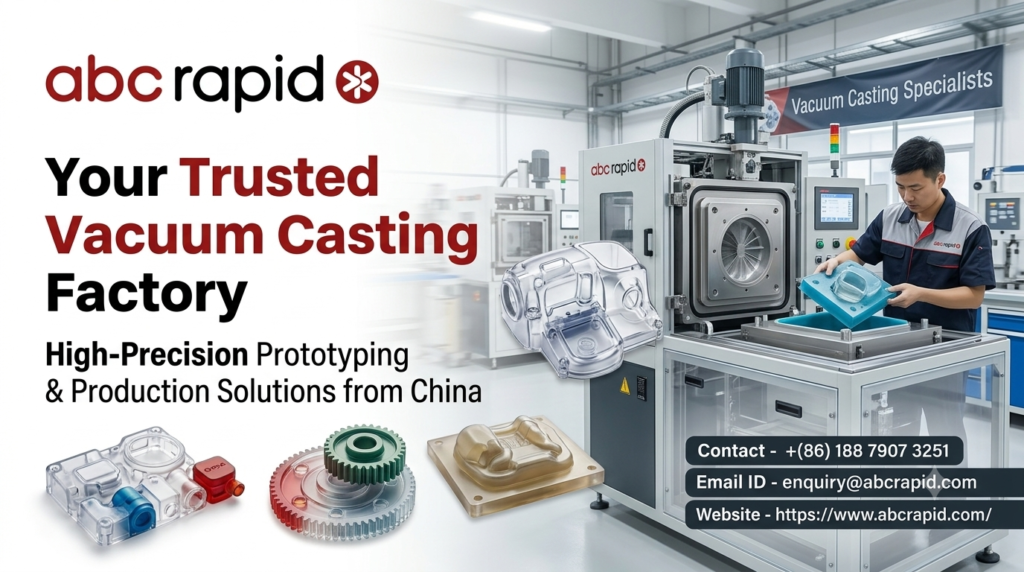
A vacuum casting factory specializes in producing high-quality plastic parts by pouring polyurethane resin into silicone molds under vacuum conditions. The vacuum process removes trapped air bubbles, ensuring smooth surfaces and accurate details.
This manufacturing method is ideal when companies need small production runs, prototype testing, or bridge manufacturing before investing in expensive production tooling.
How the Vacuum Casting Process Works
The process begins with creating a master model, usually through CNC machining or 3D printing. A silicone mold is then produced from the master pattern. Liquid resin is poured into the mold inside a vacuum chamber, where air is removed to prevent defects. After curing, the finished component is carefully removed and inspected for quality.
This approach allows manufacturers to produce multiple identical parts while maintaining excellent consistency.
Vacuum Casting vs. Injection Molding
| Feature | Vacuum Casting | Injection Molding |
| Tooling Cost | Low | High |
| Production Volume | 10–100 parts | Thousands to millions |
| Lead Time | Fast | Longer |
| Design Changes | Easy | Expensive |
| Best Use | Prototypes and low-volume production | Mass production |
For startups and product developers, vacuum casting offers a practical solution before committing to permanent tooling.
Practical Example
Imagine an electronics company designing a new handheld device. Before launching mass production, engineers need 40 functional housings for durability testing, customer demonstrations, and design validation.
Instead of investing in costly injection molds, they work with a vacuum casting factory to produce accurate polyurethane parts that closely match the appearance and performance of final production components. This saves both time and development costs while allowing design improvements before large-scale manufacturing.
Key Benefits of Choosing a Professional Vacuum Casting Factory
- Faster prototype development
- Lower tooling investment
- Excellent surface finish
- High dimensional accuracy
- Multiple resin material options
- Easy design modifications
- Ideal for bridge production and market testing
These advantages help businesses reduce product development risks while accelerating time to market.
Tips for Selecting the Right Vacuum Casting Factory
Before choosing a manufacturing partner, consider these factors:
- Review previous manufacturing projects.
- Ask about quality inspection procedures.
- Confirm available material options.
- Evaluate production capacity and lead times.
- Check communication and engineering support.
- Ensure experience with your industry requirements.
Working with an experienced supplier minimizes delays and improves product consistency throughout development.
Why Quality Matters
Even small defects in prototype parts can affect product testing and customer evaluations. A professional vacuum casting factory follows strict quality control, verifies dimensional accuracy, and performs careful finishing to deliver reliable components suitable for engineering validation and presentation models.
Reliable production also supports faster product launches by reducing rework and manufacturing delays.
Frequently Asked Questions
1. What products are commonly made using vacuum casting?
Prototype enclosures, automotive components, medical device housings, consumer electronics, and industrial equipment parts are common applications.
2. How many parts can one silicone mold produce?
A silicone mold typically produces between 15 and 30 high-quality parts, depending on the material and design complexity.
3. Is vacuum casting suitable for functional testing?
Yes. Many polyurethane resins provide mechanical properties suitable for engineering evaluation and functional testing.
4. How long does vacuum casting production take?
Most projects can be completed within one to three weeks, depending on design complexity and production quantity.
5. When should I choose vacuum casting instead of injection molding?
Vacuum casting is the better option for prototypes, product validation, bridge production, and low-volume manufacturing before investing in mass-production tooling.
Conclusion
Selecting the right vacuum casting factory is an important step in successful product development. From rapid prototypes to low-volume manufacturing, this process delivers cost-effective, high-quality parts with impressive accuracy and flexibility. Companies looking for dependable manufacturing support can rely on Abc Rapid for precision vacuum casting solutions, engineering expertise, and efficient production services that help transform innovative ideas into market-ready products.
Contact – +(86) 188 7907 3251
Email ID – enquiry@abcrapid.com
Website – https://www.abcrapid.com/