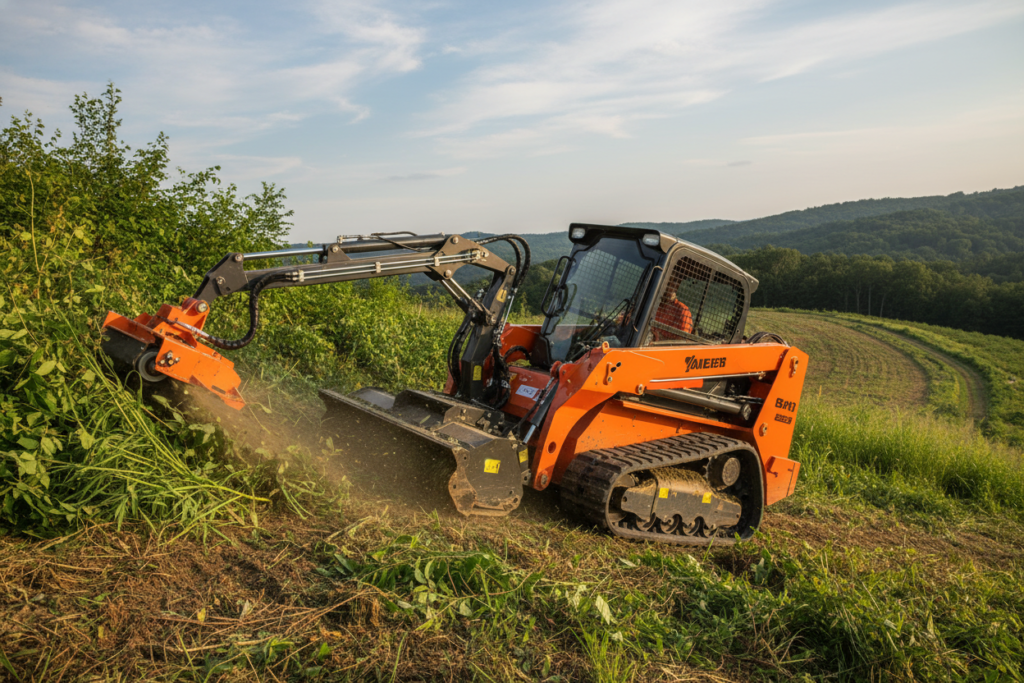
If you’ve ever hooked up a cutter and thought, “this thing should be hitting harder,” you’re not alone. Happens all the time. Guys blame the attachment, or the brand, or the blades… but a lot of the time, the real issue is hydraulic flow. Not exciting, I know. But it’s the difference between clean cuts and a machine that just struggles through brush like it’s half asleep.
When you’re running a brush cutter attachment for excavator, hydraulic flow isn’t just a spec on paper. It’s the whole game. It controls speed, torque, cutting power — basically how well the job gets done. Ignore it, and yeah, you’ll feel it real quick on site.
What Hydraulic Flow Actually Means (Without the Textbook Talk)
Let’s keep this simple.
Hydraulic flow is how much oil your machine pushes to the attachment. Usually measured in gallons per minute (GPM). More flow means more movement. More blade speed. More cutting ability.
But here’s where people mess up — they think more is always better. Not exactly.
Too little flow? The cutter bogs down. Can’t keep blade speed. Struggles in thick brush.
Too much flow? You can overdrive the motor, build heat, wear things out faster. It’s not free power. There’s a balance.
So yeah, it’s not just “does it work.” It’s “does it match.”
Matching Your Excavator to the Attachment
This is where things get practical.
Every excavator has a hydraulic range. And every cutter attachment has a requirement. Those two need to line up. If they don’t, you’re either underperforming or slowly damaging something.
Contractors, landscapers, even municipal crews — they all run into this. Especially when swapping attachments between machines.
You’ll see something like:
- Attachment requires 15–25 GPM
- Machine delivers 12 GPM
That gap matters. You’ll feel it the moment you start cutting thick material.
On the flip side, if your machine pushes more than the attachment is rated for, you better have flow control or you’re asking for trouble.
Brands like Spartan Equipment usually give clear specs for a reason. Not just to fill space on a product page. It’s so you don’t mismatch and regret it later.
Flow vs Pressure – Don’t Confuse Them
Quick reality check.
Flow is volume. Pressure is force.
You need both.
Flow spins the blades. Pressure keeps them from stalling when you hit resistance. If you’ve got flow but weak pressure, the cutter spins fast but dies when it hits thicker brush. If you’ve got pressure but low flow, it’s strong… but slow. Feels sluggish.
The best setups balance both. That’s when you get clean, consistent cutting without the machine fighting itself.
Why Your Cutter Feels Weak (Even When It Shouldn’t)
This comes up a lot.
You’ve got the right attachment. Specs look fine. But performance just isn’t there.
Usually it’s one of these:
- Flow settings not adjusted correctly
- Hydraulic lines restricting movement
- Worn components inside the motor
- Machine not actually delivering rated flow
Or honestly… operator pushing too hard, too fast.
You can’t force a cutter through heavy material and expect it to keep up. Let it work. Keep blade speed up. That’s where efficiency comes from.
High Flow vs Standard Flow – Does It Really Matter?
Short answer? Yeah, it does.
Standard flow machines handle lighter to medium brush just fine. No issues there.
But when you step into:
- Dense vegetation
- Thick saplings
- Heavy land clearing
High flow setups make a difference. More speed, more torque, cleaner cuts.
That said, not every job needs it. A lot of contractors overbuy here. Spend more than they need just chasing “more power.”
Better approach — match your typical job, not your worst-case scenario.
Hydraulic Heat – The Silent Problem
Nobody talks about this enough.
When flow and pressure aren’t balanced, or when the system is overworked, heat builds up. Slowly at first. Then it starts affecting performance.
You’ll notice:
- Reduced efficiency
- Slower response
- Attachment just not hitting the same
And long-term? It wears everything out faster.
Good setups manage heat better. Proper flow matching helps with that more than people realize.
Middle Ground – Where Skid Steer Attachments Fit In
Now here’s where things get interesting.
Some operators compare excavator cutters with options like a skid steer articulating brush cutter. Different machines, different approach, but similar goal — clearing efficiently.
Skid steer setups usually rely on high flow systems and front-mounted operation. Faster in open areas, no doubt.
But excavators? They bring reach, control, and better positioning. Especially in tight or uneven terrain.
Hydraulic flow still matters on both. Just applied differently.
If you understand flow on one machine, you’re already ahead on the other.
How to Get the Best Performance Out of Your Setup
Not complicated. Just overlooked.
First, know your machine’s actual output. Not what the manual says — what it really delivers.
Second, match the attachment properly. Stay within the recommended range.
Third, adjust flow settings if your machine allows it. A lot of newer equipment does, but people never touch it.
And finally, operate with some control. Don’t rush the cut. Let the hydraulics do their job.
That’s where performance shows up.
Why Quality Still Matters Here
You can have perfect flow… and still get poor results if the attachment isn’t built right.
Hydraulic motors, internal components, blade design — all of it plays a role.
That’s why brands like Spartan Equipment focus on matching engineering with real-world use. Because specs alone don’t mean much if the build can’t handle job site conditions.
A solid cutter, matched with the right flow, that’s where things click.
Final Thoughts
Hydraulic flow isn’t the most exciting topic. But it’s one of the most important if you’re running a brush cutter attachment for excavator.
Get it right, and the machine feels smooth, powerful, efficient. Get it wrong, and you’re fighting it all day, burning time and fuel.
Doesn’t matter if you’re a contractor clearing land, a farmer maintaining property, or running municipal jobs — the principle stays the same.
Understand your machine. Match your attachment. Don’t ignore the small stuff.
And yeah, whether you’re running an excavator or even looking at something like a skid steer articulating brush cutter, the idea doesn’t change — hydraulic performance drives everything.
Dial that in, and the rest gets a whole lot easier.