Education is often called the great equalizer, yet the path to the classroom is rarely a level playing field. For many children in India, the obstacles to success aren’t just lack of books or schools, but deeply ingrained societal issues. Identifying the different types of social barriers is essential for any meaningful intervention in community development. At CRY India, we believe that by addressing these invisible walls, we can unlock the potential of every child.
1. Gender Discrimination
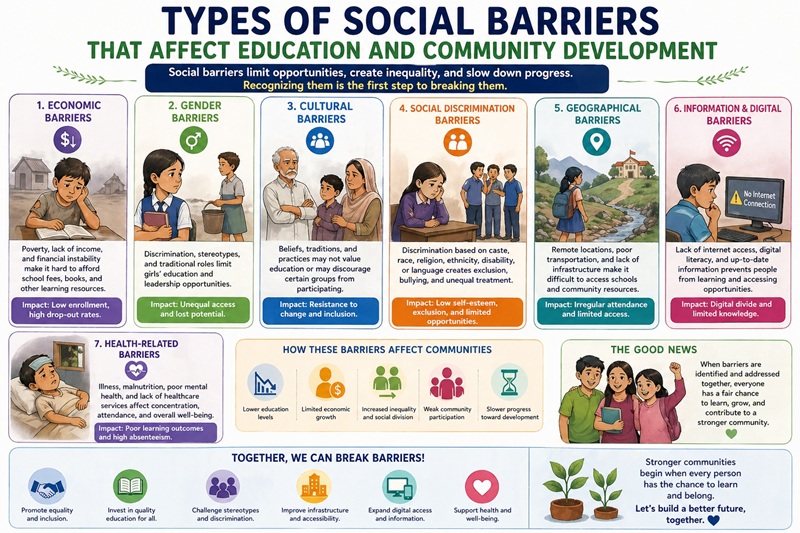
One of the most persistent types of social barriers is gender bias. In many communities, the education of a male child is prioritized over that of a female child. Traditional mindsets often dictate that a girl’s role is confined to domestic chores or early marriage. This doesn’t just harm the individual; it stunts community development. When girls are educated, they are more likely to reinvest in their families and health, creating a ripple effect of progress.
2. Caste and Social Stratification
In the Indian context, the caste system remains a significant hurdle. Even when schools are physically accessible, children from marginalized castes may face social exclusion or subtle discrimination from peers and authority figures. These types of social barriers create a sense of alienation, leading to higher dropout rates. Community development remains incomplete until every child, regardless of their social standing at birth, feels a sense of belonging in the educational ecosystem.
3. Economic Inequality and the Poverty Cycle
While poverty is an economic condition, it creates social barriers that are hard to penetrate. Poverty often forces children into labor to support their families, making education a distant luxury. Furthermore, the social stigma associated with poverty can lead to a lack of confidence among students. At CRY India, we see how financial instability acts as a gatekeeper, preventing talented children from accessing the resources they need to thrive.
4. Language and Cultural Gaps
For many tribal or migrant communities, the medium of instruction in schools can be a barrier. When a child’s home language is vastly different from the school’s language, it creates a “cognitive wall.” These types of social barriers make children feel inadequate, not because they lack intelligence, but because the system fails to accommodate their cultural identity. Inclusive community development requires a curriculum that respects and incorporates linguistic diversity.
5. Disability and Lack of Inclusivity
Children with disabilities often face the harshest types of social barriers. The lack of inclusive infrastructure is compounded by social myths that suggest children with disabilities cannot learn or contribute to society. This leads to isolation and a denial of their fundamental rights. Breaking this barrier requires a shift in mindset—viewing disability not as a limitation, but as a different way of experiencing the world that requires specific support.
The Way Forward with CRY India
Dismantling these barriers is not the work of a single day or a single person. It requires systemic change, policy advocacy, and grassroots awareness. CRY India works closely with communities to challenge these norms and ensure that social structures support, rather than hinder, a child’s growth. By fostering an environment of equity, we can ensure that “community development” is not just a buzzword, but a lived reality for all.
Frequently Asked Questions (FAQs)
1. What are the most common types of social barriers in rural India? In rural areas, gender discrimination, caste-based exclusion, and deep-rooted poverty are the most prevalent barriers. These factors often intersect, making it even harder for children from these backgrounds to stay in school.
2. How do social barriers impact community development? Social barriers prevent a large section of the population from contributing to the economy and social fabric. When a community is divided by bias or inequality, it lacks the collective strength needed for long-term growth and innovation.
3. Can education help in overcoming types of social barriers? Yes. Education is a double-edged sword; while it is hindered by social barriers, it is also the primary tool to break them. Education fosters critical thinking, which allows individuals to question and change regressive social norms.
4. What is CRY India’s role in removing these obstacles? CRY India identifies the specific barriers in a community—whether it’s child marriage or lack of schools—and works with local leaders and parents to create a protective environment for children.
5. How can individuals help in breaking down social barriers? Individuals can help by promoting inclusivity in their own circles, supporting organizations like CRY India, and advocating for policies that protect the rights of marginalized groups.
Must Read: 5 Severe Consequences of Child Labour | CRY India Advocacy