Table of Contents
- What Is Sadaqah in Islam? A Simple Explanation
- Zakat vs Sadaqah: Complete Guide for Beginners
- 10 Types of Sadaqah in Islam You Should Know
- 10 Powerful Benefits of Sadaqah in Islam
- Sadaqah Donation Ideas for Muslims
- How the Islamic Charity System Transforms Communities
- Conclusion
- Frequently Asked Questions
What Is Sadaqah in Islam? A Simple Explanation
Ever wondered why giving feels so good? In Islam, that warm glow isn’t just psychological — it’s spiritual. Sadaqah meaning in Islam simple explanation boils down to one beautiful concept: voluntary charity given purely for the sake of Allah (SWT). Unlike obligatory payments, sadaqah flows from the heart. It’s the spiritual equivalent of a spontaneous hug — unplanned, genuine, and deeply felt.
What is sadaqah in Islam with examples? Think about it this way. You drop a coin into a donation box at your local masjid. You buy groceries for a struggling neighbor. You even smile at a stranger on the subway. Believe it or not, all of these count. The Prophet Muhammad ﷺ said, “Every act of kindness is sadaqah” (Sahih Muslim). That’s how expansive this concept truly is.
For those looking to start their journey of giving, organizations like Al Mustafa Canada offer incredible pathways to channel your sadaqah toward meaningful causes. Whether it’s donating directly or exploring specific projects, the door is always open.
Sadaqah Meaning in Islam
At its core, the word “sadaqah” stems from the Arabic root “sidq,” which means truthfulness and sincerity. So when you give sadaqah, you’re essentially proving the truthfulness of your faith through action. It’s not a tax. It’s not a burden. It’s a love letter to your Creator, written in the ink of generosity.
Difference Between Zakat and Sadaqah
Here’s where many Muslims get tangled up. The difference between zakat and sadaqah is actually straightforward. Zakat is mandatory — a fixed pillar of Islam. Sadaqah is voluntary — a boundless ocean of opportunity. Think of zakat as your monthly rent (you have to pay it), while sadaqah is like tipping your barista (you don’t have to, but it makes everyone’s day better).
Zakat vs Sadaqah: Complete Guide for Beginners
If you’re new to the Islamic charity system, don’t worry. Let’s break it down like we’re chatting over chai. The zakat vs sadaqah complete guide for beginners starts with understanding that both are essential, but they operate on completely different tracks.
What Is Zakat in Islam Explained Simply
What is zakat in Islam explained simply? Zakat is the third pillar of Islam. It’s an obligatory annual payment of 2.5% on qualifying wealth that has been held for a full lunar year. The zakat meaning and importance in Islam cannot be overstated — it purifies your wealth, uplifts communities, and fulfills a divine command. If you want to dive deeper, check out this zakat resource page for practical guidance.
How to Calculate Zakat Step by Step
The step by step zakat calculation guide for Muslims is easier than you think:
- Identify your zakatable assets — savings, gold, silver, business inventory, and investments.
- Subtract your immediate liabilities — debts, bills, and obligations due now.
- Check the nisab threshold — your net assets must exceed the value of 87.48 grams of gold or 612.36 grams of silver.
- Apply 2.5% — if you’re above nisab, multiply your net zakatable wealth by 0.025.
How much zakat should I pay on savings? Simply 2.5% of your total savings that have been sitting untouched for one lunar year. For a zakat calculation guide, visit Al Mustafa Canada’s Zakat Calculator.
Zakat Rules for Gold and Silver
Zakat rules for gold and silver state that if you own gold exceeding 87.48 grams or silver exceeding 612.36 grams, you owe 2.5% of the total market value. This applies to jewelry, coins, and bullion — yes, even the necklace tucked away in your drawer.
Zakat on Business Income Calculation
Zakat on business income calculation requires you to assess the total value of your business inventory, receivables, and cash at the end of each lunar year. Subtract liabilities, and pay 2.5% on the remainder. It’s like a spiritual audit — and trust me, the ROI is heavenly.
Who Is Eligible to Receive Zakat in Islam
The Quran (Surah At-Tawbah 9:60) clearly outlines who is eligible to receive zakat in Islam: the poor, the needy, zakat administrators, those whose hearts are to be reconciled, those in bondage, the debt-ridden, those in the cause of Allah, and travelers. Zakat distribution rules in Islam ensure that wealth circulates like blood through a body — reaching every limb that needs nourishment. Learn more about zakat distribution and how your contributions reach those who need them most.
| Aspect | Zakat | Sadaqah |
|---|---|---|
| Obligation | Mandatory (Fard) | Voluntary (Nafl) |
| Amount | Fixed at 2.5% | Any amount |
| Timing | Once per lunar year | Anytime |
| Recipients | 8 specific categories | Anyone |
| Type of Wealth | Specific assets | Anything (money, time, smile) |
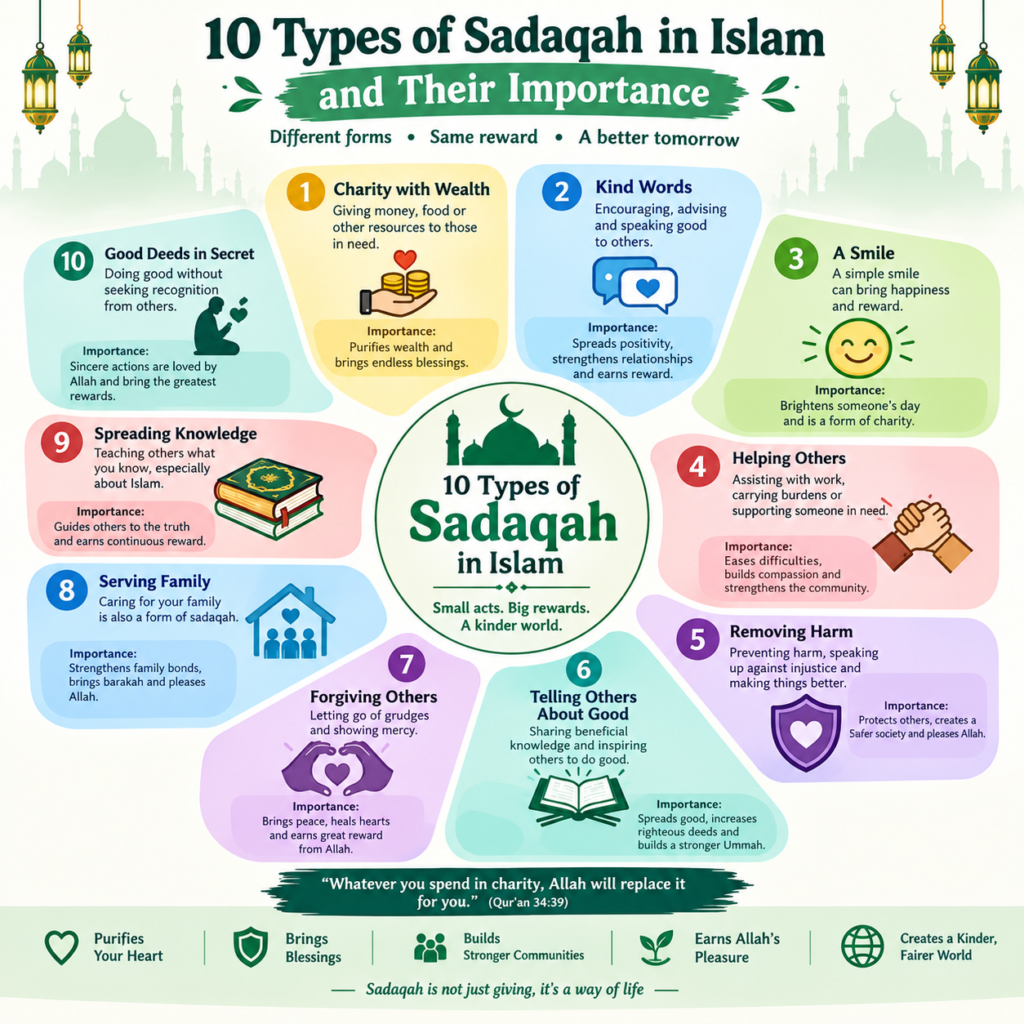
10 Types of Sadaqah in Islam You Should Know
Now, let’s get to the heart of this article. The types of sadaqah in Islam are as diverse as the ummah itself. Whether you’re wealthy or barely making ends meet, there’s a form of sadaqah with your name on it. Ready? Let’s count them down.
1. Sadaqah Jariyah (Ongoing Charity)
Sadaqah jariyah meaning refers to a continuous charity that keeps rewarding you long after you’re gone. Think of it like planting a mango tree — you might not eat every fruit, but generations will. Sadaqah jariyah examples include building wells, funding schools, and establishing hospitals. You can start your own sadaqah jariyah through Al Mustafa Canada’s water projects or education initiatives.
2. Financial Sadaqah
The most common form. You give money — any amount — to someone in need. It could be $5 or $5,000. Allah doesn’t look at the number; He looks at the intention. Helping poor in Islam through financial sadaqah is one of the fastest ways to earn divine pleasure.
3. Sadaqah Through Knowledge
Teaching someone to read the Quran? Sharing a beneficial Islamic lecture? That’s sadaqah. Knowledge is the one currency that multiplies when you spend it. The best sadaqah to give in Islam often involves empowering others with skills and wisdom they’ll carry for life.
4. Sadaqah of a Smile and Kind Words
Yes, you read that right. The Prophet ﷺ said, “Your smile in the face of your brother is charity” (Tirmidhi). In a world drowning in negativity, a genuine smile is revolutionary. Sadaqah benefits in daily life start with something as simple as being kind to the cashier at your grocery store.
5. Sadaqah Through Feeding the Hungry
Zakat for poor families and communities often overlaps with sadaqah in this area. Feeding a fasting person during Ramadan, sponsoring an iftar, or contributing to food banks — these are all powerful forms of sadaqah. Explore Ramadan giving opportunities to maximize your impact during the holiest month.
6. Sadaqah of Water
Providing clean drinking water is among the most beloved acts in Islam. The Prophet ﷺ was once asked about the best sadaqah, and he replied, “A drink of water” (Ibn Majah). Consider contributing to clean water projects that transform entire villages.
7. Sadaqah for Health and Protection
Sadaqah for health and protection is deeply rooted in prophetic tradition. The Prophet ﷺ advised giving sadaqah to ward off illness and calamity. It’s like a spiritual insurance policy — except the premiums are tiny and the coverage is infinite. Support healthcare initiatives to channel your sadaqah toward healing communities.
8. Sadaqah for Forgiveness of Sins
Sadaqah for forgiveness of sins operates on a profound spiritual principle: charity extinguishes sins like water extinguishes fire. When guilt weighs heavy on your chest, reach into your pocket. The act of giving lightens both your wallet and your soul.
9. Sadaqah Through Removing Harm
Picking up a thorn from the road? Removing a banana peel from the sidewalk? That counts. This type of sadaqah reminds us that charity isn’t always grand gestures — sometimes it’s the quiet, invisible acts that matter most.
10. Sadaqah of Time and Volunteering
Voluntary charity in Islam isn’t limited to money. Donating your time at a soup kitchen, mentoring a young Muslim, or helping at your local masjid are all valid forms of sadaqah. Time is the one resource you can never earn back, which makes giving it away incredibly precious.
| Type of Sadaqah | Example | Reward Duration |
|---|---|---|
| Sadaqah Jariyah | Building a well or school | Lifetime + After death |
| Financial Sadaqah | Donating cash to the poor | One-time (multiplied by Allah) |
| Knowledge | Teaching Quran | Ongoing |
| Smile | Greeting someone warmly | Instant |
| Feeding | Providing iftar meals | Seasonal / Ongoing |
| Water | Digging a well | Lifetime + After death |
| Health | Funding medical camps | Ongoing |
| Forgiveness | Giving after a sin | Instant |
| Removing Harm | Cleaning a path | Instant |
| Volunteering | Mentoring youth | Ongoing |
10 Powerful Benefits of Sadaqah in Islam
The 10 powerful benefits of sadaqah in Islam will blow your mind. Benefits of charity in Islam extend far beyond the material realm:
- Purifies your wealth — just like zakat, sadaqah cleanses your earnings.
- Shades you on the Day of Judgment — the Prophet ﷺ said a believer’s shade will be their sadaqah.
- Heals illnesses — both physical and spiritual.
- Removes hardships — charity acts as a shield against calamity.
- Increases wealth — paradoxically, giving makes you richer. Allah promises to replace what you spend.
- Softens the heart — regular giving melts arrogance and builds empathy.
- Strengthens community bonds — the Islamic social welfare system thrives on mutual generosity.
- Opens doors of sustenance — sadaqah is a key that unlocks barakah.
- Earns continuous reward — especially through sadaqah jariyah.
- Brings inner peace — there’s a tranquility in giving that no luxury purchase can replicate.
Why zakat is important for society and how how zakat helps reduce poverty in Islam are questions answered beautifully when you see the benefits of paying zakat in Islam intertwined with sadaqah. Together, they form a safety net that catches those falling through the cracks.
Sadaqah Donation Ideas for Muslims
Looking for sadaqah donation ideas for Muslims? Here are a few practical suggestions:
- Sponsor an orphan through Al Mustafa Canada’s Orphan Program.
- Contribute to Qurbani programs during Eid ul-Adha.
- Fund an Aqiqah ceremony for a newborn in a struggling family.
- Give giving charity in Ramadan a priority by donating nightly during Taraweeh.
- Set up a monthly auto-donation through Al Mustafa Canada’s donation portal.
How the Islamic Charity System Transforms Communities
The zakat distribution system and sadaqah networks collectively form the backbone of the Islamic social welfare system. When you combine the zakat obligation in Islam with the flexibility of sadaqah, you create a dual-engine system that drives poverty reduction, education access, and healthcare delivery.
How zakat helps reduce poverty in Islam is no longer a theoretical question — it’s a lived reality in communities worldwide. From the dusty villages of sub-Saharan Africa to the refugee camps of the Middle East, zakat and sadaqah funds are building schools, drilling wells, and feeding families. Organizations like Al Mustafa Canada are on the front lines, ensuring every dollar reaches its intended destination. If you’d like to learn more or get involved, contact their team today.
Conclusion
So there you have it — a deep dive into the types of sadaqah in Islam and the breathtaking impact they carry. From the quiet smile you offer a stranger to the well you fund on the other side of the world, every act of sadaqah is a seed planted in the garden of the hereafter. The beauty of Islam’s charity system lies in its accessibility. You don’t need to be a millionaire to make a difference. You just need a willing heart and an open hand. Whether you’re calculating your zakat obligation in Islam or looking for the best sadaqah to give in Islam, remember this: Allah doesn’t need your money. The poor do. And in giving, you receive far more than you ever let go. Start today. Give generously. And watch how the universe conspires to give back.
Frequently Asked Questions (FAQs)
1. What are the main types of sadaqah in Islam?
The main types of sadaqah in Islam include financial donations, sadaqah jariyah (ongoing charity), feeding the hungry, providing water, sharing knowledge, smiling, removing harm from pathways, volunteering time, giving for health and protection, and donating for the forgiveness of sins. Each type carries unique rewards and can be practiced by anyone regardless of financial status.
2. What is the difference between zakat and sadaqah?
The difference between zakat and sadaqah is that zakat is a mandatory annual payment of 2.5% on qualifying wealth, while sadaqah is entirely voluntary and can be given in any amount, at any time, and in any form — including non-monetary acts like smiling or helping someone carry groceries.
3. How do I calculate zakat on my savings step by step?
To follow a step by step zakat calculation guide for Muslims, total your savings and zakatable assets, subtract immediate debts, ensure the remainder exceeds the nisab threshold (value of 87.48g of gold), and then pay 2.5% of the net amount. Use the Al Mustafa Canada Zakat page for a detailed calculator.
4. What is the best sadaqah to give in Islam?
The best sadaqah to give in Islam is sadaqah jariyah — ongoing charity that continues benefiting people after your death. Examples include building wells, funding schools, and planting trees. However, the Prophet ﷺ also emphasized that giving water and feeding the hungry are among the most beloved acts of sadaqah.
5. Can sadaqah be given to non-Muslims?
Absolutely! While zakat has specific recipient categories outlined in the Quran, sadaqah has no such restrictions. You can give sadaqah to anyone in need — Muslim or non-Muslim, neighbor or stranger. The sadaqah meaning in Islam simple explanation is that it’s a universal act of compassion, and its doors are open to all of humanity.