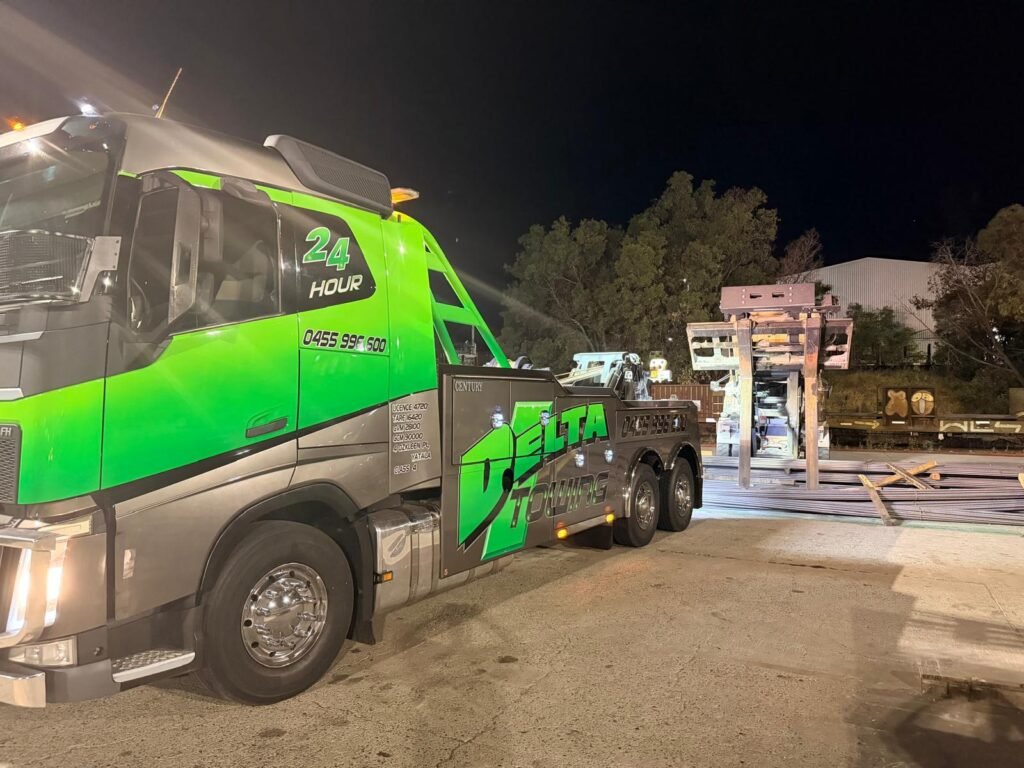
Truck Breakdown Brisbane
Truck breakdown Brisbane drivers face can happen anywhere, from the Gateway Motorway to the Warrego Highway. If your truck or bus breaks down, get the vehicle as far off the traffic lane as you safely can, turn on your hazard lights, and get yourself and any passengers away from moving traffic. Then call a heavy towing operator and give them your exact location, vehicle type, load and what happened. If anyone is hurt or the vehicle is blocking a lane, call 000 first.
That’s the short version. Here’s the full picture, written by people who get these calls every day.
Why the first 15 minutes matter most
Every truck breakdown Brisbane operators deal with looks different, but the first 15 minutes follow a pattern. But the first 15 minutes follow a pattern, and what you do in them affects safety, cost and how fast you’re moving again.
At Delta Heavy Towing we answer calls from drivers, fleet managers and bus operators around the clock. The calls that go smoothest almost always start with a driver who has stopped, stayed calm and knows what to say. This guide is for that driver.
Step 1: Get safe before you get help
Your safety comes before the truck, the load and the schedule.
- Move off the road if you can. If the vehicle still has momentum, try to reach the shoulder, a breakdown bay or an emergency stopping area.
- Switch on your hazard lights. Do it as soon as you know something is wrong.
- Set out warning devices if it’s safe to do so and your operation requires them. Never walk into live traffic to place them.
- Get out on the side away from traffic. Stand well clear of the vehicle, ideally behind a barrier or the guardrail.
- Bring passengers with you. On a bus or coach, move everyone to a safe spot away from the carriageway.
If anyone is injured, there’s a fire risk, a fuel spill, or the vehicle is blocking lanes, call 000 first. Then call your tow operator.
Step 2: Write down your exact location
“Somewhere past the exit” gets you a slow response. Dispatchers send the closest truck, and they can only do that if they know exactly where you are.
Use whatever you have:
- The highway name and direction of travel (for example, Gateway Motorway northbound)
- The nearest exit, interchange or cross street
- Distance markers, bridge names or landmarks
- Your phone’s map pin or GPS coordinates
A dropped pin from a phone map takes ten seconds and removes most of the guesswork.
Step 3: Know what to tell the dispatcher
When you call, the more clearly you describe the job, the faster the right truck gets sent. Be ready to tell us:
- What the vehicle is. Rigid, semi, prime mover, B-double, bus, coach or machinery.
- Whether it’s loaded. What the load is, and roughly how heavy.
- What happened. Mechanical failure, flat tyres, accident, rollover, bogged off-road.
- Where it’s sitting. On the shoulder, in a lane, off the bitumen or on a slope.
- Where it needs to go. Your depot, a workshop or a customer site.
This matters because the right truck is not the same for every job. A light rigid and a loaded road train need very different equipment. A rollover may need a rotator rather than a standard hook-up. Our dispatchers ask these questions before assigning a unit so the truck that arrives is the one that can finish the job.
Step 4: Ask for the ETA and the price
A good heavy towing operator should be able to tell you, before the truck leaves the depot:
- A realistic arrival time
- A clear price for the job
- What could change that price, and when they’d tell you
At Delta, the price you agree on the phone is the price on the invoice. We don’t add surcharges afterwards for equipment, distance or time of day. If something on site changes the job, we tell you before we go ahead, not after. Metro Brisbane jobs are typically on scene inside 45 minutes, and regional jobs take longer. We’d rather give you an honest time than a hopeful one.
Step 5: Stay put, stay visible and stay in touch
While you wait:
- Stay away from the road, in a safe spot.
- Keep your phone charged and answer calls from the dispatcher or driver.
- Don’t try a roadside repair in live traffic.
- Take photos of the vehicle, the load and the surroundings. They help with insurance and fleet reporting.
- Let your fleet manager or base know your status.
Step 6: What happens when the tow truck arrives
The operator will assess the scene, check the vehicle and load, and decide how to recover it safely. Depending on the situation, that might mean a heavy-duty tow, splitting a combination such as a road train or B-double, or lifting rather than dragging. Don’t be alarmed if it takes a few minutes before anything is hooked up. A careful assessment is what keeps the vehicle, the load and the crew undamaged.
Keep your paperwork handy. Registration, load documents and your insurer or fleet contact details speed everything up.
Common mistakes that make a breakdown worse
- Calling the cheapest number first. If an operator can’t recover your vehicle, you’ve lost time and still need a second truck.
- Not mentioning the load. A heavier or awkward load changes the equipment needed.
- Staying in the cab. On a busy motorway, the cab is not the safest place to wait.
- Moving a damaged vehicle. Driving on with a failing component can turn a simple tow into a major recovery.
- Giving a vague location. This is the biggest cause of delays.
Why local depots matter
When a truck breakdown Brisbane side happens, recovery speed depends on distance, so Delta sends the truck from the closest of our six depots. That covers the M1, Gateway Motorway, Warrego Highway and Bruce Highway corridors, with coverage from the Sunshine Coast down to Ballina and west to the Darling Downs.
Be prepared before it happens
A few minutes of preparation can save hours on the day:
- Save your towing operator’s number in every driver’s phone.
- Keep a short breakdown checklist in the cab.
- Make sure drivers know your fleet’s vehicle details and your insurer’s contact.
- Choose an operator that is TruckSafe accredited, NHVR compliant and holds public liability and goods-in-transit cover. Ask for the certificates before you need them.
Frequently asked questions
What should I do first if my truck breaks down on a highway?
Move to the shoulder if it’s safe, turn on your hazard lights, get yourself and any passengers away from traffic, then call a heavy towing operator. If anyone is hurt or lanes are blocked, call 000 first.
What information does a heavy tow operator need from me?
Your exact location, the vehicle type (truck, bus, prime mover, B-double), whether it’s loaded, what happened, and where it needs to go.
How long does a heavy tow truck take to arrive in Brisbane?
Metro Brisbane jobs from Delta are typically on scene inside 45 minutes. Regional jobs take longer, and we give you a real ETA on the phone before you commit.
Can a normal tow truck recover a loaded semi or bus?
Usually not. Heavy vehicles need rated equipment. Delta’s heavy units are rated above 23 tonnes GVM, and a rotator is used for rollovers and off-road recoveries.
Does heavy towing cost more at night or on weekends?
At Delta, no. The price agreed on the phone is the price invoiced, with no after-the-fact surcharges for time of day, equipment or distance.
Do I need to be there when the tow truck arrives?
It helps. The operator will likely want to confirm details about the vehicle and load, and you’ll need to be reachable for paperwork and instructions.
Need a heavy tow right now?
If you’re off the road, call us on 0455 996 600. Dispatch is answered by a real person 24 hours a day, and we’ll get a truck moving while you’re still on the phone.
Delta Heavy Towing
4 Ozkleen Pl, Yatala QLD 4207, Australia
Phone: 0455 996 600
Website: deltaheavytowing.com.au
Planning a move rather than dealing with an emergency? Request a quote and we’ll come back with a price.