Understanding High Alumina Bricks
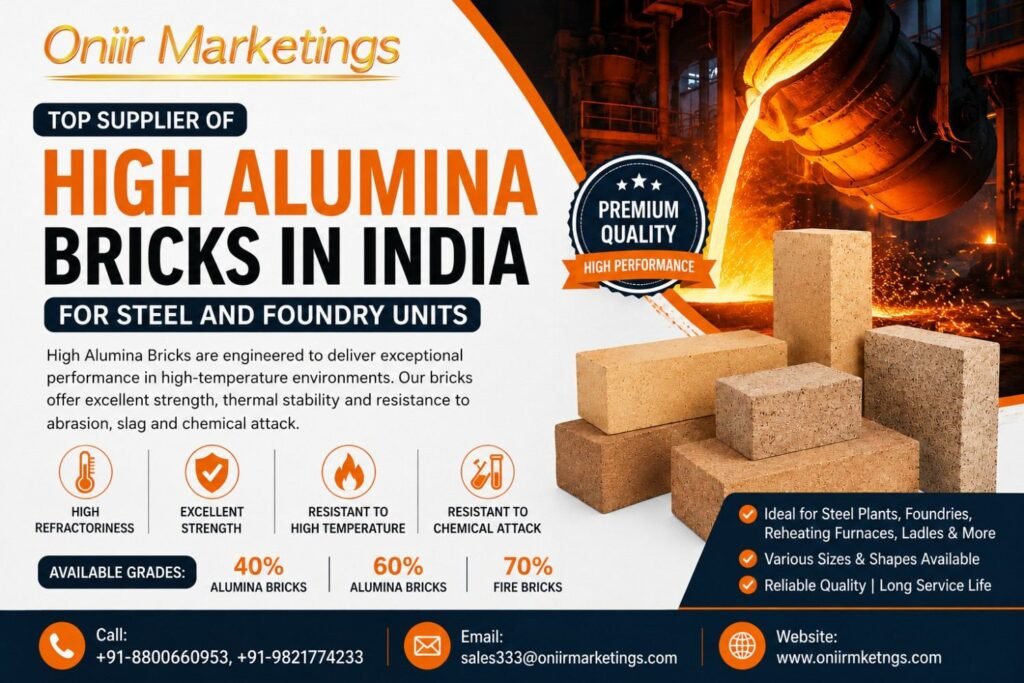
High alumina bricks are premium quality refractory bricks that can withstand high temperatures, stresses, abrasions, and corrosion in industrial furnaces. The production of these bricks involves the use of aluminum oxide content raw materials and controlled firing processes to form a dense and durable structure. Based on usage, these bricks are classified into various alumina brick grades like 40% alumina brick, 50% alumina brick, 60% alumina brick, and 70% fire brick. They are commonly used in steel plants, foundries, reheating furnaces, heat treatment facilities, kilns, and many other high-temperature apparatus. In contrast to general construction bricks, these high alumina fire bricks have been specially designed for industrial uses.Why High Alumina Fire Bricks Are Important for Steel Plants
Steel production is characterized by very rigorous temperature requirements; hence, the choice of refractories becomes an essential component of furnace maintenance. High alumina refractory fire bricks are commonly used in locations subjected to high temperatures, thermal shocks, abrasive environments, and interaction with liquid metals or slag. The alumina content makes these refractories offer high refractoriness and also ensures stability under high temperatures. Different grades can be used depending on the location of the furnace, where instead of using the same kind of brick across the entire lining of the furnace, different grades of bricks can be used. High alumina fire bricks can be used for severe duty sections, while medium alumina refractories can be used for relatively moderate locations. Buyers in need of high alumina bricks in India can consult Oniir Marketings.High Alumina Bricks for Foundry Units
Foundry furnaces undergo cycles of heating, melting, and cooling; therefore, the refractory lining may experience significant stress. Alumina bricks can be used for many foundry operations since these bricks exhibit high-temperature performance, mechanical durability, and abrasion resistance. Based on the furnace and operational conditions, the right refractory bricks should be installed on furnace walls, hearths, heating zones, and other exposed areas of the furnaces. 40% alumina bricks may be used for moderate-duty furnaces, while 60% or 70% alumina bricks should be used under more severe conditions. These bricks should be based on parameters such as furnace temperatures, molten metal, fuels, location of the lining, and the operational cycle. It is recommended that a professional refractory provider helps in finding the right brick grade instead of choosing high-alumina bricks.40% Alumina Bricks for Moderate-Duty Applications
40% alumina bricks represent an appropriate compromise between the efficiency of refractories and their cost. They include 40% Al₂O₃ and are commonly used when a higher efficiency is needed than that of normal fire clay bricks, but not an extremely high content of alumina is required. 40% alumina fire bricks may be applied in some furnace walls, heat treatment facilities, moderate temperature furnaces, and other industrial uses. Their efficiency will depend on such parameters as bulk density, apparent porosity, cold crushing strength, and quality of firing. Selection of 40% alumina fire bricks does not mean that we have chosen a poor product – it just corresponds to real requirements. Under such conditions, when temperatures and chemical influence are within the range of grade capability, 40% alumina fire bricks represent a good choice.70% Fire Bricks for High-Temperature Applications
70% fire bricks are high-performing refractory bricks made up of 70% alumina and used in harsh thermal applications. They offer a higher alumina content that enhances their refractoriness and high density, along with mechanical strength depending on the formula. They are applied in severe furnace zones, steel industries, foundry applications, and many others where normal fire bricks fail to perform adequately. But alumina percentage is not the sole deciding factor. Other parameters such as Fe2O3, bulk density, apparent porosity, cold crushing strength, RUL, and thermal expansion have to be looked into too. Buyers can ask about 70% high alumina fire bricks from Oniir Marketings based on their application and requirements. The technical information needs to be cross-checked with the present specifications of the manufacturer.Fire Bricks vs High Alumina Fire Bricks
Fire bricks are a wide range of refractory bricks for heat applications, while high alumina fire bricks are an example of a specific type of brick with much higher contents of alumina. Fire bricks may suit furnace construction or moderate temperature conditions, whereas high alumina types are recommended where increased refractoriness, strength, or chemical resistance is needed. Two refractory bricks could have different properties but look very much alike. Hence, potential buyers should not buy only based on the looks or cost of bricks. The specification of the brick must clearly describe the percentage of alumina, physical properties, size, and use. Oniir Marketings can offer different refractory materials according to industrial needs and help customers understand what type of fire brick – fire brick, 40%, 60% or 70% – is needed.Applications of Alumina Refractory Bricks
- Steel Reheating Furnaces: Used for furnace walls, roofs and other high-temperature zones.
- Foundry Furnaces: Suitable for selected furnace walls, hearths and heating areas.
- Soaking Pits: Used where resistance to high temperatures and mechanical stress is required.
- Industrial Kilns: Suitable for selected high-temperature kiln sections.
- Heat-Treatment Furnaces: Used in thermal-processing equipment requiring reliable refractory protection.
- Steel Ladles: Higher-grade alumina bricks can be used in selected demanding lining applications.
- Furnace Hearths: Protect against heat, abrasion, and mechanical wear.
- Burner Areas: Specially shaped refractory bricks can be used around burner openings.
- Furnace Roofs and Walls: Help protect structural components from intense heat.
- Industrial Thermal Equipment: Used across various high-temperature processing industries.
Key Technical Specifications to Check
- Alumina Content (Al₂O₃): Refractory brick classification and suitability for various operating temperatures.
- Iron Oxide (Fe₂O₃): Less is better for challenging high-temperature conditions.
- Bulk Density: Reflects the density and structure of the refractory brick.
- Porosity: The lower, the better in terms of protection from metal/slag penetration.
- Cold Crushing Strength (CCS): Reflects the resistance to mechanical load of the refractory brick.
- Refractoriness Under Load (RUL): Reflects the performance of the brick under load at high temperatures.
- Permanent Linear Change (PLC): Allows evaluating the dimensional stability under high-temperature operation.
- Thermal Shock Resistance: Important characteristic for those furnaces that experience thermal shocks.
- Brick Dimensions: Proper dimensions and tolerances are necessary for correct furnace installation.
- Special Shapes: Arches, wedges, burner blocks, and other custom shapes can be required for specific furnace designs.
Manufacturer, Supplier, Exporter, Stockist and Distributor in India
Oniir Marketings caters to industries in need of refractories and refractory materials in India, including high alumina bricks, fire bricks, and refractory material requirements. Customers normally use keywords like high alumina bricks manufacturers in India, high alumina bricks suppliers in India, refractory bricks exporters, fire bricks stockists, and refractory distributors while procuring industrial raw materials. Besides the requirement of grade and technical aspects of materials, volume, availability, and delivery considerations are also of equal importance in case of high volume orders. The seller must be ready to discuss grade, size, quantity, packing, and applications before the purchase of material. In case of an independent manufacturer, the technical documents of the manufacturing company should be verified to match the specifications.Benefits of Using High Alumina Refractory Bricks
- High Temperature Resistance: Created to operate dependably under challenging thermal conditions.
- High Refractoriness: Useful in furnaces and machinery that run at high temperatures.
- Good Mechanical Strength: Useful in handling mechanical stresses.
- Wear Resistance: Useful in locations subjected to wear.
- Chemical Resistance: May offer increased resistance to some slags and other corrosive materials.
- Thermal Stability: Useful in retaining structural stability during operation at high temperatures.
- Increased Lifespan: Well-chosen grades may increase the lifetime of the refractory lining.
- Various Grades of Alumina: Available in alumina grades such as 40% and 70%.
- Various Forms and Sizes: Available in common forms and custom-made forms.
- Optimization of Costs: Choosing the right grades for each section of the furnace may optimize costs.
High Alumina Bricks for Steel Furnaces and Ladles
Steel furnace linings and ladles need refractory bricks that can resist high temperatures and thermal shock. High alumina bricks can be used in furnace walls, reheaters, soaking pits, and any other high-temperature parts of the furnace as per the lining specification. High-grade high alumina bricks can be used in areas subjected to tough thermal and mechanical stresses. Consideration has to be made on molten steel composition, slag composition, abrasiveness, furnace atmosphere, and mechanical loading. It is also crucial to identify whether the lining is working lining, backup lining, or safety lining, as each lining may need different types of refractories. Oniir Marketings can assist buyers of the steel industry in procuring high alumina fire bricks and alumina refractory bricks. Buyers have to give furnace application, temperature, dimensions, and required alumina grade before procurement.High Alumina Bricks for Foundry Furnaces
There is need to have refractory linings that can withstand melting, as well as thermal and mechanical shock. Depending on the design of the furnace, refractory alumina bricks can be used in the wall, hearth, and any other area that experiences high temperatures. The different metals to be melted determine the refractory material to be used since different metals have different effects on the molten metal and slag. One section might require a medium alumina refractory brick while another section requires a high alumina brick. This is why there is a need for the foundry to provide information about the furnace, type of fuel used, operating temperature, metal being used, and location of the brick. Oniir Marketings can help buyers identify suitable fire bricks and high alumina fire bricks for foundry applications depending on availability.How to Select the Right Alumina Grade
The selection process of an appropriate alumina grade starts with the identification of the furnace and not from a product catalogue. The first step is the identification of the maximum operating temperature, after which one identifies if the brick will be exposed to molten metals, slags, abrasion, impact, or thermal shock. The location of the brick in the lining is also another consideration because workable linings are usually subjected to more severe environments than back-up linings. Once the above requirements have been identified, the technical requirements such as Al2O3, Fe2O3, density, porosity, CCS and RUL are compared. The 40% alumina bricks could prove to be economically viable in moderate-duty environments, while the 70% fire bricks are for more severe duty environments. The most costly brick is not always the beshttps://www.humanizeai.pro/_next/static/media/SquareDouble.faccfce6.svgt brick.Technical Comparison of Common Grades
| Refractory Grade | Approx. Alumina | Typical Use |
| Standard Fire Bricks | 30–35% | General/moderate-duty furnace areas |
| 40% Alumina Bricks | ~40% | Moderate-duty industrial applications |
| 50% Alumina Bricks | ~50% | Medium to higher-duty furnace areas |
| 60% Alumina Bricks | ~60% | Reheating and higher-temperature applications |
| 70% Fire Bricks | ~70% | Severe-duty steel and foundry applications |