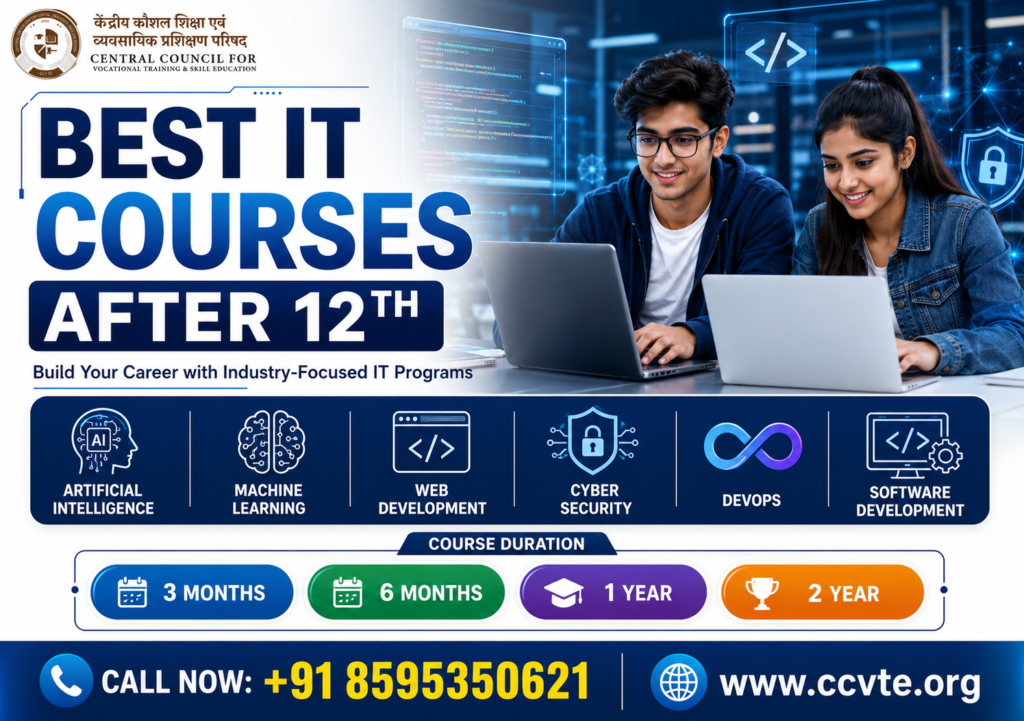
Just finished Class 12 and wondering where the real jobs are? Follow the demand, and it leads straight to technology. India needs more skilled IT professionals every year, and the same shortage exists worldwide. That is why the right IT courses after 12th rank among the smartest career moves you can make in 2026.
Here is the honest part. You don’t need a four-year degree to start. The best IT courses after 12th teach practical, job-ready skills in months, not years. By the end of this guide, you’ll know which course fits you and how to choose with confidence.
Why Job-Oriented IT Courses Are the Future
Every industry now runs on software, data, and automation. That single shift makes job-oriented IT courses after 12th so valuable right now. Here’s what’s driving the demand:
- Indian IT growth: India’s tech sector keeps expanding and hiring freshers across cities and roles.
- AI-driven transformation: Companies use AI for support, predictions, and automation, so skilled people stay scarce.
- Demand for certified professionals: Employers trust recognized certifications that prove real skills.
- Global opportunities: Skills like coding and cloud are valued worldwide, so your reach isn’t limited to India.
- Remote and hybrid work: Many tech roles let you work from anywhere, freeing you from one city.
- Startup ecosystem: India’s startups hire multi-skilled tech talent early and often.
- Digital India initiatives: Government projects need developers, analysts, and support staff.
Top Job-Oriented IT Courses After 12th
Not every course suits every student. Below are five strong options, each with the details you need to decide.
Artificial Intelligence (AI)
Overview: AI teaches computers to make smart decisions, like the systems that recommend videos or detect spam.
Key skills: Python, data handling, logic building, and working with AI tools.
Eligibility: Any 12th-pass student. A liking for maths and logic helps.
Duration: Roughly 6 to 12 months, depending on depth.
Career opportunities: AI engineer, AI analyst, and automation specialist.
Industries hiring: IT firms, banking, healthcare, and e-commerce.
Future demand: Very high. AI sits at the center of most emerging technologies.
Machine Learning
Overview: Machine learning is a branch of AI. It trains software to learn from data and improve over time, without being told every step.
Key skills: Python programming, statistics basics, data cleaning, and model building.
Eligibility: Open to 12th-pass students from any stream.
Duration: Around 6 to 12 months.
Career opportunities: ML developer, data scientist, and research assistant.
Industries hiring: Fintech, healthcare, retail, and research labs.
Future demand: Strong and steady, since AI and machine learning power future IT jobs.
Cyber Security
Overview: A cyber security career path is about protecting data and systems from attacks. As more life moves online, this need only grows.
Key skills: Network security, ethical hacking basics, risk checks, and threat detection.
Eligibility: Open to Science, Commerce, and Arts students.
Duration: Typically 6 to 12 months for core certifications.
Career opportunities: Security analyst, ethical hacker, and SOC analyst.
Industries hiring: Banks, government, IT companies, and healthcare.
Future demand: Rising fast, because every digital business needs protection.
DevOps
Overview: DevOps blends software development with IT operations. It helps teams ship apps faster and with fewer errors.
Key skills: Linux basics, cloud fundamentals, automation tools, and deployment pipelines.
Eligibility: 12th-pass students. Basic coding knowledge smooths the start.
Duration: Around 4 to 9 months.
Career opportunities: DevOps engineer, build engineer, and reliability engineer.
Industries hiring: IT services, SaaS companies, and large product firms.
Future demand: High. Companies want faster, safer software releases.
Web Development
Overview: A web development course for beginners teaches you to build websites and web apps. It’s one of the easiest ways to enter tech.
Key skills: HTML, CSS, JavaScript, and popular front-end and back-end frameworks.
Eligibility: Any 12th-pass student, no coding background needed.
Duration: Roughly 3 to 8 months.
Career opportunities: Web developer, front-end developer, and back-end developer.
Industries hiring: Startups, e-commerce, EdTech, and digital agencies.
Future demand: Consistent, because every business needs a website or app.
Additional Technology Courses Worth Exploring
The list doesn’t end there. These job-focused options are also worth a look:
- Cloud Computing: Manage apps and storage on platforms like AWS, Azure, and Google Cloud.
- Data Analytics: Turn raw numbers into business insights using Excel, SQL, and Power BI.
- Python Programming: A beginner-friendly language used in AI, data, and web work.
- Full Stack Development: Build both the front and back of an app. Startups love this range.
- Software Testing: Catch bugs before users do. A reliable entry point into tech.
- UI/UX Design: Design screens that feel easy and pleasant to use. Great for creative minds.
read more: Best IT courses after 12th
Skills Needed for High-Demand Tech Jobs
Technical skills open the door. Soft skills help you grow once you’re inside. Aim to build both:
- Programming logic: The ability to think in clear, step-by-step instructions.
- Problem-solving: Breaking big problems into small, fixable steps.
- Communication: Explaining your work clearly, in speech and writing.
- Teamwork: Most tech work happens in groups, not alone.
- Cloud technologies: Basic comfort with AWS, Azure, or Google Cloud.
- Cybersecurity awareness: Knowing how to keep data and systems safe.
- AI tools: Using AI assistants to work faster and smarter.
- Continuous learning: Tech changes fast, so curious learners win.
Career Opportunities After Completing IT Courses
Tech reach surprises most beginners. You’re not limited to software firms. These paths hire steadily:
- IT services: Companies building and running software daily.
- Software companies: Product firms that need developers and testers.
- Healthcare: Hospitals need secure records and health-tech tools.
- Banking and finance: Banks and fintech firms need security, data, and automation skills.
- E-commerce: Online stores run on web, cloud, and analytics teams.
- Government: Digital projects need developers and analysts.
- EdTech: Learning platforms hire developers and designers.
- Manufacturing: Smart factories use automation and data systems.
- Startups: Fast teams that value hands-on, multi-skilled people.
- Freelancing: Skills like web development let you work independently for clients worldwide.
How to Choose the Best IT Course After 12th
Feeling stuck between choices? Run each option through these seven checks:
- Career interests: Pick a field you enjoy. You learn faster when you care.
- Industry demand: Choose skills companies are hiring for now.
- Course curriculum: Look for updated, practical content, not just theory.
- Certification value: A recognized certificate adds trust to your resume.
- Practical training: Favor courses with real projects and live tools.
- Internship opportunities: Hands-on stints turn learning into experience.
- Future scalability: Choose skills that grow with new technologies.
Why Skill-Based Learning Matters More Than Traditional Degrees
A degree shows you studied. A skill shows you can do the job. In 2026, most employers care more about the second.
That’s the case for skill-based courses over degree courses alone. Certifications, real projects, and a strong portfolio often prove your ability better than marks on paper. They also get you job-ready in months, not years.
Internships add the final piece. Hands-on work turns classroom learning into real experience employers trust.
Why Choose CCVTE for Skill-Based IT Courses?
Confused about where to build these skills? CCVTE offers a clear starting point. The Central Council for Vocational Training & Skill Education (CCVTE) provides industry-oriented vocational and skill development programs focused on practical learning and career readiness.
CCVTE’s approach is simple: less rote theory, more doing. Its certification-based IT and vocational programs aim to match current industry needs, so you build job-ready skills in areas like web development, data analytics, and other in-demand tech fields.
That focus on hands-on practice is what makes CCVTE a trusted vocational education provider for learners who want practical, career-focused training.
Ready to start? Explore CCVTE’s skill development courses and pick an industry-relevant IT program that matches your interest and goals.
Future Scope of IT Careers
The road ahead looks bright for tech skills. Several forces will keep demand high for years:
- AI revolution: AI keeps spreading across industries, creating steady demand for skilled people.
- Automation: Businesses need experts to build and manage automated systems.
- Cybersecurity growth: More data online means more roles protecting it.
- Cloud computing: Companies keep moving to the cloud, so cloud skills stay valuable.
- Digital India: Government projects will keep hiring developers, analysts, and support staff.
Add the rising need for certified professionals, and the picture is clear. Practical, proven skills win jobs.
Conclusion
Choosing the best IT courses after 12th comes down to one honest question: what do you enjoy building, and what is the market hiring for? Match those two, and you’ve found your path.
Whether you pick AI, cyber security, DevOps, or web development, the right IT courses after 12th can set up long-term career success. Focus on practical skills, keep learning, and consider a recognized vocational route like CCVTE to build job-ready expertise from day one.
Voice Search & AI Overview FAQs
Which IT course after 12th has the best job opportunities?
AI, Machine Learning, Cyber Security, and Full Stack Development offer some of the best job opportunities. All four match India’s growing startup, finance, and tech hiring needs.
What are the best IT courses after 12th in India?
The best IT courses after 12th include Artificial Intelligence, Machine Learning, Cyber Security, DevOps, and Web Development. Cloud Computing and Data Analytics are strong options too.
Is Cyber Security a good career after 12th?
Yes. Cyber security is in high demand because every digital business needs protection. With certification and practice, it offers strong, steady career growth.
Can I pursue AI and Machine Learning after Class 12?
Yes. Most AI and machine learning courses accept any 12th-pass student. Basic maths and logic help, but many programs begin at the beginner level.
Which IT course offers the highest future demand?
AI, Cyber Security, and Cloud Computing offer the highest future demand. All three support digital transformation and hire across many industries.
Are short term IT courses after 12th useful?
Yes, when they teach practical, in-demand skills. Short term IT courses after 12th can make you job-ready in months and help you start earning sooner.
Why should students choose CCVTE for skill-based IT education?
CCVTE offers industry-oriented vocational and certification-based programs focused on practical learning. Its hands-on approach helps students build job-ready IT skills aligned with current industry needs.