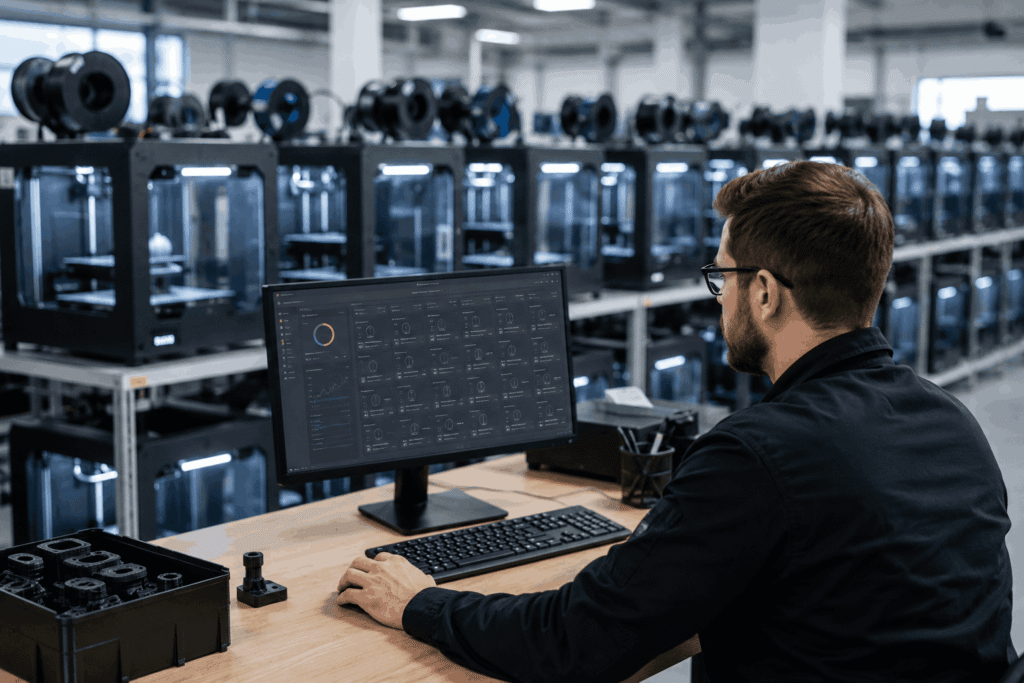
Managing a small number of printers is very different from operating a large-scale additive manufacturing environment. As organizations expand from a few devices to hundreds of machines across multiple departments or locations, operational complexity increases significantly.
Large print farms often face challenges involving:
- Printer downtime
- Workflow inefficiencies
- Poor queue coordination
- Inconsistent print quality
- Limited operational visibility
- Manual management bottlenecks
Without centralized infrastructure, these issues can reduce productivity and increase operational costs. Modern 3D printer software helps organizations address these challenges through automation, remote oversight, and centralized workflow management.
Inefficient Print Queue Management Across Multiple Machines
Manual print scheduling often leads to underutilized hardware and workflow delays. Operators may struggle to prioritize urgent jobs while balancing workloads across available printers.
Modern 3D printer software improves efficiency through:
- Automated queue management
- Smart job distribution
- Centralized scheduling
- Real-time printer availability tracking
These features help organizations reduce idle time while improving throughput across the entire print farm.
Lack of Centralized Control and Visibility
Managing printers across different locations becomes increasingly difficult without centralized oversight. Separate systems and disconnected workflows often limit operational visibility.
Centralized management platforms provide:
- Unified dashboards
- Live printer monitoring
- Centralized workflow oversight
- Remote operational access
This allows administrators to make faster and more informed production decisions.
High Failure Rates and Print Errors
Failed prints increase material waste, production delays, and operational costs. In many environments, operators only discover failures after jobs have already consumed significant resources.
Modern platforms reduce failure rates through:
- Automated alerts
- Early failure detection
- Live monitoring tools
- AI-assisted print analysis
Early identification of print issues helps organizations minimize waste while improving operational reliability.
Printer Downtime and Maintenance Challenges
Unexpected downtime can significantly impact production schedules in large print farms. Traditional workflows often lack visibility into maintenance requirements or machine performance trends.
Modern systems improve maintenance management through:
- Maintenance scheduling
- Performance tracking
- Automated service alerts
- Printer health monitoring
These capabilities help organizations maintain higher equipment availability across distributed fleets.
Inconsistent Print Quality Across Machines
Large additive manufacturing environments often experience inconsistencies between machines due to varying settings, calibration differences, or workflow fragmentation.
Modern 3D printer design software and management platforms help standardize operations through:
- Shared print profiles
- Centralized slicing workflows
- Standardized configuration settings
- Controlled user permissions
This improves consistency across production environments while reducing configuration related errors.
Difficulty Managing Multiple Users and Access Levels
Universities, enterprise labs, OEMs, and manufacturing facilities frequently operate shared print environments involving many users. Without proper controls, workflow conflicts and operational inefficiencies can increase rapidly.
Modern platforms support:
- Role based user access
- Department level permissions
- Usage tracking
- Workflow governance
- Print quotas
These controls help organizations coordinate shared resources more efficiently.
File Management and Version Control Issues
Managing multiple design files across departments often creates confusion around file versions and print readiness. Fragmented storage systems can also increase the risk of outdated files entering production.
Cloud-based platforms simplify file management through:
- Centralized file storage
- Version tracking
- Secure file access
- Shared project visibility
This improves collaboration while reducing workflow errors.
Limited Scalability with Traditional Systems
Manual workflows may function adequately for small print environments but often struggle as printer fleets grow.
Cloud-based 3D printer software platforms improve scalability through:
- Centralized infrastructure
- Automated workflow coordination
- Remote management capabilities
- Multi location oversight
This allows organizations to expand operations without proportionally increasing management complexity.
Lack of Remote Monitoring and Performance Insights
Traditional on site management limits operational flexibility. Distributed print farms require real time visibility across multiple locations.
Modern platforms provide:
- Remote printer access
- Live production monitoring
- Analytics dashboards
- Operational reporting tools
These insights help organizations improve efficiency while identifying opportunities for workflow optimization over time.
How Modern 3D Printer Software Transforms Large Print Farm Operations
Modern additive manufacturing environments require more than basic printer connectivity. Organizations increasingly depend on software platforms that improve automation, scalability, operational visibility, and workflow consistency.
3DPrinterOS combines cloud-based slicing, remote monitoring, centralized queue management, multi-user coordination, and workflow oversight within a single platform designed for enterprise print farm operations.
Investing in the right 3D printer software helps organizations reduce failures, improve throughput, and scale additive manufacturing workflows more efficiently. Contact 3DPrinterOS to grow print farms with modern 3D design software that works as a critical operational investment rather than just a supporting tool.