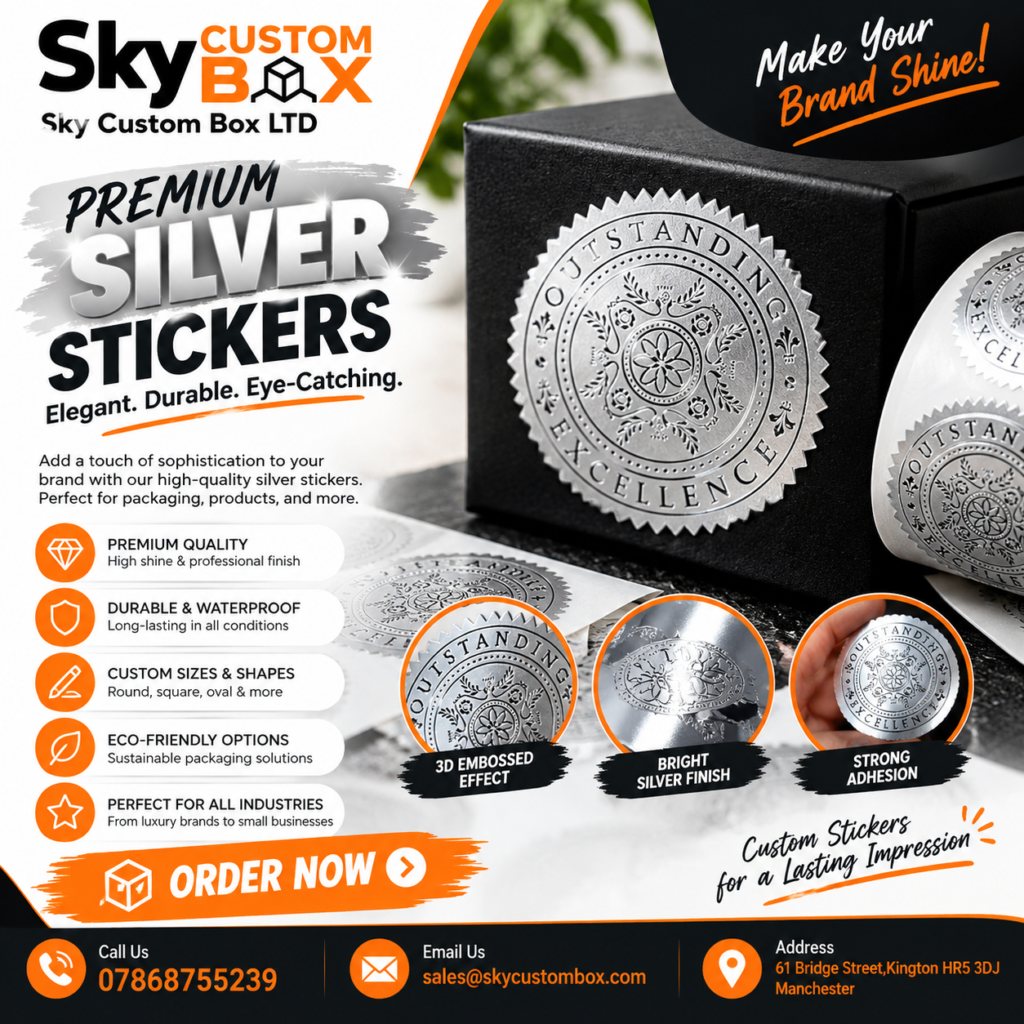
In competitive retail markets, packaging has become much more than a protective layer around a product. It is often the first physical interaction a customer has with a brand. From the colour and typography to the texture and finishing details, every element can influence how a product is perceived. Among the many decorative options available today, silver stickers have become a practical choice for brands looking to create a refined, contemporary appearance without completely redesigning their packaging.
Silver finishes can add visual contrast, highlight important information, and create a premium impression across a wide range of products. They can also be combined with techniques such as embossing, metallic foiling, and textured printing to create packaging that feels distinctive while remaining functional.
For businesses operating in retail, cosmetics, food, beverages, electronics, and specialty products, understanding how metallic labels work can help with more effective packaging decisions.
Why Silver Stickers Have Become Popular in Product Branding
Metallic packaging finishes have long been associated with premium products. However, advances in label manufacturing have made metallic effects more accessible for smaller businesses and emerging brands.
A silver surface interacts with light differently from conventional white or matte labels. This reflective quality can help specific packaging elements stand out on a crowded shelf or within an online product photograph.
Several factors have contributed to the growing use of silver finishes:
- Visual differentiation: Metallic surfaces can distinguish a product from standard printed packaging.
- Premium perception: Silver is commonly associated with sophistication, technology, precision, and quality.
- Design flexibility: Metallic labels can work with minimalist, contemporary, luxury, or industrial branding.
- Highlighting important information: Logos, product names, batch information, or selected design elements can be emphasised.
- Compatibility with different packaging: Silver labels can be applied to boxes, bottles, jars, pouches, containers, and other surfaces.
Importantly, a metallic effect does not automatically make packaging successful. The finish should support the brand’s identity rather than dominate the overall design.
How Metallic Finishes Influence Consumer Perception
Packaging communicates information before a customer reads every word on the label. Colour, material, typography, and finishing techniques work together to create visual signals.
Silver often communicates qualities such as modernity, cleanliness, technology, and sophistication. These associations can make it particularly relevant to industries where presentation is important.
For example, a technology accessory may use a silver label to reinforce a modern aesthetic, while a cosmetic product may combine a metallic finish with elegant typography and minimal graphics.
The effectiveness of the design depends on context. A highly reflective label may work well for a premium product but could be unsuitable where a softer, natural appearance is central to the brand.
This is why packaging professionals generally consider the complete visual system rather than choosing a finish in isolation.
The Importance of Contrast
Contrast is one of the most useful design principles when working with metallic surfaces.
A silver background can be paired with darker typography to improve visual definition. Alternatively, a designer may use metallic details selectively rather than covering the entire label.
Common approaches include:
- Silver background with black or dark typography.
- White label with silver metallic accents.
- Silver logo against a coloured packaging surface.
- Metallic borders surrounding important information.
- Silver elements combined with embossed textures.
Using metallic finishing as an accent can often create a more controlled appearance than applying it to every element.
Embossed Metallic Stickers and Tactile Branding
Visual appearance is only one part of packaging design. Physical texture can also influence how customers interact with a product.
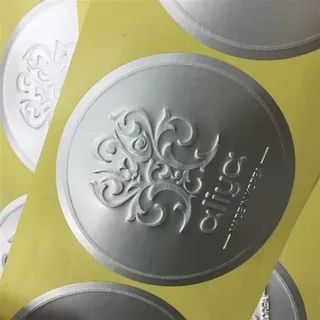
Embossed metallic stickers combine a reflective finish with raised or recessed details. The resulting surface provides both visual and tactile contrast, making certain design elements easier to notice when handling the packaging.
Embossing can be used for:
- Brand names and logos
- Decorative borders
- Product symbols
- Monograms
- Certification-style graphics
- Special edition markings
- Patterned design elements
The combination of metallic colour and raised detail can create a layered effect that is difficult to reproduce with ordinary flat printing.
However, embossing requires careful planning. Very small lettering or complicated graphics may not produce the desired result when converted into a physical raised design. Designers should therefore consider the size, depth, spacing, and material of the label before final production.
Practical Applications Across Different Industries
Metallic stickers are not limited to luxury packaging. Their versatility makes them suitable for many retail and commercial applications.
Cosmetics and Personal Care
Beauty brands frequently use metallic finishes to communicate elegance and premium positioning. Silver can be particularly effective on skincare bottles, fragrance packaging, cosmetic boxes, and accessory products.
A simple metallic logo can sometimes provide enough visual distinction without requiring elaborate packaging.
Food and Beverage
Specialty foods, confectionery, coffee, beverages, and gift products can use metallic labels to identify limited editions or premium product lines.
For example, a silver accent may be used to distinguish a seasonal product from a company’s standard range.
Electronics and Technology
Silver naturally fits technology-oriented branding because it is commonly associated with modern materials, precision, and engineering.
Labels can be used on product boxes, accessories, equipment packaging, and promotional editions.
Retail and Gift Products
Gift packaging benefits from finishes that attract attention without requiring complex structural changes. Metallic labels can provide an additional decorative layer to otherwise simple boxes or containers.
Businesses can also use different label finishes to differentiate product collections while maintaining consistent brand colours and typography.
Common Challenges When Using Metallic Labels
Despite their advantages, metallic finishes can create design and production challenges.
Legibility
Highly reflective surfaces can sometimes reduce readability, particularly when light reflects directly from the label. Typography should therefore be selected for clarity rather than decoration alone.
Colour Accuracy
Metallic substrates can affect how printed colours appear. A colour that looks one way on a standard digital proof may appear different when applied over a reflective surface.
Professional sampling can help identify these differences before a larger production run.
Adhesion
The packaging material itself matters. Glass, coated cardboard, plastic, kraft paper, and textured surfaces can all behave differently when labels are applied.
The adhesive should be suitable for the intended substrate and environmental conditions.
Overdesign
Another common mistake is using too many decorative effects at once. Metallic foil, embossing, gradients, glossy coatings, complex typography, and multiple colours can compete for attention.
A more restrained approach often produces clearer brand communication.
Best Practices for Designing Silver Product Labels
A successful metallic label begins with a clear design objective.
Before production, businesses should consider:
- What part of the packaging needs emphasis?
- Is the metallic effect consistent with the brand identity?
- Will the label remain readable under different lighting conditions?
- What packaging material will receive the label?
- Is the product exposed to moisture, heat, friction, or refrigeration?
- Does the design need to work in both physical stores and digital photographs?
- Would embossing or another tactile treatment add genuine value?
It is also useful to request physical samples rather than relying entirely on digital previews. Metallic surfaces are inherently dependent on light, viewing angle, material, and printing technique.
Packaging providers such as Sky Custom Box can be considered when businesses are evaluating how labels, boxes, and other packaging elements work together as a complete presentation system.
The Relationship Between Labels and Sustainable Packaging
Modern packaging decisions increasingly involve environmental considerations alongside appearance.
Metallic effects should therefore be evaluated as part of the entire packaging system. Businesses may need to consider the label material, adhesive, printing process, packaging substrate, and end-of-life recycling requirements.
A visually attractive label is only one component of responsible packaging design.
For brands focused on sustainability, it can be useful to investigate material specifications and disposal requirements before selecting a particular metallic finish. Packaging regulations and recycling systems can also vary between markets, so manufacturers should provide accurate information about the materials being used.
The Future of Metallic Branding
Packaging design continues to move toward greater personalization and visual differentiation. Digital printing, improved finishing technologies, textured materials, and smaller production runs are giving brands more opportunities to experiment with premium-looking packaging.
Metallic effects are likely to remain relevant because they can be used in both subtle and highly decorative ways. Instead of covering an entire package with reflective material, future designs may increasingly use metallic details strategically alongside tactile finishes, minimalist layouts, and environmentally conscious materials.
Personalized labels and limited-edition packaging may also benefit from metallic treatments because they allow businesses to create a sense of distinction without completely changing their underlying packaging structure.
Conclusion
The role of silver stickers in modern product branding extends beyond simple decoration. Their reflective appearance can improve shelf visibility, reinforce particular brand associations, and create opportunities for more sophisticated packaging designs.
Read More: