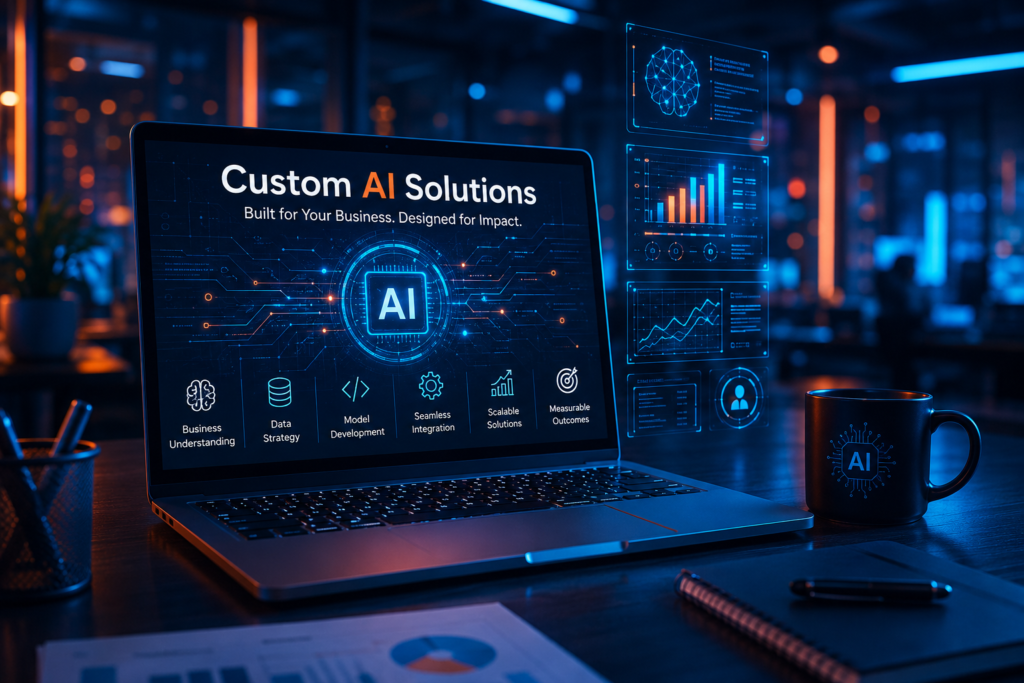
Artificial intelligence is no longer an emerging technology reserved for innovation labs. Businesses across industries are actively using AI to improve efficiency, automate processes, and unlock new growth opportunities.
However, as adoption increases, many organizations are discovering that off-the-shelf AI tools cannot fully address their unique business requirements. Every company has different workflows, data environments, customer expectations, and operational challenges. As a result, demand for custom AI solutions is growing rapidly.
This shift is also reflected in the increasing number of real-world AI implementations. MindInventory alone has delivered more than 80 AI projects with a team of 70+ AI engineers serving businesses across 40+ countries. These projects highlight a broader trend: organizations are looking for AI solutions built around their specific goals rather than generic capabilities.
So, what can companies learn from this approach?
Why Businesses Are Moving Toward Custom AI Solutions
One-Size-Fits-All AI Has Limitations
Pre-built AI platforms can help businesses get started quickly, but they often come with constraints.
Common challenges include:
- Limited customization
- Generic outputs that lack business context
- Integration difficulties with existing systems
- Compliance and security concerns
As organizations mature in their AI adoption journey, they often need solutions tailored to their operations rather than adapting their operations to fit a tool.
Competitive Advantage Requires Customization
The most successful AI initiatives are designed to solve specific business problems.
Whether it’s automating claims processing, improving forecasting accuracy, enhancing customer support, or streamlining operations, custom AI solutions allow organizations to leverage proprietary data and workflows that competitors cannot easily replicate.
In many cases, customization becomes the difference between simply using AI and gaining a competitive advantage from it.
Common Challenges Companies Face When Building AI Solutions
Defining the Right Use Case
Many AI projects struggle because organizations focus on technology before identifying a business problem.
Successful initiatives start by answering a simple question:
What business challenge are we trying to solve?
Data Readiness Issues
Data quality remains one of the biggest barriers to successful AI implementation.
Incomplete, inconsistent, or siloed data can significantly limit the effectiveness of even the most advanced AI models.
Integration Complexity
AI does not operate in isolation.
To deliver value, it must integrate with existing systems, processes, and workflows. Poor integration often leads to low adoption and reduced business impact.
Measuring Business Impact
Organizations frequently track technical metrics but overlook business outcomes.
Without clear KPIs tied to revenue, cost savings, productivity, or customer experience, it becomes difficult to evaluate success.
What Companies Can Learn from MindInventory’s Approach
Start With Business Goals
One of the most valuable lessons is that AI projects should begin with business objectives, not technology choices.
Organizations that define measurable outcomes first are more likely to achieve meaningful results and stronger ROI.
Prioritize User Adoption
An AI solution only creates value when people actually use it.
Successful implementations focus on user experience, workflow alignment, and ease of adoption from the beginning rather than treating these factors as afterthoughts.
Build for Scalability
Many companies successfully launch AI pilots but struggle when it’s time to scale.
A scalable approach considers infrastructure, security, performance, and future growth requirements from day one.
Focus on Practical Value Over Innovation Hype
Not every challenge requires the latest AI breakthrough.
Often, the highest returns come from solving practical operational problems.
This focus on business outcomes is one reason custom AI continues to gain traction. According to MindInventory’s AI implementation experience, organizations deploying production-ready AI systems have achieved an average 30–40% reduction in manual processing costs within six months of deployment. The lesson is clear: measurable business value matters more than experimentation.
Organizations looking to achieve similar outcomes often work with teams offering specialized AI development services that align technical execution with business goals.
A Framework for Evaluating Custom AI Opportunities
Before investing in custom AI, businesses should evaluate opportunities through a structured framework.
Step 1: Identify a High-Impact Business Problem
Look for:
- Repetitive manual tasks
- Operational bottlenecks
- Data-heavy decision-making processes
- Customer experience challenges
Step 2: Assess Data Availability
Evaluate:
- Data quality
- Accessibility
- Security requirements
- Compliance considerations
Step 3: Define Success Metrics
Examples include:
- Cost reduction
- Productivity improvement
- Revenue growth
- Faster processing times
- Customer satisfaction improvements
Step 4: Plan for Adoption
Consider:
- Employee training
- Change management
- Workflow integration
- Long-term support
The success of an AI initiative depends as much on adoption as it does on technology.
When Does Custom AI Make More Sense Than Off-the-Shelf Tools?
Custom AI solutions are often the better choice when:
- Proprietary business data is involved
- Existing tools cannot support specific requirements
- Competitive differentiation is important
- Workflows require advanced automation
- Compliance and security requirements are strict
In these situations, customization often delivers greater long-term value than a generic platform.
Custom AI in Action
Real-world implementations demonstrate why businesses are increasingly choosing tailored solutions.
For example:
- An AI-powered construction management platform helped reduce compliance errors by 40% while improving task delivery speed by 4x.
- An AI-driven claims processing solution achieved 20% faster claim processing and reduced manual handling by 25%.
These outcomes illustrate how custom AI can address specific operational challenges while delivering measurable business value.
Conclusion
The growing demand for custom AI solutions reflects a broader shift in how organizations approach AI adoption.
Businesses are moving beyond experimentation and looking for solutions that solve real problems, integrate seamlessly into operations, and generate measurable results.
Companies evaluating their own AI initiatives can learn valuable lessons from MindInventory’s approach: start with business objectives, prioritize adoption, build for scale, and focus relentlessly on outcomes.
Ultimately, successful AI projects are not defined by the sophistication of the technology but by the value they create for the business.