Advanced therapy medicinal products (ATMPs) have transformed pharmaceutical development by introducing innovative approaches based on living cells, genes, and engineered tissues. However, their biological complexity also creates demanding manufacturing and quality-control requirements. Among these, contamination control is a critical consideration because microbial contamination can compromise product quality and potentially create serious risks for patients.
Sterility testing for ATMPs plays an important role in demonstrating that a finished product meets applicable microbiological quality requirements. At the same time, sterility testing is only one part of a broader contamination-control and quality-assurance strategy. Manufacturers must combine appropriate testing with controlled manufacturing environments, validated processes, environmental monitoring, and robust quality systems.
Understanding how these elements work together helps ATMP manufacturers develop reliable approaches to product quality and release.
Why Sterility Matters in ATMP Manufacturing
ATMPs can contain viable cells or other sensitive biological components that require carefully controlled manufacturing conditions. Many products also have complex and relatively short manufacturing timelines.
Microbial contamination can occur through raw materials, equipment, personnel, facilities, or processing activities. Once contamination enters a manufacturing process, it can affect product quality and disrupt production.
For this reason, ATMP sterility testing forms part of a wider strategy designed to detect and prevent microbial contamination. The goal is not simply to perform a final test but to establish confidence that the manufacturing process consistently protects the product from unacceptable contamination.
What Is Sterility Testing for ATMPs?
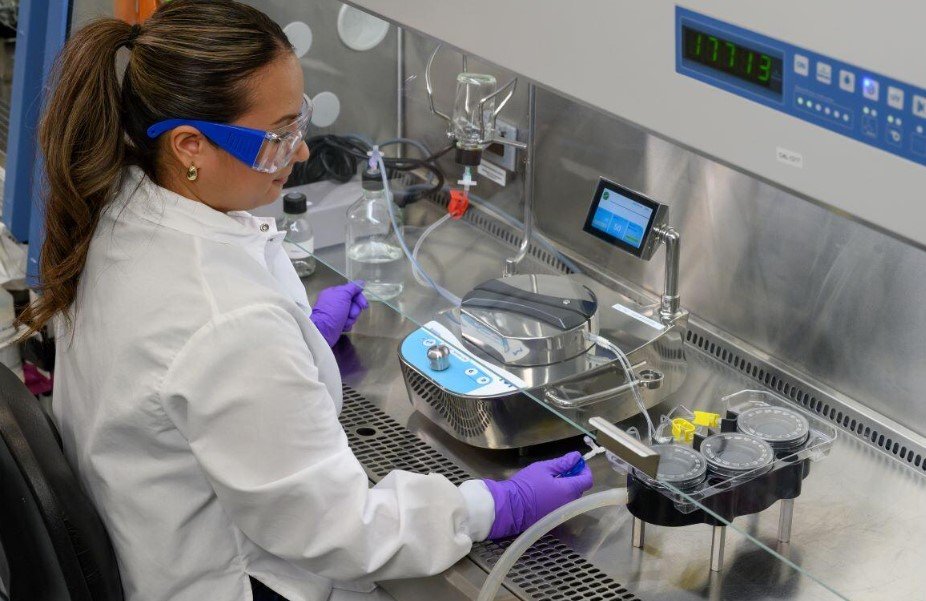
Sterility testing is a microbiological quality-control procedure intended to detect viable microorganisms in a sample under defined test conditions.
For conventional pharmaceutical products, sterility testing can often be incorporated into established release workflows. ATMPs may require more specialized consideration because of their biological characteristics, limited product quantities, manufacturing complexity, and short shelf life.
The specific testing approach depends on the product, manufacturing process, applicable regulatory expectations, and validated analytical method. Manufacturers should establish scientifically justified procedures rather than applying a one-size-fits-all approach.
The Role of Sterility Testing in Product Release
One of the most important applications of sterility testing is its contribution to the product-release decision.
Before an ATMP can be released, the manufacturer must evaluate relevant quality information against predefined specifications and acceptance criteria. Sterility results may form part of this overall assessment.
However, a sterility test result should not be viewed in isolation. Product release typically involves a broader review of manufacturing records, in-process controls, analytical results, environmental monitoring data, deviations, and other relevant quality information.
This integrated approach helps quality teams determine whether the manufacturing process remained within established controls.
Challenges of Sterility Testing for ATMPs
Short Product Shelf Life
Some ATMPs have limited stability after manufacturing. Waiting for conventional microbiological test results may therefore create a practical challenge.
Manufacturers must balance microbiological assurance with the need to make timely release decisions. Depending on the product and applicable requirements, alternative or rapid microbiological methods may be evaluated when scientifically appropriate and properly qualified or validated.
Limited Sample Availability
ATMP manufacturing can involve relatively small quantities of final product. Taking samples for quality-control testing must therefore be carefully planned to avoid unnecessarily reducing the material available for treatment.
Sampling strategies should be scientifically justified and incorporated into the overall manufacturing design.
Complex Biological Matrices
Cell-based and other biological products can present analytical challenges. The product matrix may interfere with testing or make microbiological detection more complicated than testing a simpler pharmaceutical formulation.
Method suitability is therefore an important consideration when developing sterility testing for cell therapy products.
Sterility Testing and Contamination Control
Sterility testing cannot compensate for weaknesses in manufacturing controls. A negative test result provides information about the sample tested under the conditions of the method; it does not prove that every unit of a production batch is completely free of microorganisms.
This is why a comprehensive contamination-control strategy is essential.
Manufacturers should control potential contamination sources through appropriate facility design, personnel practices, equipment controls, raw-material management, environmental monitoring, and validated processing procedures.
A strong ATMP contamination control strategy creates multiple layers of protection rather than depending on a single end-product test.
Environmental Monitoring Supports Sterility Assurance
Environmental monitoring can provide important information about manufacturing conditions.
Depending on the facility and process, monitoring programs may assess viable and non-viable particles, microorganisms, surfaces, personnel, and other relevant environmental conditions.
The resulting data can help manufacturers identify trends and detect potential changes in the controlled environment.
When environmental monitoring data are considered alongside sterility results and manufacturing records, quality teams gain a broader view of contamination-control performance.
The Importance of Method Validation
Reliable GMP sterility testing depends on an appropriate analytical method. Manufacturers need to demonstrate that the method is suitable for its intended purpose and capable of detecting relevant microorganisms under defined conditions.
Method suitability becomes particularly important for ATMPs because product-specific characteristics can influence microbiological testing.
Analytical development teams should consider factors such as sample characteristics, potential antimicrobial effects, recovery of microorganisms, controls, and method performance.
Appropriate validation or qualification provides greater confidence that test results accurately represent the performance of the analytical procedure.
Integrating Rapid Microbiological Methods
Rapid microbiological methods are attracting interest in ATMP manufacturing because they may provide information faster than traditional approaches.
For products with short shelf lives, earlier microbiological information can potentially support more efficient manufacturing and release workflows.
However, rapid methods require appropriate scientific evaluation. Their suitability, sensitivity, specificity, reliability, and relationship to established methods must be understood before they are incorporated into a quality system.
The technology should address a genuine manufacturing need while maintaining appropriate microbiological assurance.
Building a Reliable ATMP Quality-Control Strategy
An effective ATMP quality control program connects sterility testing with other critical quality activities.
Manufacturers should establish clear responsibilities, documented procedures, qualified personnel, appropriate facilities, and controlled laboratory practices. Test results should be reviewed through established quality systems, particularly when unexpected findings or deviations occur.
Data integrity is also essential. Analytical records should remain accurate, complete, traceable, and appropriately controlled throughout the testing process.
This integrated approach supports informed quality decisions and helps manufacturers maintain consistency across development and commercial manufacturing.
Conclusion
Sterility testing for ATMPs is an important component of product quality and release, but it works most effectively as part of a broader contamination-control strategy. ATMP manufacturers must consider product characteristics, manufacturing processes, sampling requirements, analytical methods, environmental monitoring, and release timelines when developing their approach.
Because ATMPs can involve living cells, complex biological materials, and short manufacturing windows, sterility assurance requires careful planning from early development through GMP production.
By combining scientifically appropriate sterility testing with strong contamination controls, validated analytical methods, environmental monitoring, and comprehensive quality systems, manufacturers can build greater confidence in ATMP quality and support well-controlled product-release processes.