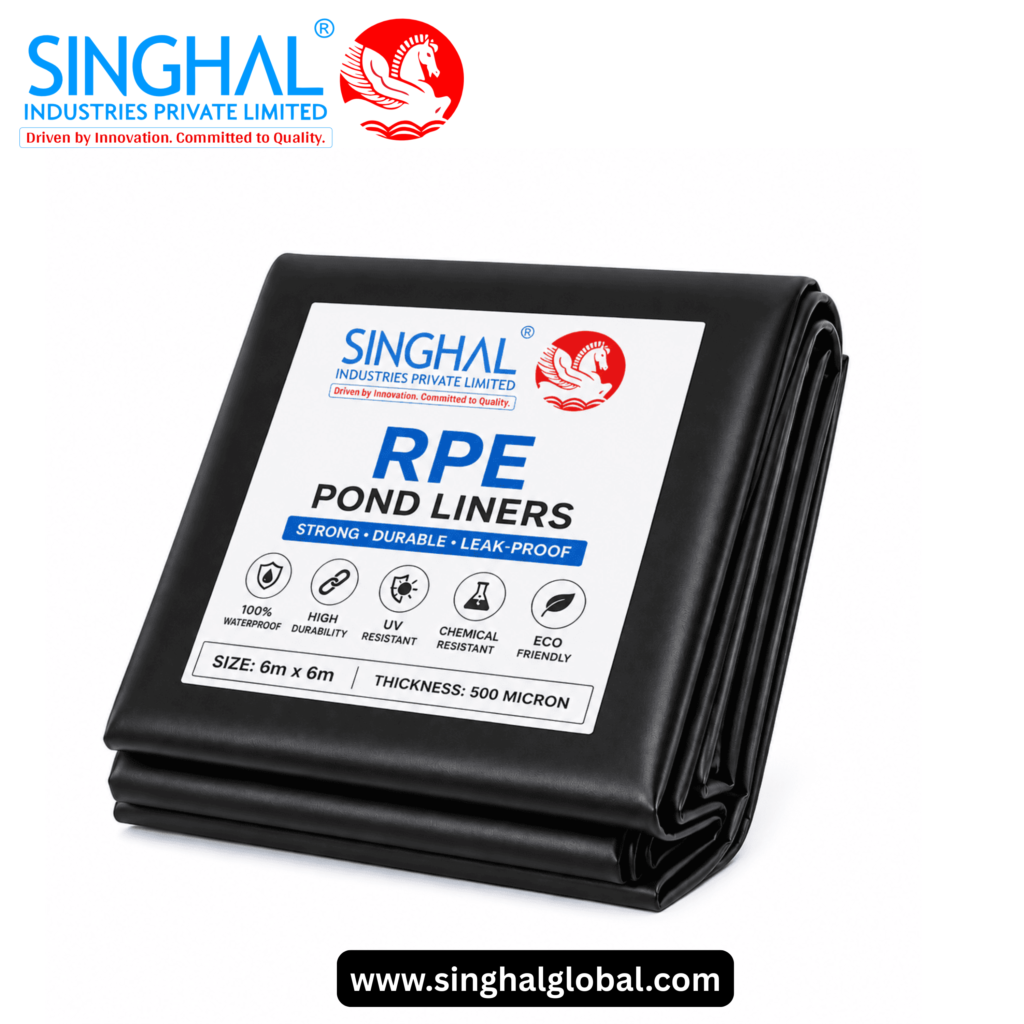
RPE Pond Liner
Resourcing water storage through sustainable methods is moving at the fastest pace so agricultural and aquaculture harvesting with landscaping rainwater has turned into an industrial top end application. otareka[1], an otamehkiki with earthen pond-like characteristics that can lose water by seepage if the soil/basin area surrounding the basin is inclining sediment – where permeable content to sustain a wet area, within which fishes are kept. RPE Pond Liners are an intuitive method to contain stored water with a rational boundary between the earth below and what is contained above. RPE refers to reinforced polyethylene — a polymer formed by the combination of elements with reinforcement characteristics that can enhance handling properties and dimensional stability in plastic applications. These are used in applications where flexibility, strength and constant water retention is needed. They are used in irrigation ponds, farm reservoirs fish basins artificial lakes and wastewater containment devices. A lined pond surface enables users to set a more predictable containment condition, reducing the likelihood of brass —based interference with water-bearing soil around stored water.
Material Structure and Performance Characteristics
Introduction: Design An RPE Pond Liner Manufacturer Provides it with Many Qualities that Make Them Suitable For Heavy-Duty Containment Projects Reinforced polyethylene typically consists of a layer in which the support can be pulled and provide some elastic behavior, but also dimensional stability. This construction helps in pulling it into the pond more easily while also provides a natural resistance of everyday stresses coming from transport or using the liner afterwards. RPE liners can be manufactured in a variety of thicknesses, dimensions and configurations according to project specifications. These are less permeable and better prevent water passage through the soil of pond bottom & sides. Instead, the site conditions for any one job should determine product selection rather than a standard spec across-the-board on every project whenever possible. Depending on the specific features of your pond (its size, depth & type), soil characteristics and anticipated environmental exposure as well as water chemistry and application method; the appropriate liner selection may also vary from one species to another.
Agricultural Water Storage and Irrigation Applications
For countless sectors of agriculture, RPE Pond Liner systems remain a perfect option. Farmers also commonly build ponds to catch rainwater or saved irrigation water that they can use in less rainy periods. If an uncoated pond gets on top of a permeable dirts water maintenance can seep directly into the dirt significantly restricting how much that is conveniently offered for near watering gardens. The RPE liner can serve as a practical barrier to limit this incidental movement of water and help keep more effective storages. All of these ponds can also be used to support agricultural applications (engineering, horticultural facilities and livestock or other agriculture-associated projects with work-oriented water assets). Actually the flexible structure of RPE is useful in situations where pond detailing calls for a liner to be fitted specifically.
Aquaculture and Fish Farming Benefits
Controlled pond environments allow for better maintenance of aquaculture. RPE Pond Liner separates pond water and natural soil which can lead to a more manageable containment system. If so, you may be excited to know that it can sometimes (perhaps surprisingly) a liner is lower upkeep than an ordinary pond mushrooming system as this technique gives you with a natural margin where dirt and water do not touch directly. This will help in cleaning and occasionally pond management as long you practice proper protocols. Reinforced RPE as the liner helps with handling while installing, especially for large pond projects. On the other side, fish ponds largely include using equipment and maintain going throughout maintenance activities compared to some additional aquaculture app may need consideration of product specifications regarding their relevance. The liner selected should be appropriate based upon expected environmental and mechanical conditions.
Industrial, Commercial, and Environmental Uses
RPE Pond Liner also extends to a broader scope with non-agricultural and aquaculture applications. Reinforced polyethylene liners function as a liquid containment layer in reservoirs, process-water ponds, evaporation and wastewater holding structures of industrial facilities. They can be utilized for commercial and also institutional tasks ( such as fabricated lakes, ornamental fish ponds, landscaping features) or even water preservation systems. They can also be compared to optimised environmental containment applications — wherein the substance is very compatible with their contents. It is especially used in industrial application as different kinds of liquid can have different temperature ranges and chemical compositions (i.e, Concentration). This means verification needs to happen on the liner concentration with which material is being contained before installation. Designers of the venture may likewise need to settle on mechanical loads, UV presentation budge & dirt conditions that will be typical throughout configuration.
Choosing a Reliable RPE Pond Liner Supplier
There likely will be lots of things to consider when you are planning a pond lining project but one important step would certainly be the selection of the best RPE Pond Liner Supplier. It is important that a liner supplier who sells different types of liners, knows how those liners are constructed and whether the customer requires one type or another in order to choose a product that best suits the application. Buyers research on the material quality — availability, thickness & dimension; reinforcement properties (type of mineral and size); uniformity in manufacturing processes along with scope for customization (refractive index edge design) and technical support. In the case of large ponds, field installation and reduced joints may require liner panels or rolls which have been shaped specifically in factory conditions. So potential customers need to provide accurate information about size, depth and use of the pond with conditions such as foot traffic issues plus exposure. Even though cost is an extremely important consideration, it should not be the only rationale on which a product selection boils down.
Importance of an Experienced RPE Pond Liner Exporter
For products going through international projects, product specifications with respect of packaging,documentation and transportation needs special treatment. RPE Pond Liner Exporter, with experience will manage these specifications and provide its international clients the product as per pre-decided specs. Liners could have literally half the globe to travel via export before being installed, so appropriate wrapping and handling is paramount. A simple representation of liner size, thickness & Number along with an application type and its destination & delivery schedule is implied. Due to different climate conditions and installation practices, such international projects may vary; Hence a technical discussion is important before placing the order. Well, an export veteran could provide continuity through the repetition of shipments and synchronization with product preparation that is required for logistical effectiveness.
Conclusion
The RPE Pond Liner Supplier Gujarat is another type of end-use oriented application catering to projects which need controlled water holdings without fixture along with flexible and strong construction. Categories consist of specific applications such as water for agricultural reservoirs, irrigation to aquaculture facilities or rainwater harvesting structures and landscaping projects; in the case with particular types industrial containment systems selected by customers. Not on flimsy, low-cost polyethylene fabric which at least still gives some handling and dimensional stability but clearly the very low permeability lining should provide containment. Yet the material itself does not prove longevity. The last efficiency from the lining system comes down to site prep, correct thickness, proper handling & transport (no twisting or folding a roll), pitch change methods and anchoring in-place including sewn joins and sealed weld. Buyers need to carefully assess the requirements of their project and partner with knowledgeable industry leaders when selecting a liner.
Frequently Asked Questions
1. Can RPE Pond Liner help conserve irrigation water?
Yes. By creating a barrier against soil seepage, an appropriately selected liner can help retain more water inside agricultural ponds and reservoirs for planned irrigation use.
2. Is RPE Pond Liner suitable for irregularly shaped ponds?
It can be suitable when the pond is properly prepared and the liner is specified and installed to accommodate its contours, slopes, corners, and dimensions.
3. What information should I provide to an RPE Pond Liner Supplier?
Provide pond dimensions, depth, shape, soil conditions, intended application, environmental exposure, expected water levels, and installation requirements to support appropriate product selection.
4. How does an RPE Pond Liner help conserve water?
It is constructed as a result of low-permability ensuring that no water percolate from the storage therefore leading to minimized losses and can be recycled more efficnetly while protecting both soil surrounding it and all groundwater underneath against contamination.
5. Who is the largest supplier of RPE Pond Liner?
Singhal Industries PVT Ltd is a supplier of RPE Pond Liner, but not necessarily and the largest in the world. The largest supplier of RPE Pond Liner, varies based on region and demand on the market.